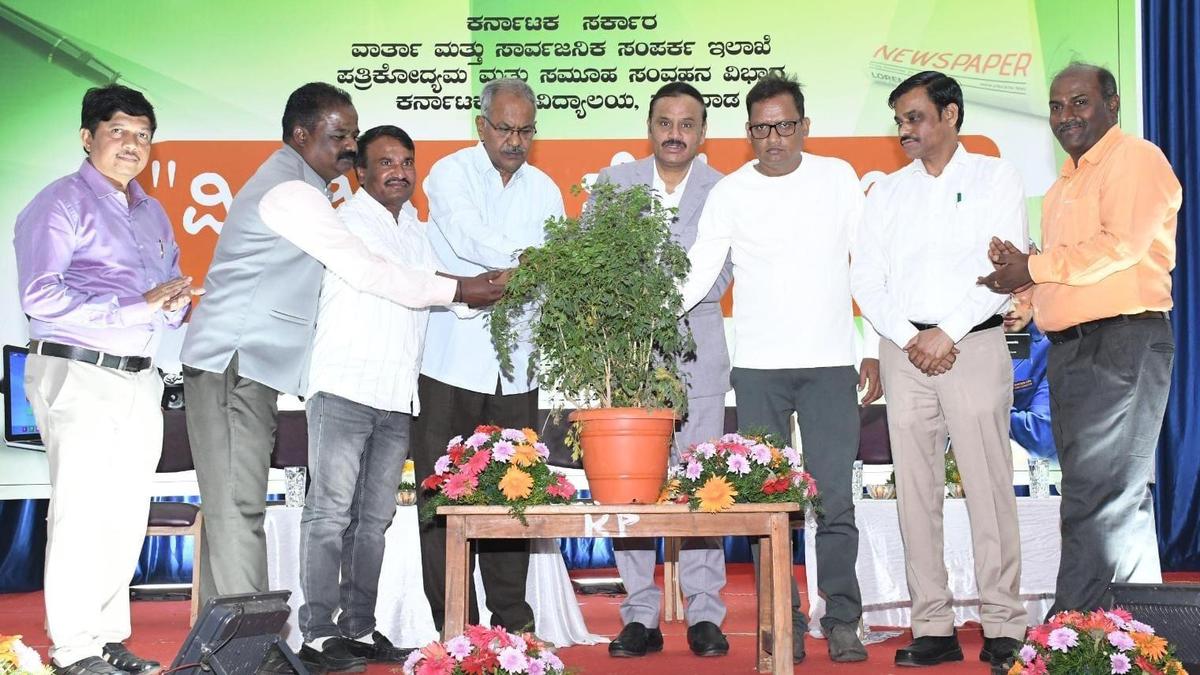
Vice-Chancellor of Karnatak University A.M. Khan and other dignitaries watering a sapling to inaugurate Media Fest 2026 in Dharwad on Monday.
| Photo Credit: SPECIAL ARRANGEMENT
Addressing concern about fewer students enrolling for journalism course, Vice-Chancellor of Karnatak University A.M. Khan said that the field still offers significant opportunities but the challenge is in adapting to technological changes and using them effectively.
He was inaugurating Media Fest 2026 organised by the Department of Journalism and Mass Communication of Karnatak University in collaboration with the Department of Information and Public Relations in Dharwad on Monday.
“Emerging approach in education and media practice is increasingly multidisciplinary,” he said and encouraged students to adopt new technologies responsibly while exploring innovative ways of working.
Speaking on the growing influence of artificial intelligence, Prof. Khan said that AI has become part of many fields, including journalism. It is also being taught in academic programmes. However, he cautioned, AI lacks originality as it is largely based on existing data.
“Human beings have the ability to perceive and anticipate what might happen next and journalism students must develop this capability,” he said.
President of the Karnataka Electronic Media Journalists Association Prakash Noolvi said that the media landscape has undergone significant changes with the rise of digital platforms.
He noted that audience now often rely on mobile phones and most often glance only at headlines rather than engage deeply with news content.
He said that television channels that once recorded 200-300 TRP ratings have also seen a decline in viewership. With the growth of citizen journalism, individuals now run their own blogs and use social media platforms to publish news and opinions, he added.
He pointed out that the transformation of the media ecosystem has also resulted in opening up of new fields such as fact checking.
Retired professor of Karnatak University A.S. Balasubramanya said that the rapid growth of digital media has provided access to vast amount of information and new opportunities for content creation.
He stressed the need for educational institutions to update equipment and training methods so that students entering the field will be prepared to work with modern technologies.
He noted that many professionals worldwide have left traditional media jobs due to the changing nature of the industry, while others have started independent digital platforms.
Emphasising adaptability, he urged students to understand emerging media platforms, learn new skills and adjust their mindset to the changing media environment.
Deputy Director of the Department of News and Public Relations Gurunath Kadaboor emphasized the need to adapt to technology and said that journalists must undergo changes from time to time.
Journalist Srikant Kubakaddi, Head of the Department of Journalism and Mass Communication Sanjaykumar Malagatti, the former Joint Director of Information and Public Relations Basavaraj Kambi, J.M. Chandunavar, Suresh Hiremath and others were present.
Published – March 09, 2026 07:29 pm IST