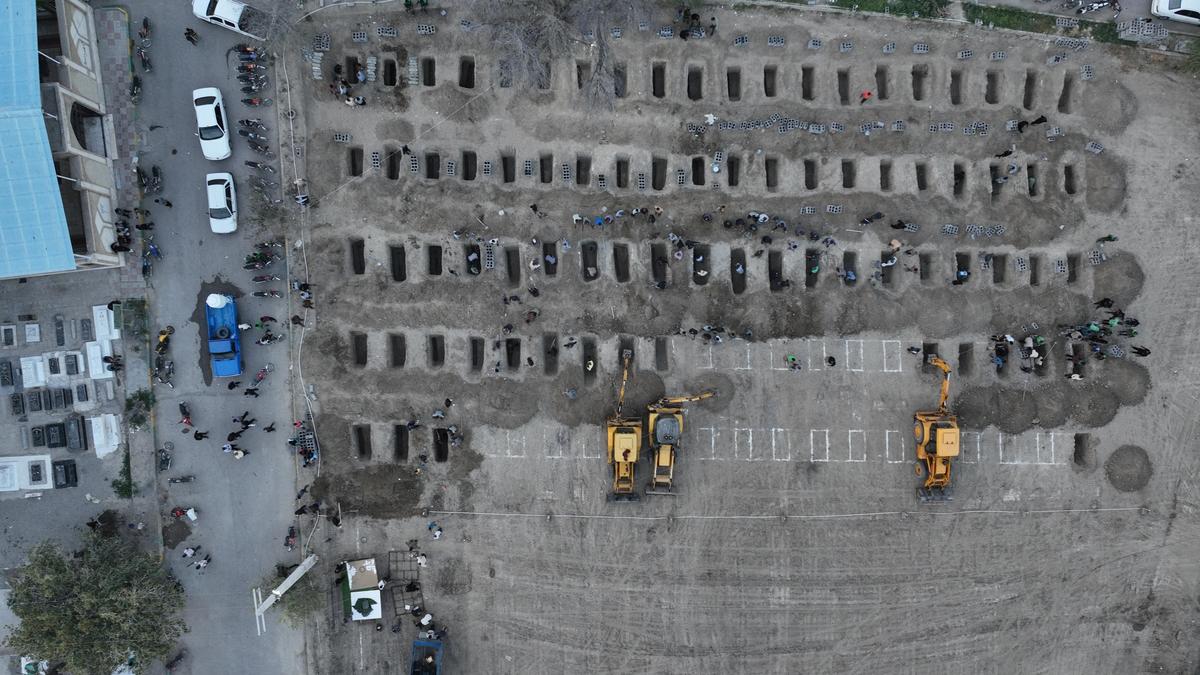
Graves are being prepared for the victims of a reported strike on a school in Minab, Iran, on March 2, 2026. Iranian Foreign Media Department/WANA (West Asia News Agency)/Handout via Reuters
The investigative group Bellingcat says the newly released video “appears to contradict” U.S. President Donald Trump’s claim that Iran was responsible for an explosion at an Iranian school that killed over 165 people at the start of the war raging in the Mideast.
It comes as mounting evidence points to U.S. culpability for the Feb. 28 strike, which hit a school adjacent to a Revolutionary Guard base in Minab, Iran, in the country’s southern Hormozgan Province. Experts interviewed by The Associated Press, citing satellite image analysis, say the school was likely struck amid a quick succession of bombs dropped on the compound.
Israel-Iran war updates on March 9, 2026
The video shared by Bellingcat is a three-second clip of a video taken the day the school was struck and circulated Sunday (March 8, 2026) by Iran’s semiofficial Mehr news agency. The video shows a munition falling on a building, sending a dark plume into the air that mingles with smoke that likely came from earlier strikes on the compound. Trevor Ball, a Bellingcat researcher, geolocated the video to a site near the school, something also done by the AP.
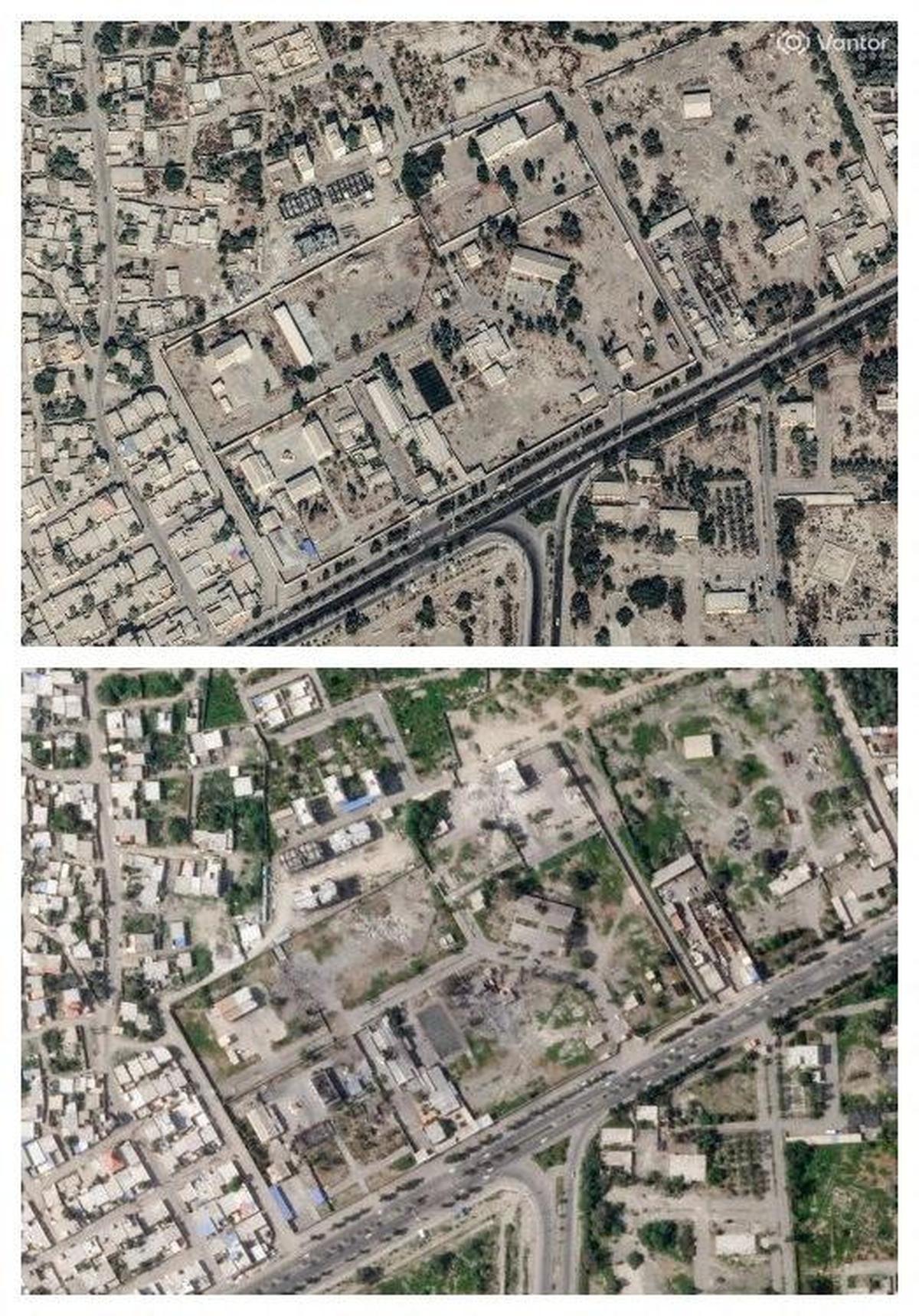
A combination of satellite images shows the Shajareh Tayyebeh girls’ school in Minab, Iran, before (above) and after being struck amid the U.S.-Israeli conflict with Iran, December 1, 2025 (above) and March 4, 2026. Vantor and 2026 Photo: Planet Labs PBC/Handout via Reuters
Ball identified the munition as a Tomahawk cruise missile, which only the U.S. is known to possess in this war. It’s the first evidence of a munition used in the strike. U.S. Central Command has acknowledged using Tomahawk missiles in this war and even released a photo of the USS Spruance, part of the USS Abraham Lincoln aircraft carrier group located within range of the school, firing a Tomahawk missile on Feb. 28.
Complicating any assessment of the incident is the lack of images of bomb fragments from the blast. No independent agency has reached the site during the war to investigate.
When asked by a reporter on Saturday whether the U.S. was responsible for the blast, which killed mostly children, Trump responded, without providing evidence: “No, in my opinion, based on what I’ve seen, that was done by Iran.” Trump added that Iran is “very inaccurate” with their munitions. Defence Secretary Pete Hegseth quickly chimed in to say the US was investigating.
Janina Dill, an expert on international law at Oxford University, wrote on X that even if the strike was a misidentification — and the attacker believed that the school had been a part of the neighbouring IRGC base — it would still be “a very serious violation of international law.” “Attackers are under an obligation to do everything feasible to verify the status of the targeted object,” she wrote.
Several factors point to a US strike.
One is the launching of an assessment of the incident by the US military. According to the Pentagon’s instructions on processes for mitigating civilian harm, an assessment is launched after a group of investigators makes an initial determination that the US military may bear culpability.
A U.S. official told the AP that the strike was likely U.S. The official spoke anonymously because they were not authorised to comment publicly on the sensitive matter.
Another is the location of the school — next to the Revolutionary Guard base and close to barracks for a naval unit. The U.S. military has focused on naval targets and acknowledged strikes in the province, including one in the vicinity of the school. Israel, which has denied conducting the strike, has focused on areas of Iran closer to Israel and hasn’t reported any strikes south of Isfahan, 800 kilometres (500 miles) away.
Neither the U.S. military’s Central Command nor the Israeli military immediately replied to requests for comment Monday from the AP on Bellingcat’s analysis.
Speaking about the U.S. operation at a press conference on March 2, Hegseth said: “America, regardless of what so-called international institutions say, is unleashing the most lethal and precise air power campaign in history.” “No stupid rules of engagement,” he said. “No politically correct wars. We fight to win, and we don’t waste time or lives.”
Published – March 09, 2026 10:40 pm IST