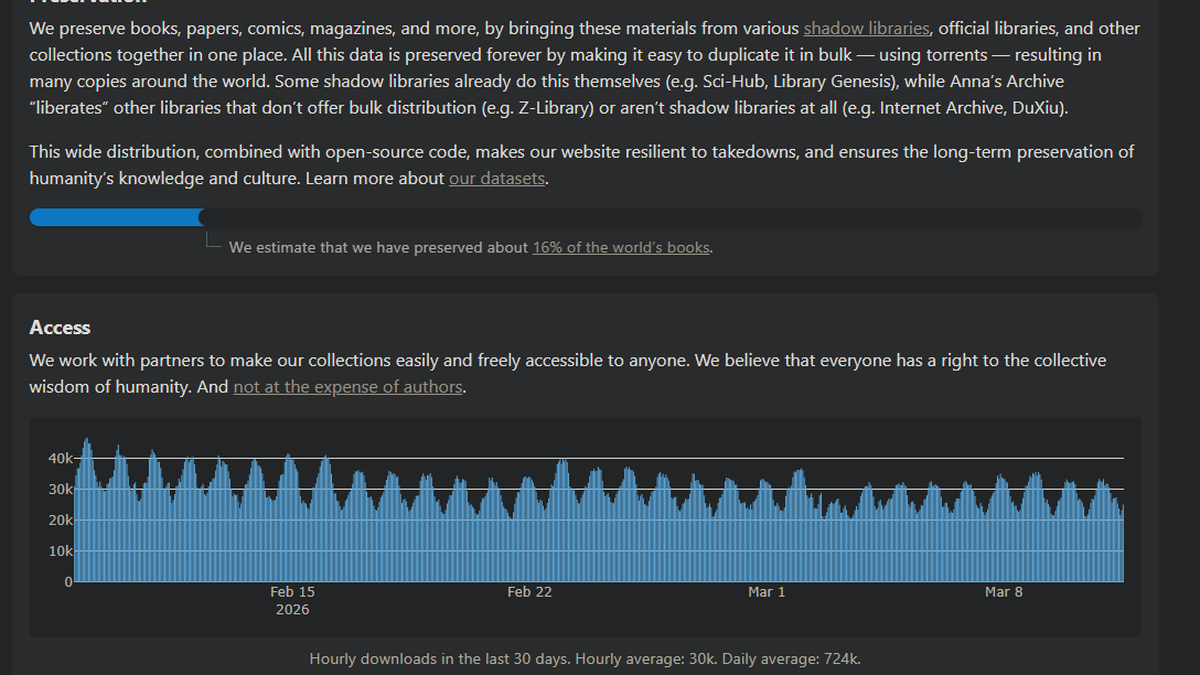
A screenshot of the FAQ page of Anna’s Archive, showing the user activity stats and the organisation’s statement of purpose, as of March 11, 2026
| Photo Credit: Anna’s Archive
Major publishers belonging to a U.S.-based publishing group have sued shadow library search engine Anna’s Archive, accusing it of illegally copying and distributing millions of protected literary works owned by publishers.
The publishers include the Big 5, apart from academic publishers such as Pearson Education and Elsevier Inc. The ‘Big 5’ publishers are made up of Hachette, Penguin Random House, HarperCollins, Macmillan, as well as Simon and Schuster.
The lawsuit, filed on March 6, referred to Anna’s Archive as a “for-profit commercial operation” and also alleged that it has been an “illegal supplier of stolen content to the AI industry”.

“Anna’s Archive is a brazen pirate operation that steals and distributes millions of literary works while outrageously offering access to AI developers in exchange for crypto payments. To fight back, we must use all available tools and believe this action in U.S. court will make a difference. The unfortunate reality is that creators face a level of digital piracy today that is so staggering it is almost unbelievable—it is an affront to the public interest,” said Maria A. Pallante, Association of American Publishers (AAP) President and CEO, in an official statement.
Launched in 2022, Anna’s Archive is a platform that compiles the contents of other databases—both legal libraries and illegal piracy platforms—in order to create a kind of search engine through which people browse the materials they want to download for free via “partner servers”.
Anna’s Archive was not known to many outside certain book and academia-related communities, but this changed after it took responsibility for scraping Spotify and claiming that it had about 300TB worth of music files/metadata.
Not much is known about the organisation or its founders, but Anna’s Archive has said it aims to preserve, back up, and make accessible the wealth of human knowledge to people world over. This naturally makes lawsuits and injunctions against the platform difficult to enforce.
However, Anna’s Archive was hit with a legal complaint brought by music companies—including Spotify—between December and January, followed by a U.S. judge’s order for its domain name registries, registrars of record, and hosting/internet services to be disabled or cut-off. Since 2026 began, Anna’s Archive has lost its prominent .org and .li web addresses.
Anna’s Archive noted on Reddit in early March that it had temporarily embargoed its Spotify file release, citing the “additional trouble the music industry’s lawyers are bringing”. The organisation said it would meanwhile work on its resilience.
Most recently on Reddit, the Anna’s Archive account noted that it experienced some issues while processing payments, due to the domain takedowns, but claimed it had manually processed users’ donations and that “things should be back up.”

Users of Anna’s Archive have cited the high cost of books or the difficulties of sourcing academic literature as reasons for downloading content through shadow libraries. But Anna’s Archive also confirmed that it is open to allowing bots and AI companies to access its pirated data sets, in return for donations or other forms of compensation.
Publishers have filed lawsuits against other shadow libraries such as Sci-Hub and Z-Library in the past, but such actions have mixed effects on their operations; many shadow libraries are designed to be quickly brought back online with alternative web addresses in order to ensure continued access. Pro-piracy volunteers also work to develop these platforms and back up their contents whenever possible.
Published – March 11, 2026 02:44 pm IST