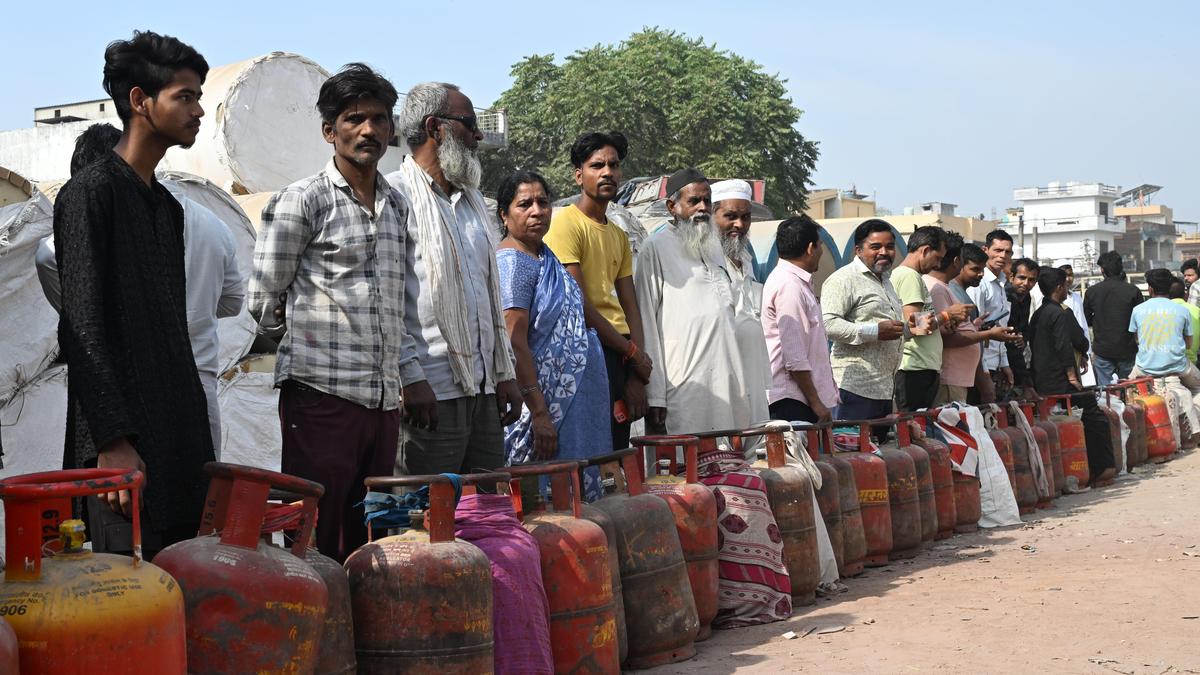
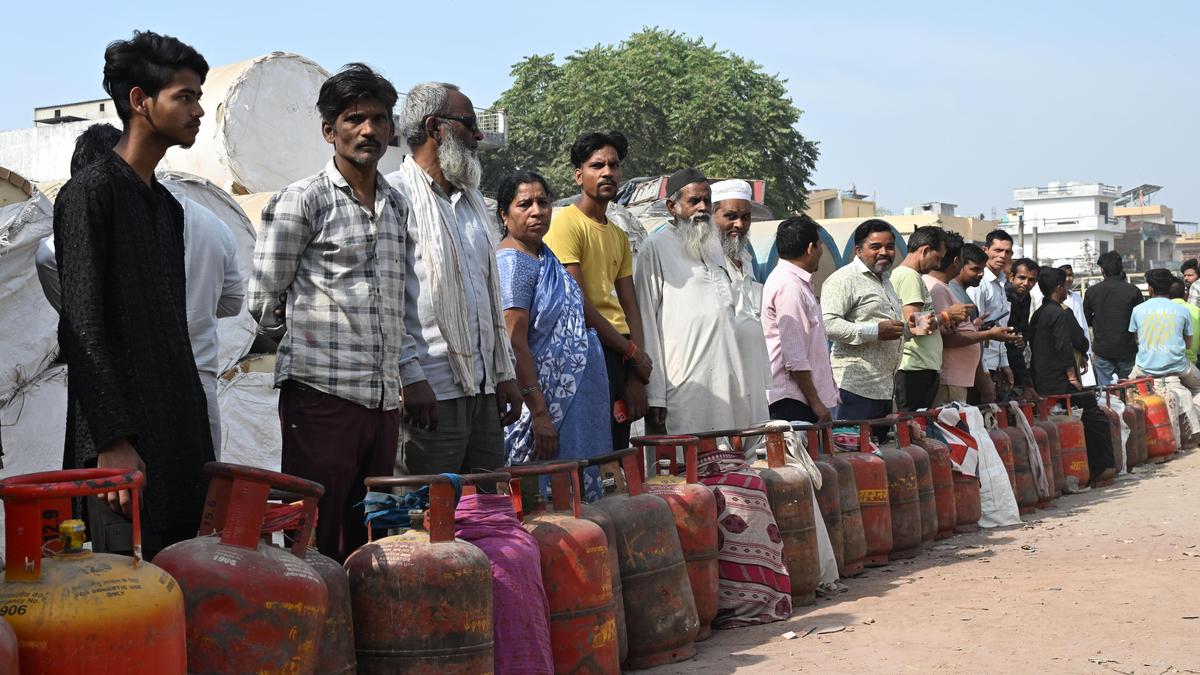
People standing in a queue to refill LPG cylinders in Lucknow on March 12, 2026.
| Photo Credit: Sandeep Saxena
The government had said on Wednesday (March 11, 2026) that recent measures taken have led to a 25% increase in domestic liquefied petroleum gas (LPG) production. A quick calculation shows that this amounts to 10% of LPG consumption on a daily basis, still leaving a shortfall of 50% that will need to be filled by LPG imports quickly since India doesn’t have much strategic, long-term storage.
In 2024-25, India’s LPG production was some 13 million tonnes as per government data, out of a total production of 283 million tonnes of petroleum products coming from India’s refineries in the public as well as private sectors. India’s LPG consumption was around 31 million tonnes that year. Broadly, there is a 60-40 import-export split.

Domestic LPG production comes from three sources: LPG is available freely in crude oil. This is separated in the distillation process. The main source of domestic LPG is, however, the refinery, which has Fluid Catalytic Cracking Units (FCCUs). The units crack the heavier fractions of crude into lighter fractions. LPG is one of the major products from FCCU. The FCCU also produces cracked naphtha, which is processed further to produce petrol.
The operating conditions and catalysts used in FCCUs can be modified to increase LPG production. But the caveat again is that the same FCCU produces propylene along with LPG, which is separated to produce polypropylene for downstream units such as plastics and synthetic rubber.
Increasing LPG production can lead to cuts in polypropylene production as well as the quality of petrol produced for automobile use.
In addition to these two sources, LPG is also produced in low quantities from catalytic reformers that make components for petrol blending and feedstock for aromatics manufacture. Here too, minor adjustments can be made to increase LPG yield.
The government had ordered that all oil refining companies must ensure that they shall not divert propane-butane for manufacture of petrochemical products or other downstream derivatives
War in West Asia: What happens to India’s oil, gas and fertilizer supply? | Business Matters
Published – March 12, 2026 11:27 pm IST


