Long before the saint-composer came to be venerated as Purandaradasa (also known as Sangeetha Pitamaha), he was known as Srinivasa Nayaka — a prosperous jeweller from Purandara Gada near Hampi in the 14th century. Popularly called Seenappa, he inherited and expanded a thriving gem and jewellery business, amassing immense wealth. Yet, along with the prosperity came a reputation for extreme miserliness; charity found little place, and devotion even less.
The turning point in his life came through a divine encounter. An old mendicant repeatedly approached Seenappa at his shop seeking alms but was refused each time. After months of persistence, the jeweller finally drove him away in anger. The mendicant then went to Seenappa’s house, where his wife Saraswathi Bai, moved by compassion, offered him her nose ring. Soon after, the same ornament appeared in Seenappa’s shop when the mysterious visitor, disguised as a wealthy man, attempted to sell it to him.
A chain of miraculous events followed, revealing the visitor to be none other than Lord Vittala himself in disguise. Overwhelmed with remorse, Seenappa renounced his riches and embraced the path of devotion under the guidance of guru Vyasaraya, taking the name of Purandaradasa.
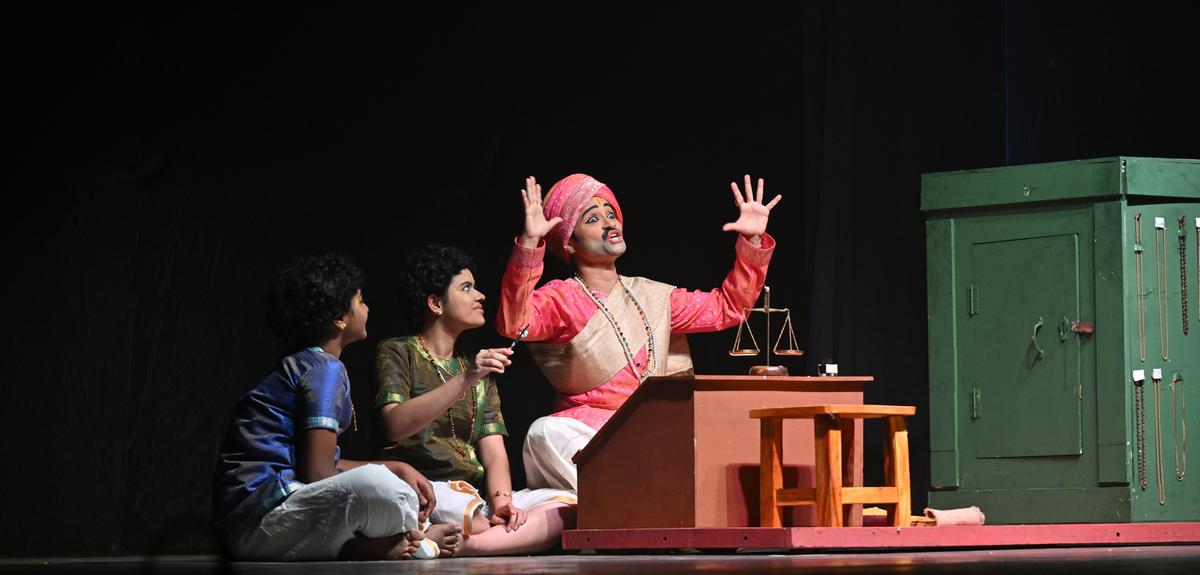
There were 14 performers with many donning multiple roles
| Photo Credit:
M. Srinath
His life, after this transformation, became one of intense devotion and musical outpouring. Purandaradasa is credited with systematising the basic lessons of Carnatic music, laying out the graded exercises that beginners still follow. Tradition attributes an astonishing 4,75,000 compositions to him. His son, Madhvapathi, is said to have composed another 25,000, bringing the family’s devotional corpus to nearly five lakh songs.
Within the Haridasa tradition, it is believed that Purandaradasa was an incarnation of sage Narada — born to remind the world that wealth is not life’s ultimate pursuit.
A life retold on stage
This remarkable life story found theatrical expression in Sri Bhagawan Panduranganin Purandaradasar, presented by Bombay Gnanam’s Arts Academy — an all-women drama troupe. Featuring 14 performers, with many donning multiple roles, the production drew on Karnataka Bhakta Vijaya and references from Harikatha exponent, Vishaka Hari.
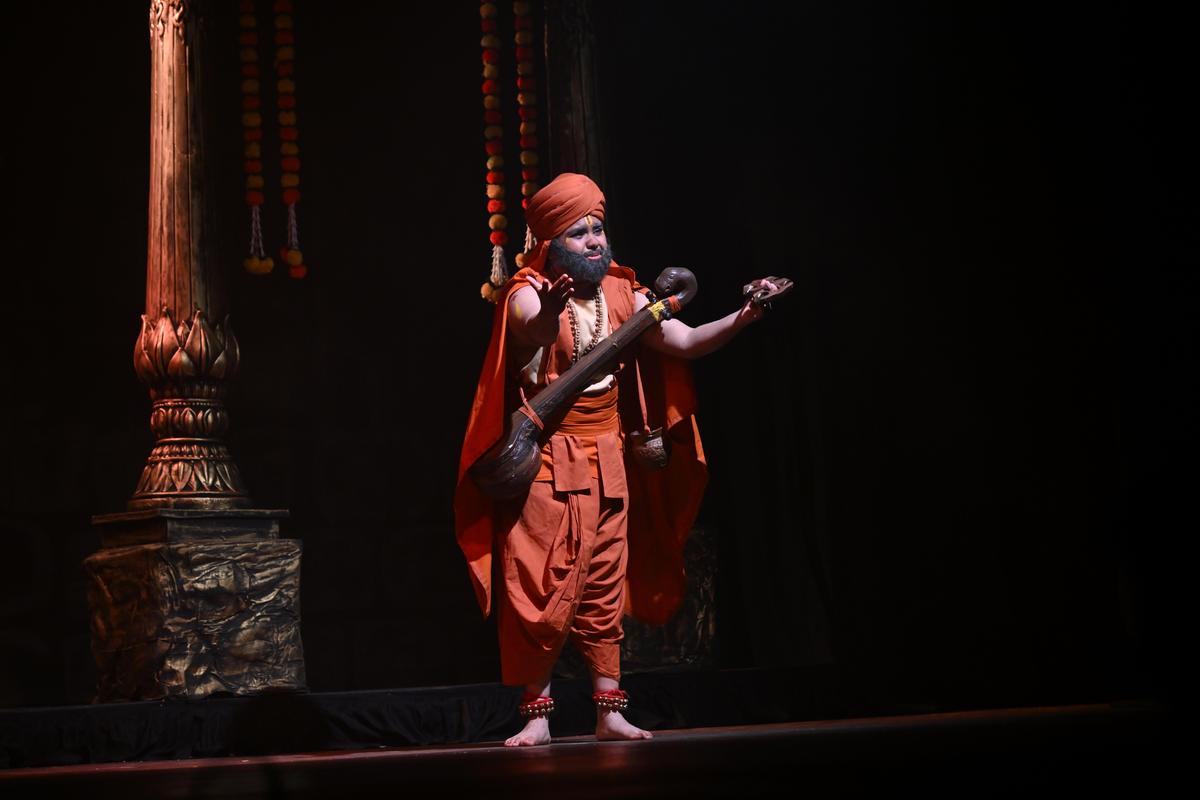
Music formed the emotional core of the production.
| Photo Credit:
M. Srinath
The play flowed seamlessly without blackouts, aided by Mohan Babu’s lighting design — reds for interiors, yellows for outdoor scenes, and blues for night or celestial moments. The production design was equally detailed: Seenappa’s shop displayed jewellery-filled lockers and old ledgers, while the domestic space featured silver vessels in the pooja room, lending authenticity to the period setting. Even subtle details — such as sandalwood paste smeared on the hands of the elderly Purandaradasa — revealed the care invested in the visual storytelling.
Costumes were carefully referenced to reflect the period setting, with jewellery ranging from gem-studded rings to armlets. Even smaller characters — soldiers, attendants, and servants — were performed with commitment.
An interesting casting decision added another layer of continuity to the narrative. The role of the elderly Purandaradasa was played by an 18-year-old performer, while the younger Seenappa was portrayed by her mother Their natural resemblance lent credibility to the transition between the two stages of the character. All the performers, based in Chennai, spent four months preparing for the production, which also marked the stage debut for some artistes.
Music formed the emotional core of the production. Familiar compositions, such as ‘Venkatachala nilayam’, ‘Jagadhodharana’, and ‘Tamboori meetidava’, were interwoven with lesser-heard pieces such as ‘Krishnamurthy’ (said to be the first song he composed), ‘Kunidado Krishna’, ‘Ninna bhagya doddadho’ and ‘Aparadhi nanalla’.
As the title of the play suggests, Lord Vittala repeatedly appears in the narrative to guide the errant jeweller towards transformation.
The response by the audience was enthusiastic, with many singing along. It was wonderful to revisit the life of a composer whose works have enriched the Carnatic repertoire and continue to stir rasikas.
Published – March 13, 2026 06:19 pm IST