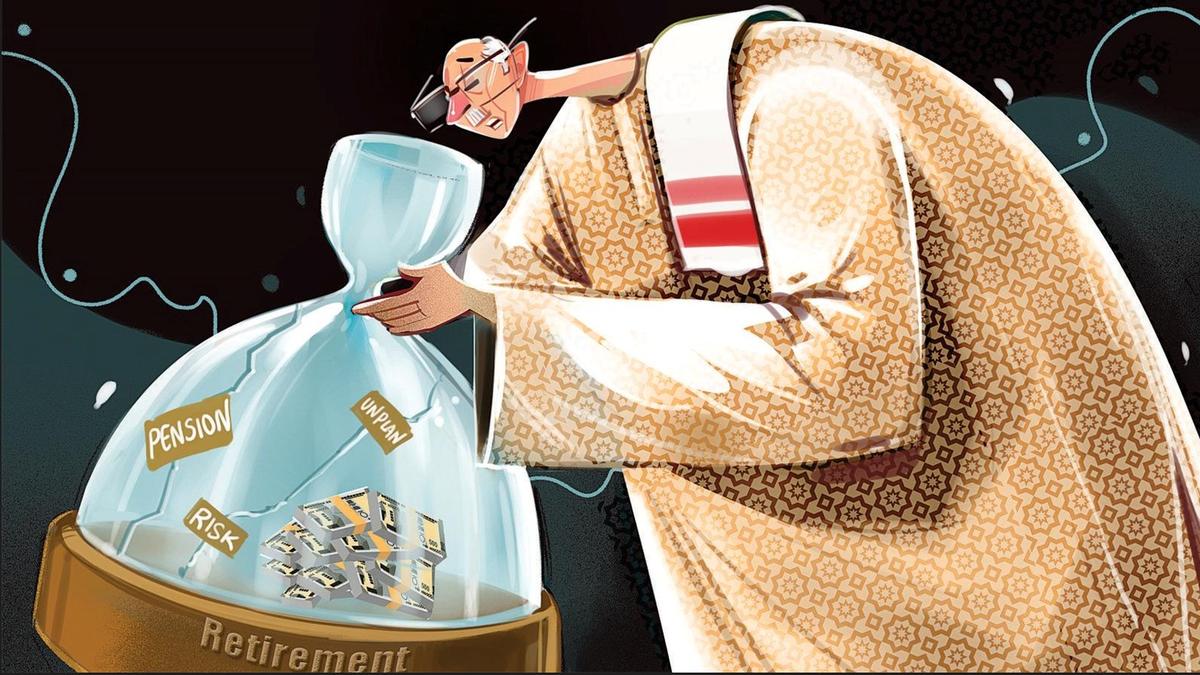
There was a time when retirement in India was largely someone else’s responsibility. A government pension or the comfort of a large joint family often filled the gap. That reality, however, has changed quietly but decisively. Today, the burden of retirement security is shifting squarely onto individuals and households. If we do not plan early and deliberately, the cost of delay can quickly become overwhelming.
The uncomfortable truth is simple. In modern India, growing old without being financially prepared is a risk many households can no longer afford.
Pension gap is real
India has made visible progress in financial inclusion. Bank account ownership is widespread, and market linked retirement products are gaining traction.
Yet beneath the surface, the pension safety net remains thin.
Recent analysis shows that formal retirement schemes such as EPFO, NPS and Atal Pension Yojana together cover less than 25% of the workforce. That means the vast majority of India’s working population is either underprepared or completely unprepared for retirement.
Even broader financial behaviour tells a similar story. While more than 78% of Indian adults have bank accounts, fewer than 14% participate in any formal pension or retirement scheme.
At the same time, the organised pension ecosystem is expanding. The National Pension System alone had over 2.1 crore subscribers and assets of over ₹16 lakh crore by December 2025, reflecting strong growth in market linked retirement saving. The direction is encouraging. The scale of the gap is still daunting.
The math of delay is brutally unforgiving.
Consider a simple retirement goal. Assume an individual wants to build a retirement corpus of ₹5 crore by age 60 and expects a long term return of 12% through disciplined investing.
If the investor starts at age 30, the required monthly SIP is roughly ₹16,229. Delay the decision by just 10 years and start at 40, and the monthly requirement jumps sharply to about ₹54,357. Wait until age 50, and the number becomes daunting, with the required monthly investment rising to nearly ₹2.23 lakh.
The message is hard to ignore. The goal remains the same, but the cost of delay rises dramatically. In retirement planning, time does the heavy lifting. The longer we wait, the heavier the monthly burden becomes. This is the hidden tax of procrastination. We often focus on market timing, product selection, or short term returns. But the single most powerful variable in retirement planning remains time in the market, not timing the market.
Why the traditional safety nets are no longer enough: Several structural shifts are reshaping retirement risk in India.
First, life expectancy is rising. Indians are living longer, which is a positive development, but it also means retirement periods are stretching to 25 to 30 years in many cases.
Second, the nature of employment is changing. Gig work, self employment and informal work arrangements are expanding, most often without built in retirement benefits.
Third, family structures are evolving. The traditional assumption that children will financially support ageing parents is becoming less reliable in urban India.
Finally, inflation continues to erode purchasing power. What looks like a comfortable retirement corpus today may prove inadequate two or three decades later.
Taken together, these trends make one conclusion unavoidable. Pension planning is no longer optional. It is foundational financial planning.
The rise of market linked retirement solutions: The good news is India’s retirement ecosystem is becoming more sophisticated and accessible.
Market linked options such as the National Pension System are gaining acceptance because they combine long term growth potential with disciplined accumulation. The rapid growth in NPS assets reflects this behavioural shift. These products matter because traditional approaches alone may struggle to beat long term inflation. For younger investors especially, exposure to equity through structured retirement vehicles can meaningfully improve outcomes over long horizons.
However, product availability is only half the story. Behavioural adoption remains the bigger challenge. The window is open, but not forever.
In today’s India, wealth creation and retirement planning cannot be sequential goals. They must happen together.
(The writer is head, Pensionbazaar.com)
Published – March 16, 2026 06:06 am IST


