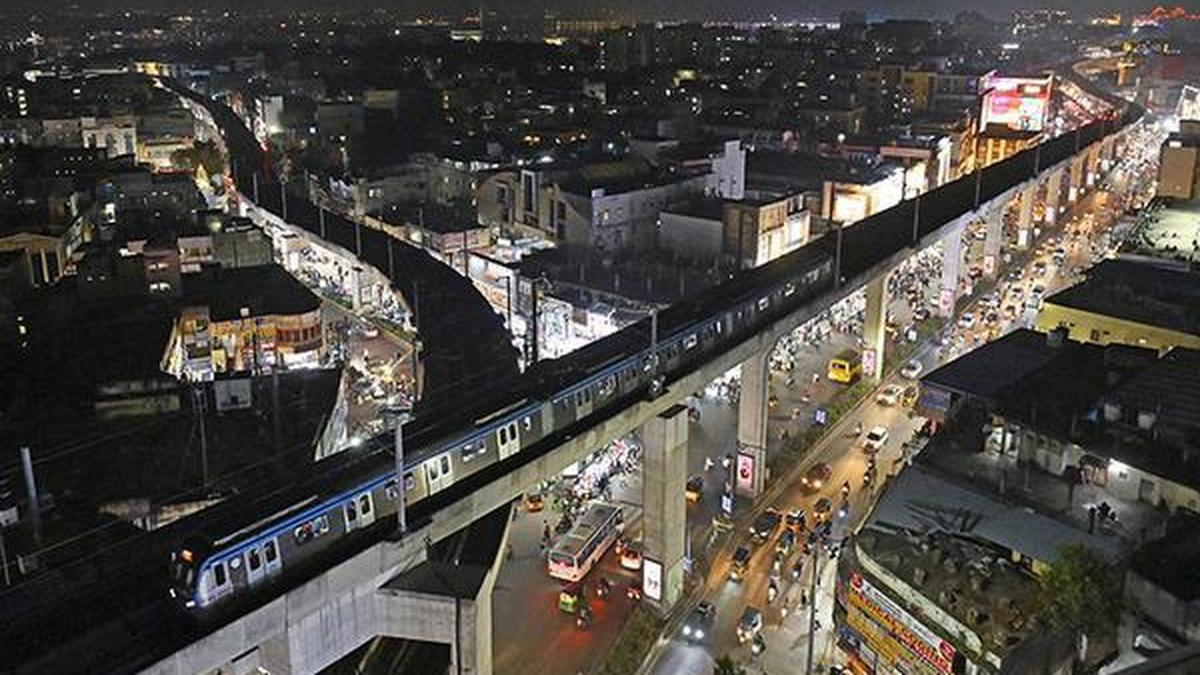
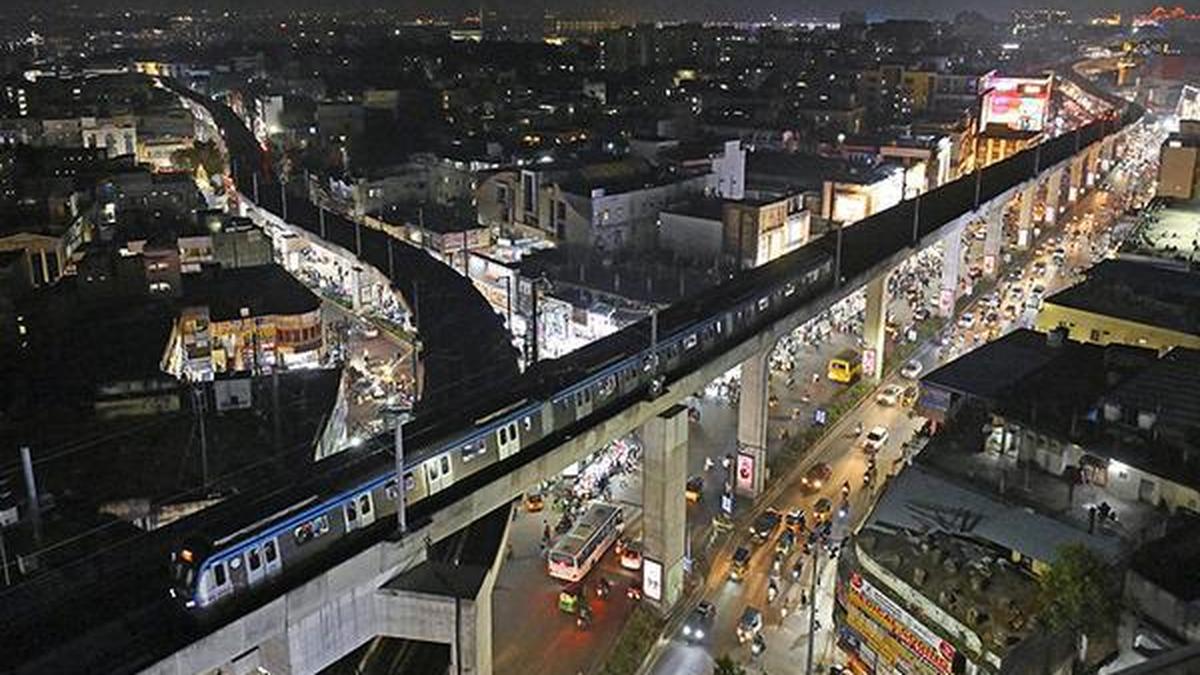
The proposed overhead viaduct, which will carry the battery-operated pods on demand, is expected to have a width of about four to five metres.
| Photo Credit: Representational Photo
Even as the State government appears to be racing against time to take over phase I of the 69.2-km Hyderabad Metro Rail (HMR) project from L&T Metro Rail Hyderabad (L&TMRH) by this month-end, its special purpose vehicle Hyderabad Metro Rail Limited (HMRL) has begun planning a new system to improve last-mile connectivity.
The proposal is to build an elevated, battery-operated pod transport system. Each pod will carry four to six passengers, with a capacity of up to 10,000 passengers per hour.
These pods will link metro stations to nearby residential areas and habitations.
To take this forward, a tender was floated last month seeking a consultant to conduct a techno-economic feasibility study, prepare designs and manage the bidding process for an automated Personal Rapid Transit (PRT) system.
The pilot is planned along the Raidurg-Kukatpally stretch, covering stations such as Raidurg, Hi-Tec City, Financial District and Secretariat.
“It will complement metro rail services, with a bridge connecting the station to the automated system. An elevated viaduct will be built along the road median, with a footprint of just 60 cm, and will be at a height of about five metres from ground level. At present, we do not foresee the need for additional land acquisition unless local ground conditions necessitate it,” said a senior official, requesting anonymity.
The overhead viaduct, which will carry the battery-operated pods on demand, is expected to have a width of about four to five metres.
Similar systems are in operation at airports in Heathrow (London), the Netherlands and Abu Dhabi, the official said.
The concept is said to have originated with the Mumbai Metro Rail and will be tried out over an 8-km stretch in the Bandra-Kurla Complex.
HMRL now intends to follow suit by commissioning a techno-economic feasibility study from interested parties.
“The chosen firm will also suggest the appropriate technology. The entire process could take up to six months,” the official added.
Although the financial outlay has not yet been specified, the project is envisaged to be implemented under a public-private partnership (PPP) model, with a defined concession period.
HMRL also plans to introduce the long-pending common fare card to integrate last-mile connectivity services with metro rail operations when the system is launched, they added.
Published – March 17, 2026 07:10 pm IST