Those who remember the tumultuous eighties would attest that the landmark Shah Bano case reshaped Indian secularism and the fault lines of identity politics for decades. But beyond the courtrooms, objections from clerics and political outrage, a story of faith, human dignity, and a woman’s rights unfolded within the four walls.
Cast within the realm of fiction and point of view, this week director Suparn Varma reimagines the story of a devoted wife abandoned post-remarriage, her husband’s instant triple talaq, a brutal severance of support, and a fierce battle for maintenance that ripples a domestic dispute into a national debate, with deep socio-political ramifications.
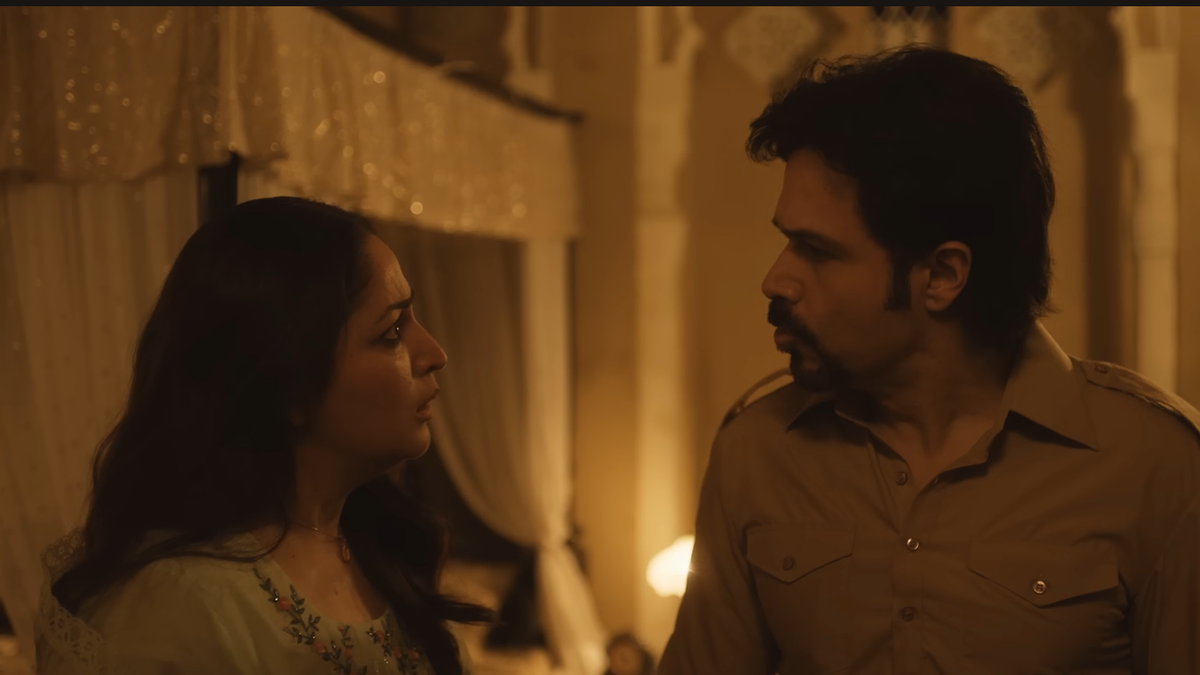
Hailing from traditional Muslim families, Abbas Khan (Emraan Hashmi) and Shazia Bano (Yami Gautam) make for a winsome couple. He is a hotshot lawyer while she is a homemaker with an opinion. It’s a relationship with the Almighty that doesn’t require a mediator.

Her god fearing, progressive father (Danish Husain) provides the cover she needs in a society that doesn’t practice what it preaches. One day, Shazia discovers that Abbas doesn’t like to mend things in his life. He prefers to change them. Soon, she finds that the habit is not limited to a sundry pressure cooker; he brings a second wife to the household. After the initial shock and pain, Shazia settles for her fate. He promises her space and dignity, but the fissures surface again, forcing Shazia to leave her abode with children and knock at the doors of justice for maintenance.
Unwilling to pay the monthly maintenance ordered by the court, Abbas divorces her and argues that, as the talaq ended their relationship, he didn’t need to pay her maintenance. When courts say there is no variance between Muslim Personal Law and Section 125 of the Code of Criminal Procedure, Abbas and the clerics turn the domestic dispute into an encroachment on the personal space of minorities, bringing persecution complex and victimhood of a section to the fore.
Haq (Hindi)
Director: Suparn Varma
Cast: Yami Gautam, Emraan Hashmi, Sheeba Chaddha, S.M. Zaheer, Danish Husain
Runtime: 134 minutes
Storyline: Shazia Bano seeks justice when her husband stops maintenance after remarrying. His attempt to silence her with instant triple talaq sparks a national debate on women’s and minority rights.
Varma sees the complex space with an even-handed gaze, refusing to vilify faith itself but probing its interpretation. He ensures that the film is not reduced to a Muslim social that either romanticises or pities women, but asks bigger questions on gender parity, education, and minority rights. The husband’s elite education enables abandonment; the wife’s understanding of the Quran enables resistance.
For Varma, who began his career as a journalist, it is a return to form after spending time in the “Acid Factory” of Bollywood. Coming after the hard-hitting Sirf Ek Banda Kaafi Hai, which he produced, Haq reads like a solid companion piece on matters of faith.

A still from ‘Haq’.
| Photo Credit:
Junglee Pictures/YouTube
The film’s strength is in its restraint. It doesn’t hammer the message that women’s rights or Haq isn’t granted; it’s seized. It doesn’t use education as a feel-good subplot but as the silent source of Shazia Bano’s rebellion.
At the same time, writer Reshu Nath confronts patriarchy head-on as the film’s emotional and intellectual core, portraying it not as a villainous caricature but as an insidious web of misinterpreted faith, legal loopholes, and societal norms that systematically silence women like Shazia.
ALSO READ: ‘Sirf Ek Bandaa Kaafi Hai’ movie review: Manoj Bajpayee steps up in court
Haq not only speaks of women’s rights but also interrogates their costs. It critiques judges who hide behind personal laws and so-called custodians of faith who use religion for vote bank politics. More importantly, the movie discusses the tendency of a section of the Muslim elite who consider the demand for Muslim women’s rights as a tool to humiliate the minorities and trample on their personal laws.
As the resilient Shazia, Yami delivers a career-defining performance. Right from Vicky Donor to Article 370, Yami has been more than just a charming screen presence. Whenever tested, she commands attention. Here, combining emotional depth and dignity, she masterfully brings the character to life: from quiet submission in a crumbling marriage to fierce courtroom defiance, there is no fumble in her flow.
Hashmi layers charm with quiet cruelty, humanising a potentially unlikeable character without seeking sympathy. Backed by powerful writing, Abbas’ ideological clashes with the system in the court feel authentic and intellectually charged.
The cinematography and production design recreate the period without drawing attention to themselves, and the background score maintains the tonality in sync with an impressive support cast led by Sheeba Chaddha and Danish Husain. It is heartening to see veterans S.M. Zaheer and Anang Desai lending their voice to a meaningful discourse.
However, those who could read between the lines would remember that the Shah Bano case brought Bharatiya Janata Party from the margins to the mainstream politics on the agenda of Muslim appeasement. Without reflecting on the roles of political parties and legislation that followed the Supreme Court judgment, Varma, using creative licence, takes the film away from the facts of Shah Bano case – the manner of divorce was never a part of the old lady’s petition – to tie it to the Muslim Women (Protection of Rights on Marriage) Act, 2019 or the Triple Talaq law which the current dispensation celebrates while many find problematic and piecemeal at best. The end note leaves one with a feeling of sitting through a well-mounted piece of surrogate advertising, but then, in a sense, all art is propaganda.
Haq hits the theatres on November 07, 2025
Published – November 06, 2025 04:18 pm IST