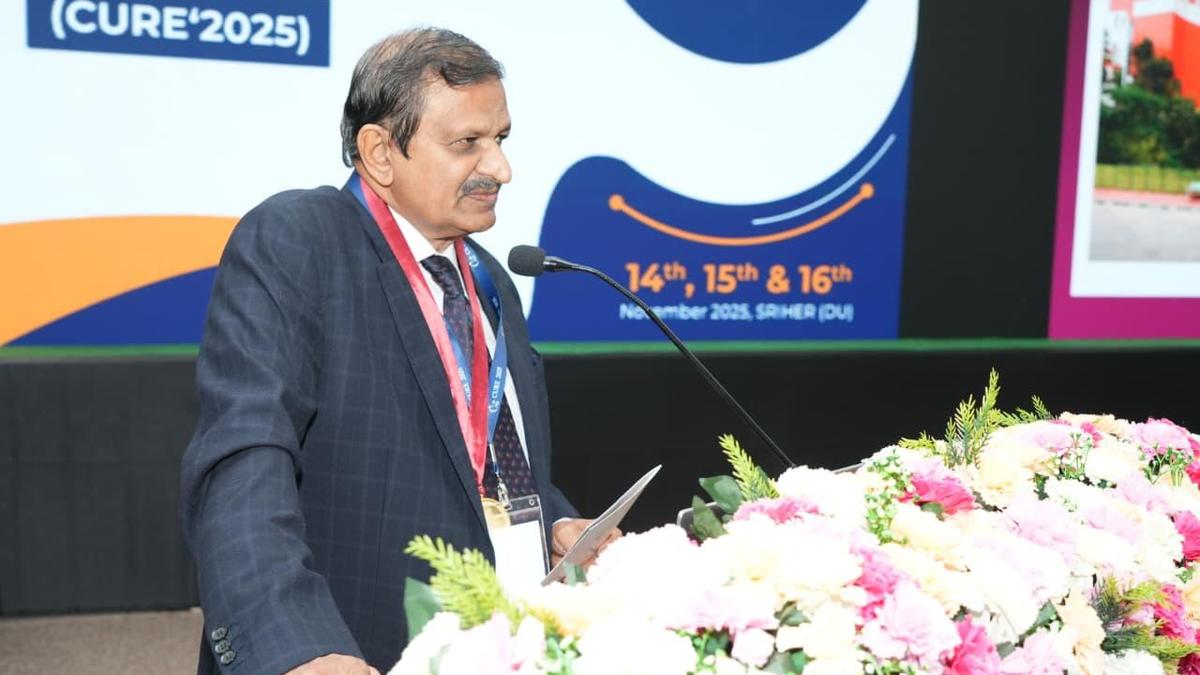
Eminent cardiologist and Karnataka MP C.N. Manjunath speaking at the Dr. S. Thanikachalam Endowment Oration in Cardiac Sciences in Chennai.
| Photo Credit: Special arrangement
Physicians and patients now find themselves increasingly caught between an explosion of technology on one side and aggressive marketing forces on the other, and this is where decision-making becomes most important in clinical medicine, said eminent cardiologist and Karnataka MP C.N. Manjunath.
Delivering the fifth Dr. S. Thanikachalam Endowment Oration in Cardiac Sciences organised by the Cardiac Care Centre of Sri Ramachandra Institute of Higher Education and Research, he said: “Today, three ‘Ts’ are relevant. On one hand, there is an explosion of technology, and on the other, there are aggressive marketing forces. Physicians and patients stand between these two forces, and we need to strike a balance. Whatever technology may be available now — artificial intelligence or machine learning — the three ‘Ts’ are most relevant today: ‘Talk, Touch, and Treat’.”
The fourth ‘T’, Dr. Manjunath said, was also equally important: ‘Trust’. Patients come to hospitals seeking medical treatment after considering several factors, with the most crucial being the hospital and consultant’s reputation, as well as affordability, reliability, and trust, he added.
“Somebody performs the procedure, somebody writes the discharge summary, someone else writes the prescription — but the most important person who is neglected is the patient. Clinical cardiology and haemodynamics are essential, but bedside discussions remain just as important. Due to the explosion of technology, clinical teaching has taken a back seat,” he said.
Pointing out that in today’s digital era everything spoken is recorded, Dr. Manjunath noted that there had been a rise in ‘internet-derived information instructing treatment’. This has led to situations where, at times, less-informed patients received better care compared to “sophisticated, distorted, and overly informed” ones, he added.
Published – November 17, 2025 11:03 pm IST