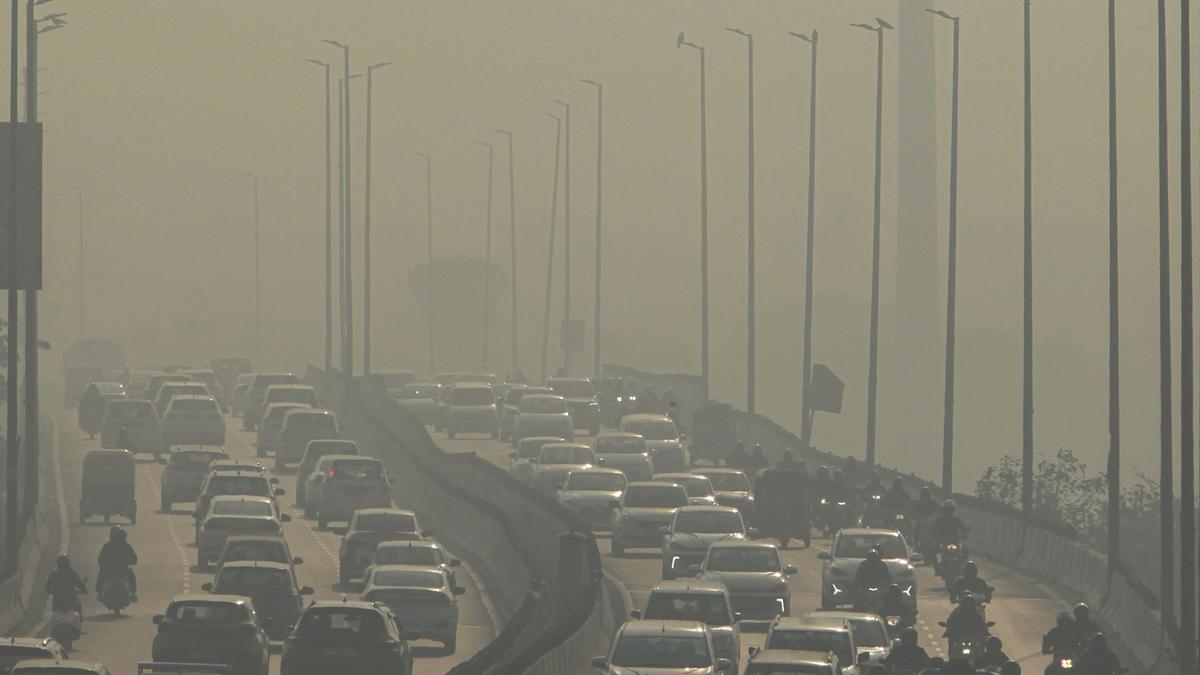
After a day of respite, the air quality in the Capital deteriorated on Monday. File
| Photo Credit: PTI
Union Environment Minister Bhupender Yadav on Monday (December 1, 2025) told the Lok Sabha that stubble burning in Punjab and the National Capital Region (NCR) is an “episodic event” in the context of air pollution in Delhi-NCR.
Later in the day, the Commission for Air Quality Management in the NCR and Adjoining Areas (CAQM) issued a statement noting a “substantial reduction” in farm fires in Punjab and Haryana — the biggest drop since the agency began monitoring State-wise crop residue management in 2018.

Mr. Yadav made the remarks while responding to a question from Congress’s Jalandhar MP Charanjit Singh Channi on whether Delhi’s air quality index (AQI) crossed 450 this year despite a reported 20% reduction in farm fires in Punjab. He also sought details about the steps taken to enforce the CAQM’s directives, including subsidies for crop residue management machinery.
The Minister said air pollution in Delhi-NCR is the result of several local and regional factors, including vehicular and industrial emissions, dust from construction, burning of municipal waste, landfill fires and meteorological conditions. Stubble burning in Punjab and the NCR is an additional “episodic event”, he added.
Listing the measures taken to curb stubble burning, Mr. Yadav said Punjab and Haryana together received over ₹3,120 crore since 2018-19 for crop residue management machinery. More than 2.6 lakh machines have been distributed to individual farmers, and the CAQM has directed both States to ensure rent-free access to these machines for marginal farmers.
The Minister also said that Delhi had recorded its lowest January-November average AQI since 2018, barring the COVID-induced lockdown year of 2020.
The AQI is a measurement of pollution on a scale of 0-500. A higher value suggests increased toxicity.
90% fewer cases
Meanwhile, the Centre’s air quality monitoring panel said in a statement on Monday (December 1) that the paddy harvesting season — from September 15 to November 30 — witnessed a “substantial reduction” in farm fires.
Punjab recorded 5,114 farm fires this season, which was 53% lower than last year, 86% lower than in 2023, 90% lower than in 2022, and 93% lower than in 2021, it said.
Likewise, Haryana logged 662 cases, registering a 53% reduction from 2024, 71% from 2023, 81% from 2022, and 91% from 2021.

“These numbers represent the most significant decline achieved since CAQM began monitoring State-specific crop residue management measures as per their action plans,” stated the pollution watchdog.
It attributed the improvement to various factors, including “large-scale deployment of crop residue management machinery, strict enforcement measures, and strengthened ex situ utilisation of paddy straw”, and awareness campaigns among farmers.
Season’s coldest day
After a day of respite, Delhi’s air quality slipped back into the ‘very poor’ category on Monday (December 1), registering an AQI of 304 as against 279 (‘poor’) logged the previous day. Monday (December 1) also witnessed the coldest day of the season, with the minimum dropping to 5.7 degrees Celsius, 4.6 degrees below the season’s average, according to the India Meteorological Department.
(With inputs from PTI)
Published – December 02, 2025 12:58 am IST