
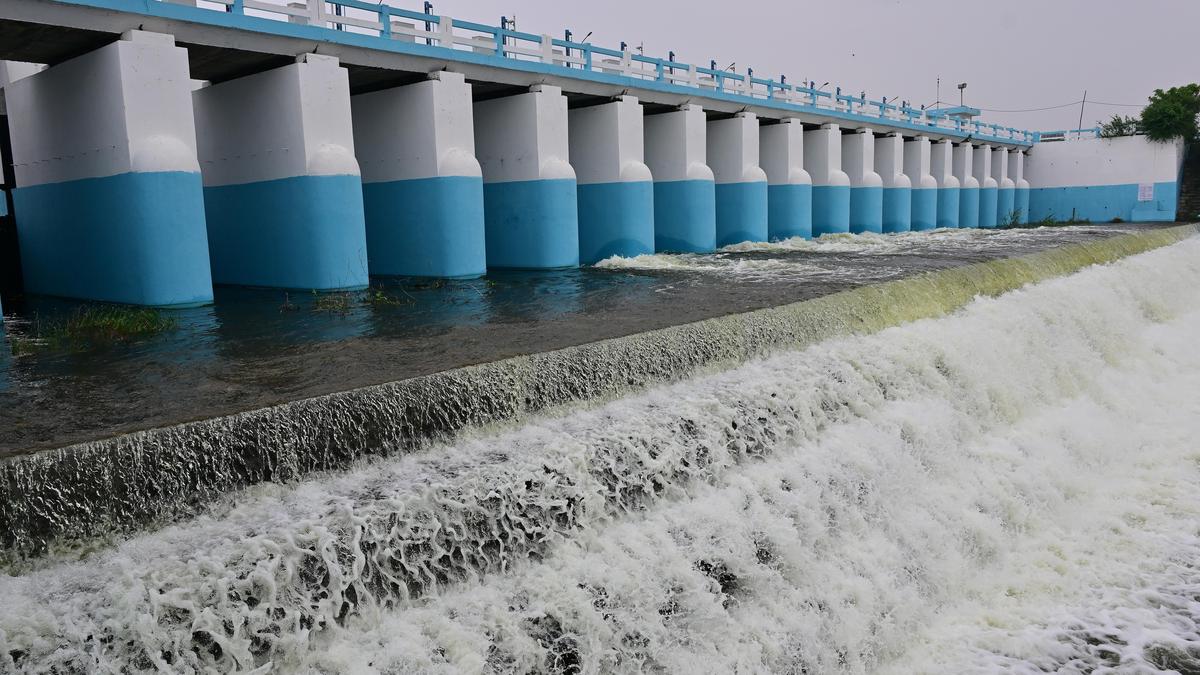
Floodgates were operated based on the inflow and rainfall rather than being kept open continuously even during dry weather
| Photo Credit: VELANKANNI RAJ B
A calibrated water release strategy from Chennai’s major reservoirs since the start of the Northeast monsoon helped prevent sudden flooding in the downstream areas, as gradual discharges kept storage levels within the safe zone despite persistent inflows, according to the Water Resources Department (WRD).
Shutters of Red Hills, Chembarambakkam, and Poondi reservoirs continue to release minimal quantities of water as the water bodies are brimming with water. The five drinking water reservoirs together hold 92.4% of their combined storage.
Residents said low-level pockets like Ezhil Nagar in north Chennai, which were battered by a torrential downpour during December first week, were waterlogged. However, areas prone to flooding when surplus water is released from Red Hills and Poondi reservoirs had a respite this time.
Cyclone Ditwah and its tail dumped massive amounts of rainfall over Tiruvallur and north Chennai areas. Areas like Ennore and Manali New Town alone received nearly 62 cm and 56 cm of rainfall spread over three days. P.K.Thenkanal Isaimozhi of Manali New Town said areas like Manali New Town housing board and Ponniamman Nagar get waterlogged for two or three days whenever surplus water is discharged from Red Hills or Poondi reservoirs.
“We were spared flooding this time because of the gradual water release and construction of new canals. Portions of bund along the Kosasthalaiyar river were also strengthened,” said Mr. Isaimozhi.
Officials of the WRD said the riverine flooding did not compound waterlogging in north Chennai unlike in the past. Apart from improvement works in waterways, the department adopted a strategy of maintaining a minimal outflow to preserve a flood buffer space ahead of heavy rainfall.
Floodgates were operated based on the inflow and rainfall rather than being kept open continuously even on dry days. In Red Hills reservoir alone, floodgates were opened six times since the onset of the monsoon.
“We closed shutters and built up storage during heavy rainfall to allow local flooding to drain in downstream areas. On dry days after the release, water from Araniyar anicut was diverted to Poondi. Similarly, water from Kesavaram and Korattur anicuts was conveyed to Chembarambakkam to augment storage,” said an official.
The department also deployed teams to monitor floodwater flow in controlled and uncontrolled arms of rivers. “We alternated shutter operations between Poondi and Red Hills reservoirs to prevent inundation and strain on waterways during peak inflows. Surplus water from Poondi reservoir was diverted through the link canal on some days to delay peak flow in waterways,” the official added.
Meanwhile, trial runs are underway to automate the floodgate operation at the reservoirs through Supervisory Control and Data Acquisition system.
Published – December 09, 2025 05:30 am IST


