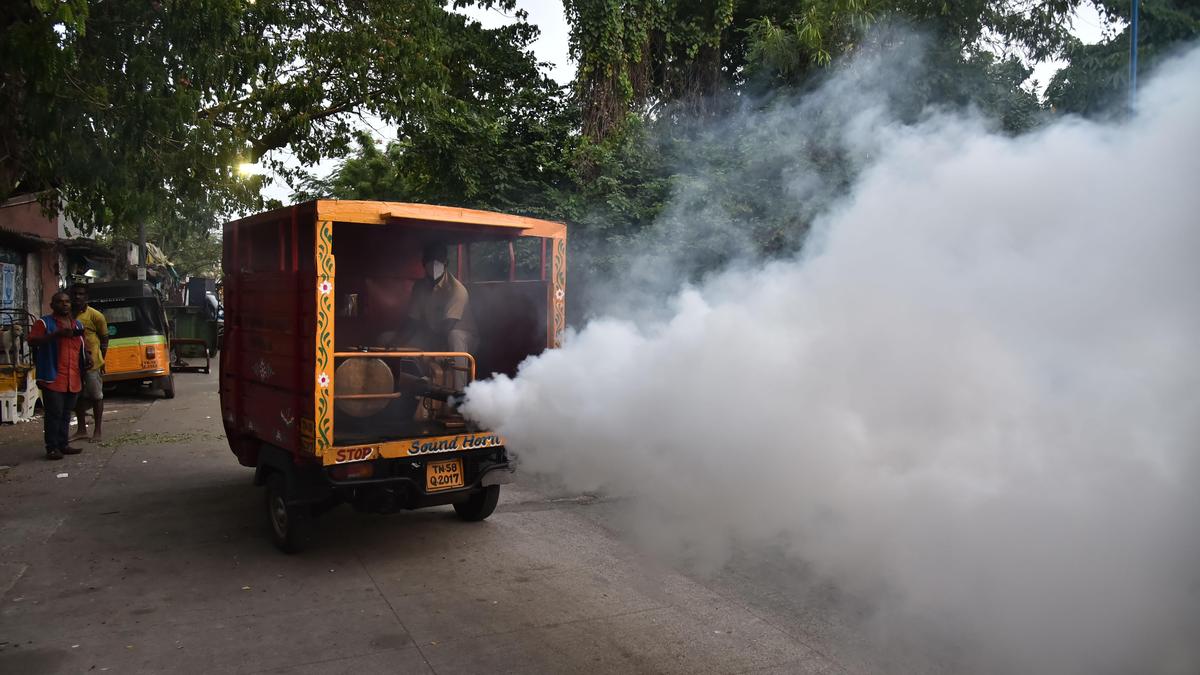
Last year, Tamil Nadu logged its highest dengue caseload, crossing the 20,000 mark for the first time since the previous peak in 2017. Though case numbers have risen steadily this year as well, doctors and public health experts point out that a stronger understanding of the disease, targeted surveillance strategies, greater public awareness and well-defined protocols have improved early diagnosis and helped reduce complications and mortality.

Previous peaks
The State, in its two earlier peaks in 2012 and 2017, had recorded 13,204 cases with 66 deaths and 23,294 cases with 65 deaths, respectively. In the years that followed, both case numbers and deaths declined, until 2024, when the number of cases again surged. Though the exact number of cases and deaths this year could not be ascertained, health officials confirmed that there are about 23,000 to 24,000 cases of dengue so far but fewer deaths than last year.
A. Somasundaram, Director of Public Health and Preventive Medicine, said that communicable diseases have both seasonal and cyclic trends. While flu is seasonal, some diseases follow a cyclic pattern. In these cycles of five to seven years, the disease builds its capacity to cause more serious infections. When this coincides with susceptible or vulnerable groups being present in large numbers, more severe disease can occur, he said
“The public health system is geared to take preventive measures. We use a triangulation approach. We focus on areas where the larval index is high and have identified locations that are traditionally dengue hotspots. We also conduct mosquito pooling, an exercise in which mosquito samples are collected and tested for dengue viruses using RT-PCR. This approach has helped us reduce both cases and mortality,” he said.

Endemic in India
Dengue is endemic in India, a senior doctor added. “It was an exotic virus in the late 1990s. But this is no longer the case. Cases of dengue increases after rains and decreases when there are no rains. This follows the dynamics of the mosquito cycle. We can control dengue with certain checks and balances. It has a unique pattern. Dengue outbreaks tend to occur once in five years when the spread is rapid, with the classic examples being outbreaks in 2012-2013 and 2017 when mortality was high,” he explained. He added that an outbreak was expected during 2021 – 2022 but did not occur owing to the COVID-19 pandemic. “In fact, dengue cases were low during that period,” he said.
Interestingly, the Directorate of Public Health and Preventive Medicine did a dengue serosurvey to determine the reasons for low prevalence of dengue during the pandemic due to possible viral interference. Dengue is caused by four serotypes of dengue virus (DENV 1 – 4). The survey was conducted during the midle of the pandemic in December 2021 to compare the antibody levels (seroprevalence) against DENV and SARS-CoV-2, and found that seroprevalence of dengue was very low in the community with 4.12% for DENV IgM and 6.4% for DENV IgG. Only 3.76% of female Aedes mosquito pools were positive for DENV. It said that while anti-SARS-CoV-2 IgG antibody levels remained high at 87.3%, the decline in dengue incidence and/or prevalence during the pandemic (2020-2022) appears to be attributed to possible viral interference and neutralising effect of SARS-CoV-2 IgG against DENV.
“Tamil Nadu has a robust vector surveillance system implemented by the Directorate of Public Health and Preventive Medicine, under which detection of dengue virus in field-caught mosquito pool samples is done by RT-PCR across the State. This surveillance enables early identification of hotspots and appropriate public health measures,” he said.

What has worked
While the dengue alarm is sounded every year, doctors say that early diagnosis and prompt referrals have improved as a result of which complications and deaths have reduced.
Janani Sankar, medical director, Kanchi Kamakoti CHILDS Trust Hospital, Chennai, said the hospital has been continuously seeing children with dengue since July, but there were no Intensive Care Unit admissions, no seriously ill cases and no deaths. “Early diagnosis has definitely improved. About 25 to 30% of children did not require hospitalisation. If they resided close by, we educated the parents on the warning symptoms and asked them to report in 24 hours to check their vital parameters. If they were from distant location, we did not want to take chances and admitted them. They were discharged in a few days,” she said.
The severity of the cases has definitely come down, she said, adding: “Improved awareness levels, including on the warning signs, among the public as well as doctors has helped to a great extent. Children are also referred to the hospital earlier. The understanding of the disease is better now.” She added that though case numbers usually fall by the end of the year, they now see sporadic cases throughout the year – though small in numbers – unlike before, when cases are usually reported after July.
Soumya Sridharan, consultant, infectious diseases, Kauvery Hospital, Alwarpet, Chennai, said that post-COVID, awareness on any fever has increased among the public. “The complications are not alarming and there has been no strain on the healthcare system. Proactive measures from the State government have reduced mortality due to dengue,” she noted.
Dr. Soumya further explained: “When there is early detection and close monitoring, management is better. In at-risk patients, dengue could cause complications. Monitoring helps to detect early signs of deterioration or complications. A cascade sets in when dehydration occurs in the febrile phase of dengue. If fluid management is not done appropriately, it could lead to shock and severe dengue when haematocrit levels rise and platelet count falls and organ dysfunction could occur. The blood pressure drops and bleeding manifestations may occur. Any organ such as the brain, heart, lung and kidney could be affected.”

S. Chandrasekar, professor and head, department of medicine, Government Stanley Medical College Hospital, Chennai, said in dengue, sudden abrupt onset of fever, myalgia and pain behind the eyes is typically seen in patients. “Nearly 95% of dengue cases are self-limiting. We can assess its severity by certain parameters – drop in white blood cell count followed by fall in platelet count and rise in haematocrit levels. We should monitor these three changes.”
While these manifestations could change every season, what has been observed in the last six months is people coming in with shock syndrome, low BP, low platelet count, and liver dysfunction markers, Dr. Chandrasekar said. Elaborating on how the hospital focused its treatment strategy, he said, “Patients required prolonged hospital stay and intensive care. So, we decided to monitor these parameters for all patients with dengue. All liver parameters including serum albumin are checked, and if any changes occur, we change our treatment strategy. The dengue virus incites an immunological reaction in the body. It can result in a cytokine storm. So, we start to treat patients focusing on fluid management in addition to mitigating the inflammation and organ dysfunction.”

Extended dengue fever
A government physician in Chennai said that fever with low platelet count is usually on the rise this time of the year. “It can be caused by a plethora of tropical infections – most commonly associated with dengue, chikungunya, any viral illness, malaria, leptospirosis or even scrub typhus. Identifying underlying disease and starting early treatment is the cornerstone to cure,” he said.
Usually in dengue, fever stops by day five to eight and the period following defervescence is crucial. “We call it the immune phase during which platelet levels drop and complications start to develop. The unusual trend we have seen for the past couple of years is that fever continues well beyond 10 days and platelet drops simultaneously with fever continuing. We call this extended dengue fever. It can be quite challenging to make a diagnosis in this phase. We see quite a lot of patients in the adolescent and younger age group with low platelet counts rather than older patients,” he said.
In Chennai, migrant workers, including those working in construction sites, are commonly seen with complications and they also present late in the illness, making it difficult to treat and get a positive outcome, he said. “Mortality seems to be low, and complication rates, when compared to previous years, are also low,” the doctor added.

A ‘man-made’ disease
Dr. Chandrasekar said that in Tamil Nadu, the overall knowledge about dengue has improved and patients are managed as per protocols. “We have charts in all fever wards and doctors are aware of the protocols. The mortality is low as of now this year, and cases will usually occur till the end of February,” he said.
Aedes mosquitoes breed in fresh clean water, and so, cases start to rise after the rains when water collections in containers and unused items such as pots, tyres and coconut shells turn into a breeding ground for mosquitoes. Though transmitted by mosquitoes, dengue is a more man-made disease, he said.