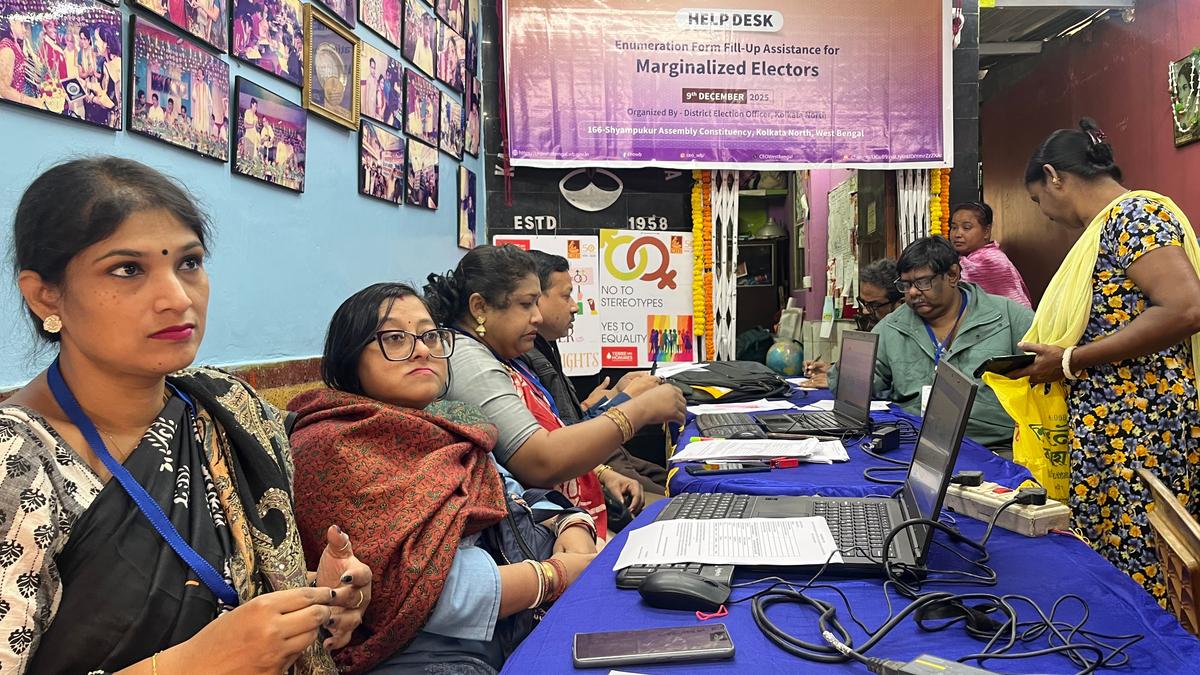
A fortnight since the sex workers of Kolkata’s Sonagachi sought assistance with the ongoing special intensive revision (SIR), the Chief Electoral Officer of West Bengal, Manoj Kumar Agarwal, visited the red-light area with other election officials on Tuesday to organise special assistance camps for marginalised electors.
“There are roughly 12,000 electors in the area. Linkage [with the 2002 voters’ list] has been established for 70% of them. The camps have been held to assist those who are remaining,” Mr. Agarwal said on Tuesday at the camp held at Durga Charan Mitra Street.
According to sources in the CEO’s office, around 800 residents participated in the assistance camps. Around 200 electors were given Form 6 for inclusion as new voters and over 50 were given Form 8 for change of address. Nearly a dozen electors submitted their enumeration forms in the camp, according to sources.
On November 21, three welfare bodies from Sonagachi, considered one of Asia’s largest red light areas, had written to Mr. Agarwal, urging him to take note of the difficulties that sex workers are facing while filling up the enumeration form, and to consider alternative identification for those who are unable to provide information or documents as per ECI guidelines.
Mita Saha, who is in her 40s and has been in the profession for several decades, was one of the first in line at the help desk. Unable to find her name on the voters’ list, officials handed her a Form 6 and the associated declaration form to get her enrolled as a new elector.
“I do not know how to read or write. When I heard that SIR had started, I sought help from some people in the neighbourhood, but they could not help me either. We women in this profession have to change houses often. I do not know where my voter slips are delivered during polls or if they are sent to me at all,” she said.
She vaguely recalled casting her vote only once in her lifetime, years ago. “I was born in a nearby neighbourhood. I have been anxious since SIR was announced, not finding my name on the final voters’ list. I am scared of being labelled an outsider and being driven out of here,” she said.
Anita Das, 47, who is also in the profession, said a large number of sex workers left Sonagachi out of fear and anxiety around SIR.
“They were scared about not possessing documents, not being able to trace their long-lost parents in the 2002 list, or not having the wherewithal to fill out forms. When SIR was first announced, so many sex workers fled that the neighbourhood almost emptied and people temporarily stopped coming here to seek services,” Das said.
Bharati Dey, a former sex worker and mentor at Durbar Mahila Samanwaya Committee who was present at one of the assistance camps on Tuesday, said that women who are engaged in sex work and are marginalised live a different reality than others, and therefore deserve consideration during such an exercise.
“During SIR, the same rules cannot apply to sex workers as for the rest of society. So many sex workers had come to us expressing their fears about not having a certain document, not having contact with their parents, or being worried about their children who are voters. That is why we had approached the CEO asking for assistance,” Ms Dey said.
On Tuesday, three special assistance camps were organised at the 166 Shyampukur assembly constituency, of which Sonagachi is a part. Two camps were held at Ward 18, one near the Shitala Mandir and one at the Kadamtala Milan Sangha, and another camp was held at Ward 26.
Mahasweta Mukherjee, advocacy officer at welfare organisation Amra Padatik, said requests have also been made to election officials for assistance camps at the red-light areas of Kalighat and Khidirpur. Amra Padatik, a collective by and for the children of sex workers, along with the Society for Human Development and Social Action (SHDSA) and Usha Multipurpose Cooperative Society Limited, were the organisations that had written to the CEO about sex workers’ concerns with SIR.
Help finding links
Booth-level officers who were present at the camps on Tuesday said most of the anxiety of the people, especially women of the area, was surrounding the “bottom half of the enumeration form”, where electoral details of one’s parents from the 2002 voters’ list had been sought.
“People are coming with a lot of anxiety. We have been telling them that there is nothing to worry about, that all we need is the name of the elector’s father, mother, or a grandparent, and if possible, the district or assembly constituency that they might have voted in. Then we are looking for the names in the 2002 list, and providing details we can find,” a booth-level officer in one of the camps said. Around their desk, several women had queued up with whichever documents they possessed, Aadhar cards, voter IDs or PAN cards.
Siddhartha Guin, the electoral registration officer of the Shyampukur assembly constituency, said that three assistance camps held on Tuesday will cover nearly 14 polling booths and over 11,000 electors.
“Most of the work has already been completed here. In this camp, we are primarily trying to help people find their link in the 2002 list, answer their queries regarding Election Commission guidelines, and distribute Form 6 for the inclusion of those whose names are not there in the electoral roll,” Mr Guin said.
Published – December 10, 2025 01:26 am IST