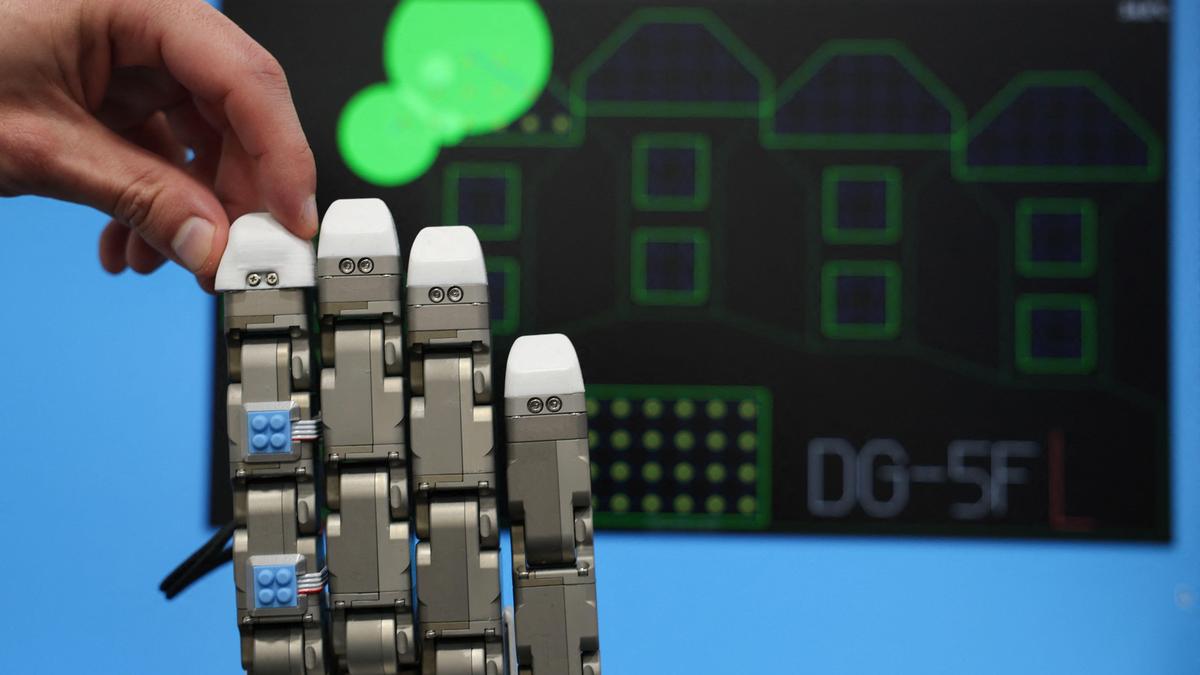

The uSkin human-touch sensors from XELA Robotics Co., Ltd. are demonstrated on a robotic hand to show pressure sensitivity during the annual Consumer Electronics Show (CES) in Las Vegas, Nevada, on January 6, 2026.
| Photo Credit: PATRICK T. FALLON
Human + AI will define the future of work and nearly all HR leaders (97%) anticipate that by 2027, the nature of work will be shaped by humans working alongside AI rather than engaging with it only intermittently, said a Nasscom study conducted in association with Indeed, a U.S.-based job site.
According to the study, this trend signalled a shift from AI being a supplementary tool to becoming an integral part of everyday roles, workflows, and decision-making processes. Also, an emerging model of Humans + AI working together is reported as the next phase of transformation, where success depends on how effectively AI will augment human capabilities, empower employees, and align with organisational purpose.
AI has already been reshaping the job, not just creating new ones. For instance, some 20-40% of work across technology organisations is already being done through AI across functions. Some 45% of the respondents highlighted that over 40% of the software development is done by AI, followed by 39% and 37% in intelligent automation and BPM, respectively. At the same time, the report also underscores that AI is not independent; more than half of respondents highlighted incomplete and low-quality outputs, reinforcing the need for human oversight to remain critical.
The report highlights that the most effective human–AI partnerships are emerging across higher-order activities such as scope definition, system architecture, and data model design. At the same time, more routine and repeatable tasks, including boilerplate code generation and unit test creation, are expected to be increasingly automated by AI over the next two to three years.
Ketaki Karnik, Head of Research, Nasscom, said, “AI is no longer a future consideration for the technology industry and is already shaping how work gets done. The real opportunity now lies in preparing people to work effectively alongside AI.’’
As AI adoption deepened, skilling and capability building would be central to ensuring that talent continued to move up the value chain and delivered meaningful outcomes for businesses, she added.
As per the findings, as AI changes tasks inside roles, the hiring is moving from headcount and credential-led selection to capability-driven evaluation, emphasising proof of work through outcomes and impact.
“What’s changing isn’t the number of jobs, it’s what those jobs expect from people,” said Sashi Kumar, Managing Director, Indeed India. “We’re seeing roles evolve internally long before hiring signals catch up.
The report also highlights that 85% of hiring managers see an increase in skills-based hiring, along with 98% highlighting the need for hybrid and multidisciplinary skills. For entry-level talent, organisations expect job-ready candidates, with assessments shifting toward live projects, hackathons, case-based questions, portfolios and a greater focus on measurable outcomes. For mid- and senior-level hiring, evaluation focuses on end-to-end ownership, decision-making under ambiguity, and multidisciplinary skill sets, with an increased emphasis on past projects and their impact, found the Nasscom-Indeed study.
Published – January 13, 2026 08:21 pm IST