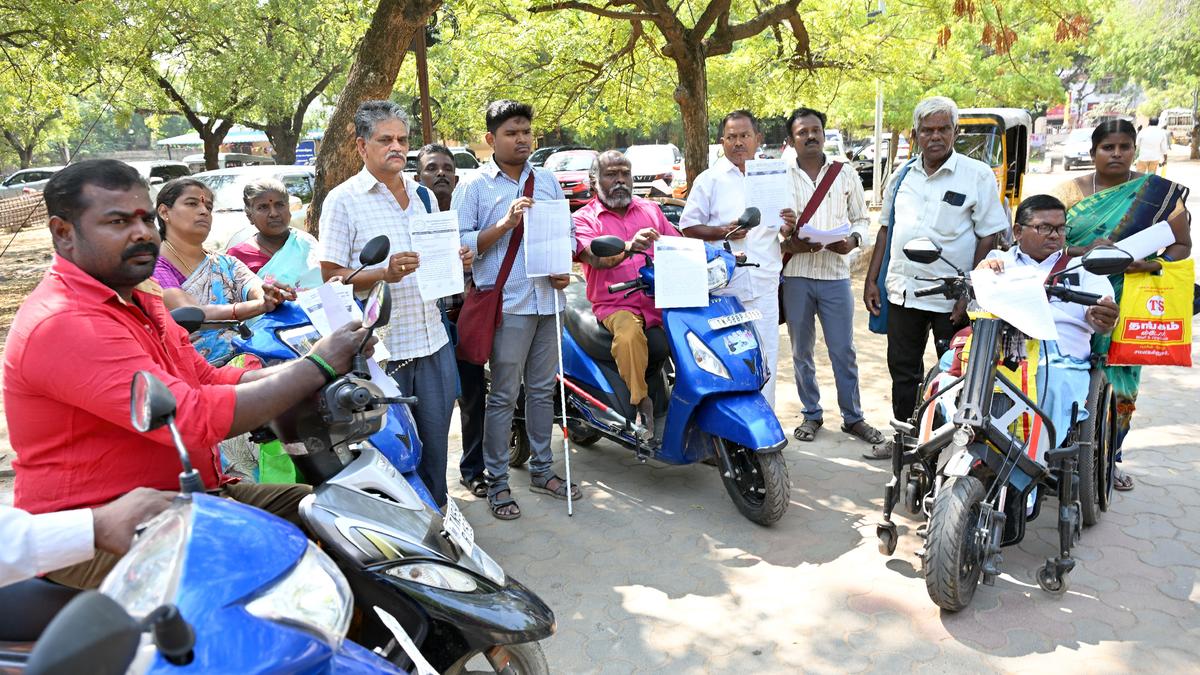
Members of TARATDAC at collectorate with petitions in Madurai on Monday.
| Photo Credit: R. ASHOK
Representatives from the Tamil Nadu Association for the Rights of All Types of Differently Abled and Caregivers (TARATDAC) submitted a petition with the District Collector K.J. Praveen Kumar seeking a specific quota in the allotment of commercial spaces for differently abled people.
A. Balamurugan, district secretary of TARATDAC, argued that as a means of empowering young entrepreneurs and individuals with disabilities, the State government should implement a 5% local reservation for the allocation of shops within commercial complexes, public markets, and various other government-controlled spaces.
He further explained that by establishing such a quota, members of the community would no longer be marginalized or deterred by the intimidating and complex administrative procedures involved in securing a shop for their personal livelihood.
This system would provide a guarantee to eligible traders, ensuring that the 5% reservation directly benefits qualified candidates through a structured allocation process.
Mr. Balamurugan emphasised that the initiative was not merely about setting aside physical space for commerce, rather, it represents a proactive measure toward enabling individuals to build stable lives through independent financial earnings.
He specifically called upon the Madurai Corporation to immediately adopt this 5% reservation framework in prominent locations such as the Periyar shopping complex, Thayir market, and the Subramaniyapuram complex for shop allocation.
Additionally, he suggested that the government should extend this preference to other public tenders, including the maintenance of public restrooms and the management of parking facilities at bus terminals and railway stations.
Such preferential treatment and reservation policies do more than just provide an opportunity—they serve as a vital catalyst for transforming the socio-economic status of the differently abled community, he stated.
Published – January 19, 2026 08:45 pm IST