
Mayor R. Priya at the Chennai Corporation Council Meeting on January 30, 2026
| Photo Credit: S.R. Raghunathan
After mandating pet dog licensing and microchipping, the Greater Chennai Corporation (GCC) now plans to do the same for cattle to curb stray cattle menace and conflicts on the streets. The civic body, at the Council meeting held on Friday (January 30, 2026), has resolved to make it compulsory for cattle owners to obtain licences for their animals across all zones.
According to the resolution tabled at the meeting, the 2024 census conducted by the GCC identified 22,875 cattle within city limits.
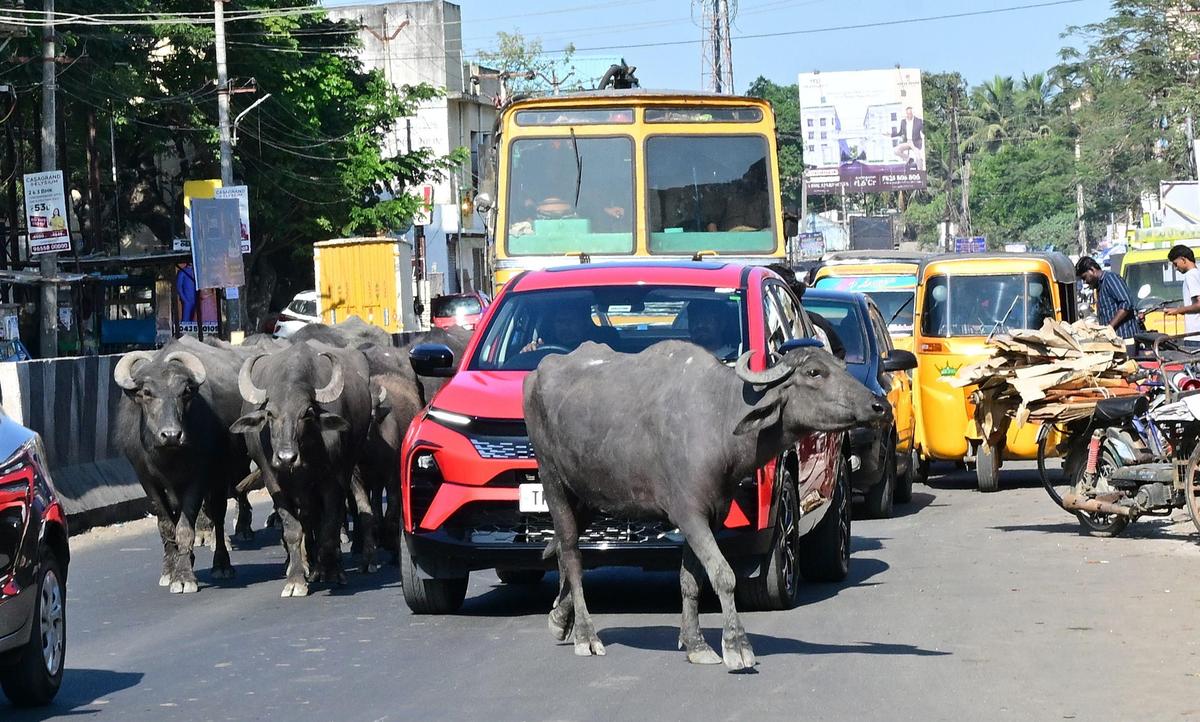
Stray cattle roaming freely on the Porur-Kundrathur main road, posing a risk to motorists. File
| Photo Credit:
B. Velankanni Raj
Many of these animals lack proper shelter and roam free on roads, causing traffic disruptions and public health hazards. Instances of cattle attacking the public have also been recorded. To address this, the GCC has deployed dedicated cattle-catching vehicles across 15 zones, each with five workers. Impounded animals are held at corporation sheds in Pudupet, and owners are charged a fine of ₹10,000 per head, with the condition that the animals should not be released back onto the streets, the resolution said.
Between 2024 and 2025, the civic body impounded 4,237 cattle and collected ₹2.22 crore in fines.
Annual data indicates a steady trend in enforcement:
1,248 cattle were caught in 2021 with fines of ₹25.69 lakh
7,199 cattle in 2022 with fines of ₹1.10 crore
4,237 cattle in 2023 with fines of ₹92.04 lakh
2,527 cattle in 2024 with fines of ₹1.27 crore
1,710 cattle in 2025 with fines of ₹94.51 lakh
What the new rules say
The new regulations require owners to download application forms from the GCC website and submit them to zonal veterinary officers. Following a field inspection by health inspectors and veterinary officers, a licence will be issued upon payment of a ₹100 fee. Each animal will be implanted with a microchip containing the owner’s name, address, and animal details. Owners have been granted a 45-day window until March 18, 2026, to obtain these licences.

The move cites provisions of the Prevention of Cruelty to Animals Act, 1960, which views overcrowding and allowing animals to roam freely as acts of cruelty. The Tamil Nadu Keeping of Animals and Birds in Urban Areas (Control and Regulation) Act, 1997, further empowers the corporation to regulate livestock to prevent the spread of infectious diseases.
Published – January 30, 2026 02:13 pm IST