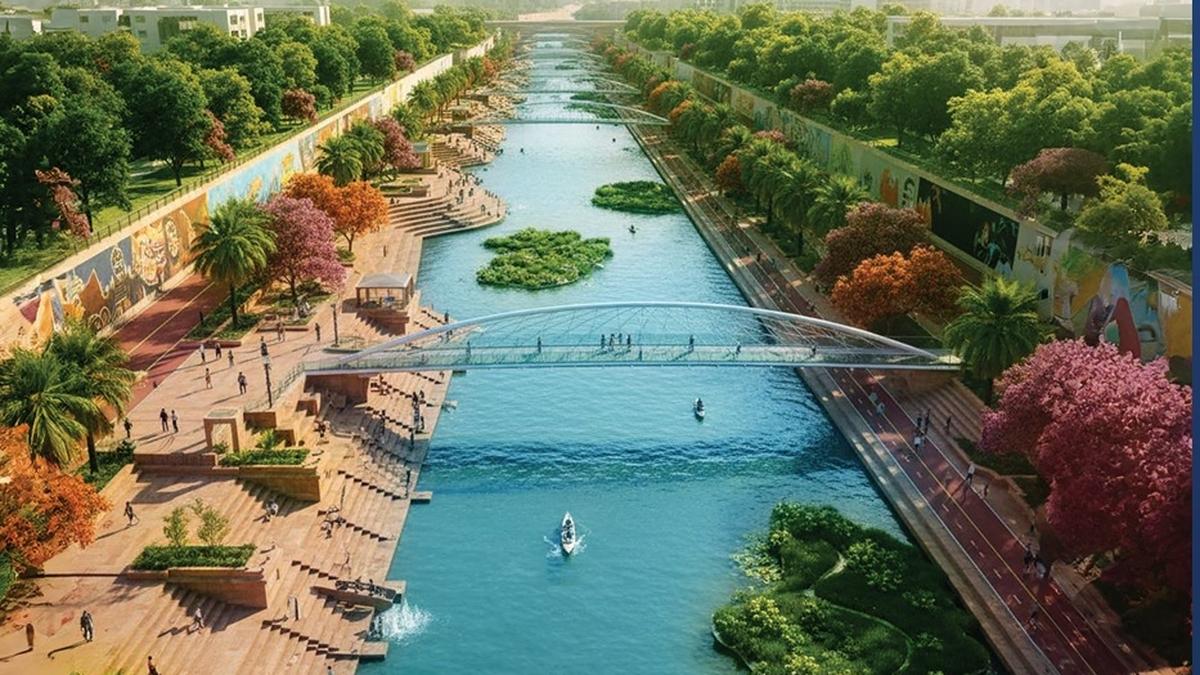
Visualisation of the River Musi that is part of the Vision 2047 document
| Photo Credit: By Arrangement
More than 25 years after the Andhra Pradesh Governor launched the Vision 2020 document at the Lalitha Kala Thoranam in Hyderabad, the Telangana government has unveiled its Vision 2047 in the Future City. An analysis of these two foundational documents with a gap of 25 years reveals distinct approaches to economic growth, social welfare, and environmental sustainability, reflecting evolving priorities and lessons learned. The newest smaller state of the country is carrying forward the legacy of the larger State with more resources and higher population.
The word poverty is mentioned seven times in the Vision 2047 document of Telangana State, while the same word is mentioned 66 times in the document for 2020. The word women/woman is mentioned 98 times in the 1999 AP document, while it mentioned 180 times in the 2047 document. The word – industry – is taken 100 times in the 2047 document, while in the 2020 document it’s taken 197 times. These three words are some of the markers of how the area that is now Telangana has changed over the past 25 years.
In Vision 2020, there were 11 goals beginning with: “Eradicate poverty and take care of its old, infirm and genuinely needy.” The 2047 document promises ‘Rich and equitable Telangana for all.”
The vision 2020 document released on January 26, 1999 by the then Governor C. Rangarajan, pegged the cost of fulfilling the goal at ₹16 lakh crores. The Vision 2047 document released by Telangana Chief Minister A. Revanth Reddy has a goal of a $3 trillion economy that is about ₹269,437,500,000,000 by 2047.
While both documents prioritise economic growth and social welfare, Telangana’s 2047 vision places a stronger emphasis on technology and sustainability. At the cusp of the Y2K problem, Andhra Pradesh’s 2020 plan mentioned IT as a growth engine and environmental concerns as part of planning. The current Telangana document integrates AI, quantum computing, cybersecurity, and climate tech across all sectors. It explicitly targets Net-Zero emissions by 2047.
The AP document aimed for a ‘developed’ State by 2020 – focusing on eradicating poverty, improving education and health, and stimulating economic growth through agriculture, industry, and services. Using 1995-96 figures, the policy aimed to reduce reliance on agriculture (from 33% to 12%) and shift to majorly services (49% to 67%) and industrial economy (18% to 21%). The 2025 Socio Economic Survey nearly matches these figures with agriculture contributing 15%, industry has dropped to 16.4% while the service sector kept the goal at 66.3% of the Gross State Value Added. It projected an average annual growth rate of 9-10% in real terms, with per capita income increasing nine-fold.
The vision 2047 shows a project GDP graph where the growth is forecasted to average 8% during 2025-30, 7% during 2031-39, and 5.2% during 2041-47, gradually moderating as the economy matures which is a sharp contrast to the runaway growth projected in 2020 document.
But there is a shift in focus for the economy from a rural-agricultural one to an urban-centric growth engine. Telangana’s strategy divides the State into Core Urban, Peri-Urban, and Rural Agri regions, each with specific economic focus. Hyderabad is envisioned as a global hub for DeepTech, AI, and advanced services (CURE), while peri-urban areas will concentrate on manufacturing (PURE), and rural regions on climate-smart agriculture and agri-based enterprises (RARE).
In line with this are projects like Bharat Future City, River Musi Rejuvenation, Dry Port, bullet train corridors, and a comprehensive road and rail network designed to connect its three economic zones. The emphasis on seamless mobility and universal, high-quality connectivity underscores a more integrated and technologically advanced infrastructure approach.
The shift in focus from Andhra Pradesh’s 2020 vision to Telangana’s 2047 blueprint highlights an evolution in development thinking
The 337-page document of Vision 2020 was prepared by consultants McKinsey for a fee of ₹2.5 crore. In contrast, the Vision 2047 is spread over 83 pages and lists government officials, Centre for Analytical Finance at Indian School of Business, Niti Aayog and host of other institutions for its creation.
Published – December 11, 2025 10:36 am IST