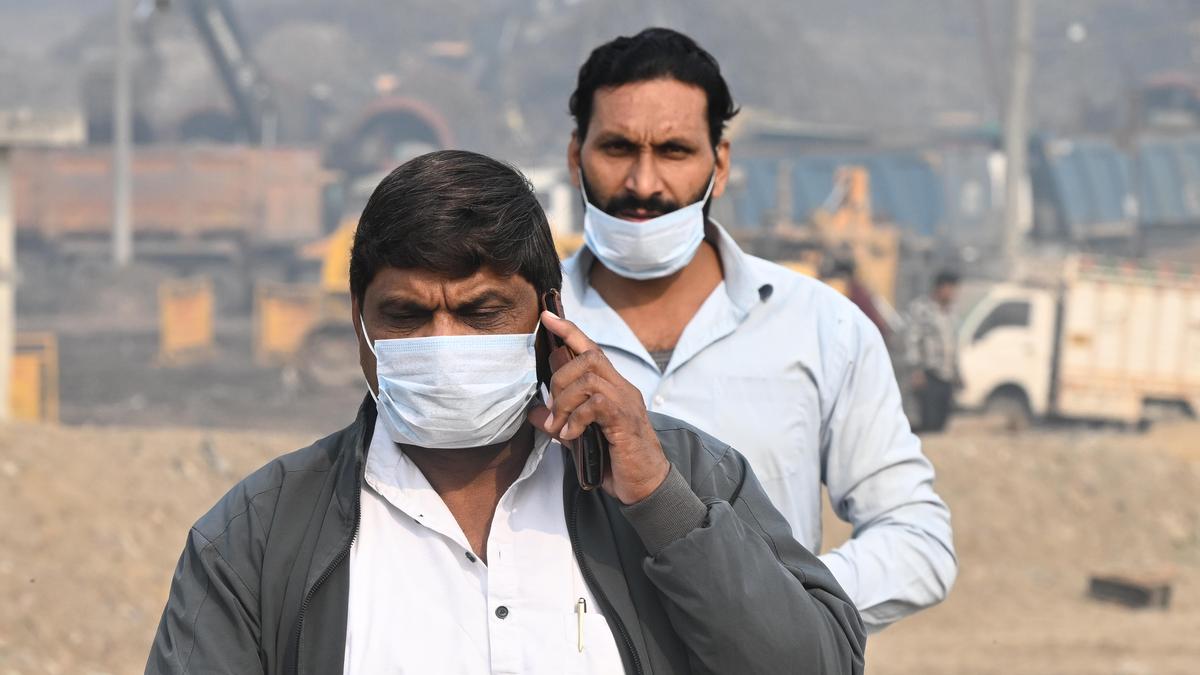
People wearing masks in the city on Thursday.
| Photo Credit: SUSHIL KUMAR VERMA
The overall air quality in Delhi remained in the ‘severe’ category for the third consecutive day on Thursday. The city’s average 24-hour air quality index (AQI) stood at 404 at 4 p.m., slightly better than the previous day’s reading of 418, according to data from the Central Pollution Control Board (CPCB).
Air quality is expected to improve to the ‘very poor’ category on Friday, as per the CPCB.
“Air quality is likely to be in the ‘very poor’ category from November 14-16. The outlook for the next six days: air quality is likely to be in the ‘very poor’ to ‘severe’ category,” said the Centre’s Air Quality Early Warning System for Delhi.
An AQI between 51 and 100 is deemed ‘satisfactory’, 101 and 200 is termed ‘moderate’, 201 and 300 ‘poor’, 301 and 400 ‘very poor’, and 401 and 500 ‘severe’, as per the CPCB.
Air quality in the ‘severe’ category “affects healthy people and seriously impacts those with existing diseases”, according to the pollution board.
Out of Delhi’s 39 monitoring stations, 28 reported ‘severe’ air quality. Wazirpur (458), Chandni Chowk (453), and Bawana (452) were among the worst-affected areas.
Across the country, only Bahadurgarh (466) and Rohtak (430) in Haryana recorded worse air quality than Delhi, according to the CPCB.
Every winter, air pollution increases in the Delhi-National Capital Region primarily due to meteorological factors such as lower wind speeds and a drop in temperature.
Stubble burning in this region during October and November and the bursting of firecrackers worsen the situation. The contribution of stubble burning to PM2.5 in Delhi on Thursday was 12%, according to data from the Union Ministry of Earth Sciences. This is predicted to rise to 17.3% on Friday and 17.35% on Saturday.
Violators penalised
Meanwhile, the Municipal Corporation of Delhi issued a total of 482 challans amounting to ₹51.26 lakh between November 1 and 12 to residents who contributed to air pollution by violating the rules of the National Green Tribunal. Most of the challans – over 100 – were issued in the Central Zone, followed by South Zone, Karol Bagh, and City S.P. Zone.
Published – November 14, 2025 01:11 am IST