The April 9 Assembly election in Assam is expected to be more than a high-voltage battle of two alliances — one led by the Bharatiya Janata Party (BJP) eyeing a third straight term and the other by the Congress.
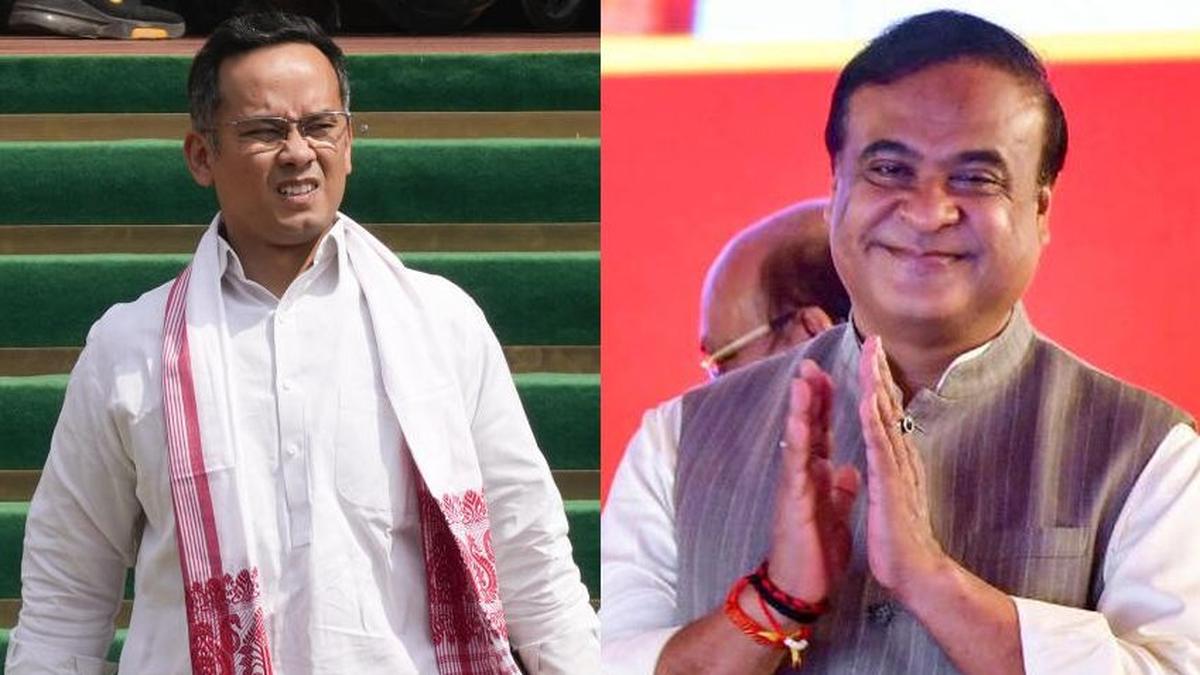
The spotlight of the election to the 126-member House, the first single-phase exercise in Assam since 2001, will be on the bitter rivalry between Chief Minister Himanta Biswa Sarma and State Congress president Gaurav Gogoi.
The countdown to the outcome of their public feud intensified on March 15 when the Election Commission of India fixed April 9 as the day of polling in Assam, along with Kerala and Puducherry. All political parties have appreciated the date, five days before the mid-April Rongali or Bohag Bihu.

Election issues in Assam are almost always repeated. These include development, floods and erosion, infrastructure push, welfare schemes, alleged corruption, and identity politics, primarily the fear of ‘Bangladeshi’ or ‘Miya’ people taking over the State and the fight of six communities — Adivasi or “Tea Tribes”, Chutia, Koch-Rajbongshi, Matak, Moran, and Tai-Ahom — demanding Scheduled Tribe (ST) status.
‘Miya’ narrative
One of the defining but all-too-familiar narratives likely to shape the upcoming election is the BJP’s political messaging around the ‘Miya’, a pejorative associated with Bengali-origin Muslim communities in Assam, often vilified as Bangladeshis. The BJP has framed issues of land encroachment, demographic change, and identity around this narrative, seeking to consolidate indigenous and Assamese-speaking Hindu voters.
The BJP claims that it is the only party serious about securing the future of Assam by launching an eviction drive to free 1.51 lakh bighas of government land from “Bangladeshi” squatters, and vowing to eject all “infiltrators” if given another chance. The anti-Miya rhetoric has become shriller than before, with Congress and other Opposition parties being projected as Muslim appeasers.

The ST issue has become more complicated with the proposal to add a new category – ST (Valley) – to the existing ST (Plains) and ST (Hills) to accommodate the six communities. While the six communities agree that getting ST status is easier said than done, the 14 existing tribes have warned against any move to expand the list and dilute the rights and privileges they enjoy.
The issue is likely to be a double-edged sword for the BJP in at least 30 Assembly constituencies covered by various tribal councils.
Among the new issues is the public demand, specifically in the Assamese heartland, for justice for singer-composer Zubeen Garg, who died in Singapore on September 19, 2025. The Congress-led alliance has been cornering the BJP-led government for allegedly shielding Garg’s ‘murderers’.

Sarma vs. Gogoi
The electoral contest, though, is likely to be known for the almost personal battle between Mr. Sarma and Mr. Gogoi, who defied an intense BJP campaign to win the Jorhat Lok Sabha seat in 2024. The latter’s popularity is perceived to be a worry for the BJP in eastern Assam, a region that yielded the BJP the bulk of its seats in 2016 and 2021.
The rivalry between the two leaders intensified after the Chief Minister accused Mr. Gogoi of maintaining links with Pakistan and ordered a Special Investigation Team probe against him.
Change in partner
The BJP is going to the polls with three partners — the Asom Gana Parishad (AGP), the Bodoland People’s Front (BPF), and the Rabha Hasong Joutha Mancha. What has changed from 2021 is the replacement of the United People’s Party Liberal (UPPL) with the BPF for 15 seats across the Bodoland Territorial Region (BTR).
The BPF will contest 11 of these seats while the BJP will contest four. The UPPL, which walked out of the NDA on Tuesday, decided to field candidates against the BJP and BPF across the BTR and six more constituencies beyond, which could affect the chances of the NDA.
‘Tea tribes’ factor
A popular theory is that elections in Assam are won or lost based on which party or alliance two ‘bulk vote banks’ — Muslims and ‘Tea tribes’ or Adivasis — support. Congress allegedly used to enjoy the support of both groups until the Adivasis began gravitating toward the BJP in the 2010s.
The BJP has demonstrated that the Adivasis, specifically across the tea belts of eastern Assam, matter to them by doling out cash benefits and starting the process of granting them land rights in the labour lines of more than 800 tea estates.
The BJP and its allies are also banking on the Orunodoi scheme, whose 40 lakh beneficiary families received ₹9,000 each less than a week before the poll schedule was announced. The money included a monthly instalment of ₹1,250 from January to April and a Rongali Bihu “bonus” of ₹4,000.
Dent in Congress votes
Congress is going to the polls with four allies, 11 fewer than in 2021. These are the Assam Jatiya Parishad, the Communist Party of India (Marxist), the CPI (Marxist-Leninist), and the All-Party Hill Leaders’ Conference.
The Congress-led alliance is wary of the damage Raijor Dal, led by activist-turned-MLA Akhil Gogoi, could inflict. Differences over a few seats led to Congress and Raijor Dal go separate ways after months of discussions to contest the polls together.
Another party that could upset the Congress applecart in Muslim-dominated seats is the minority-based All India United Democratic Front (AIUDF) led by perfume baron Badruddin Ajmal. The AIUDF, largely seen as having penetrated Congress bastions in Muslim-dominated seats, was a partner of Congress in 2021.
The AIUDF won 16 of the 50 seats that the Congress-led Mahajot (grand alliance) of 16 political parties bagged in 2021. The BJP and its allies won 75 seats that year.
Published – March 17, 2026 09:53 pm IST