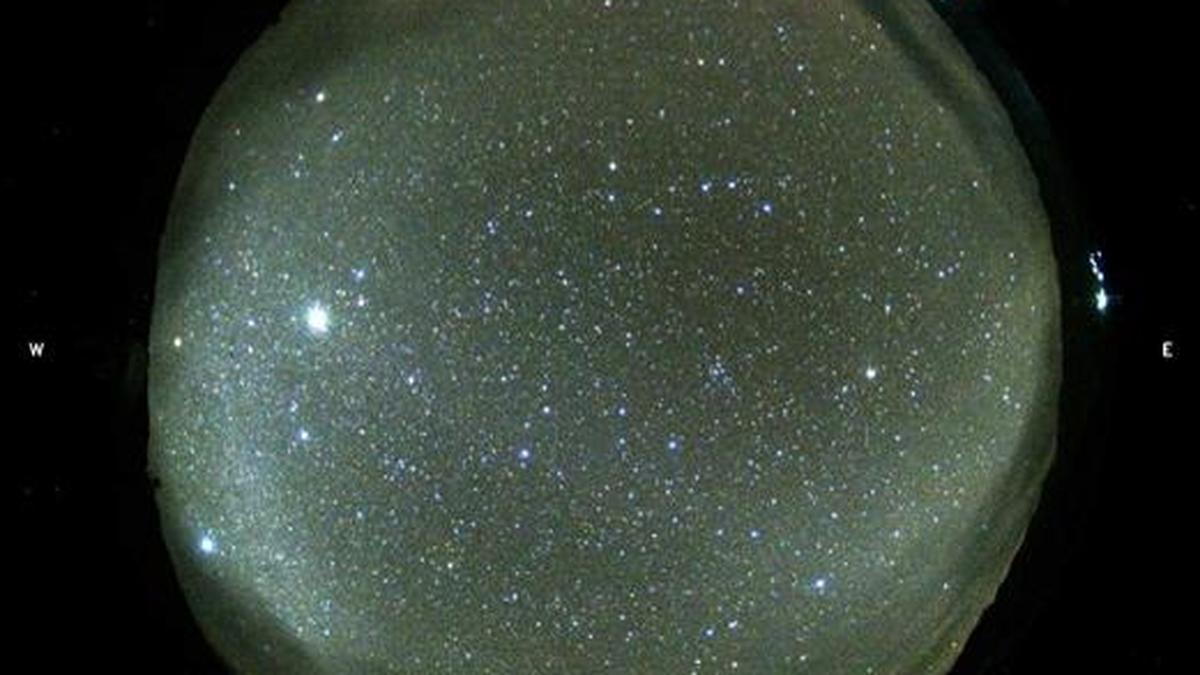
A screenshot of the auroral activity captured by the all-sky camera at the Hanle, Ladakh, by the Indian Institute of Astrophysics.
| Photo Credit: special arrangement
Auroral activity was captured by the all-sky camera at the Indian Astronomical Observatory in Hanle, Ladakh, on the nights of January 19 and 20. This is the sixth time during the current solar cycle the intense red coloured auroral activity was captured.
The Indian Institute of Astrophysics (IIA), which operates the observatory, said that the aurora seen at Hanle was owing to a strong geomagnetic storm which began at approximately 3.30 a.m. on January 20.
“The storm reached its maximum intensity at 8.30 p.m. on January 20, with a peak disturbance of −218 nano Tesla,” it said.
Interaction with CME
According to NASA’s space-based remote-sensing observations, the storm resulted from the interaction of a coronal mass ejection (CME) that was launched from the sun around 1.30 p.m. on January 18.
The CME originated from Active Region 14341 near the centre of the solar disk and was expelled at a speed of around 1,400 km/s. It was associated with an X1.9 solar flare and accompanied by solar energetic particles. In terms of space-weather severity, the event is classified as a G4-level geomagnetic storm with an S4 radiation level.
“During the ongoing 25th solar cycle, only six geomagnetic storms with intensities exceeding −200 nT have been recorded, which have the potential to cause low latitudinal arorae. A coronal hole was observed over a large area surrounding the active region, which may have facilitated the CME’s rapid propagation toward earth within approximately 28 hours,” said P. Vemareddy, a solar astrophysicist at the Indian Institute of Astrophysics.
Physical mechanism
Using a combination of ground-based and space-based observations, scientists at IIA are actively investigating the physical mechanisms behind these storms to better understand the sun’s influence on earth.
IIA said that CMEs are large expulsions of billions of tonnes of plasma and its associated magnetic fields from the sun into the interplanetary space, some of which can hit the earth and produce geomagnetic storms.
“Extreme geomagnetic storms have the potential to harm space-technology dependent human life on Earth, such as disrupting radio communication, GPS signals, etc. Predicting these storms is an important area of scientific research at IIA and many other institutions in India as well,” IIA said.
Published – January 23, 2026 07:00 am IST