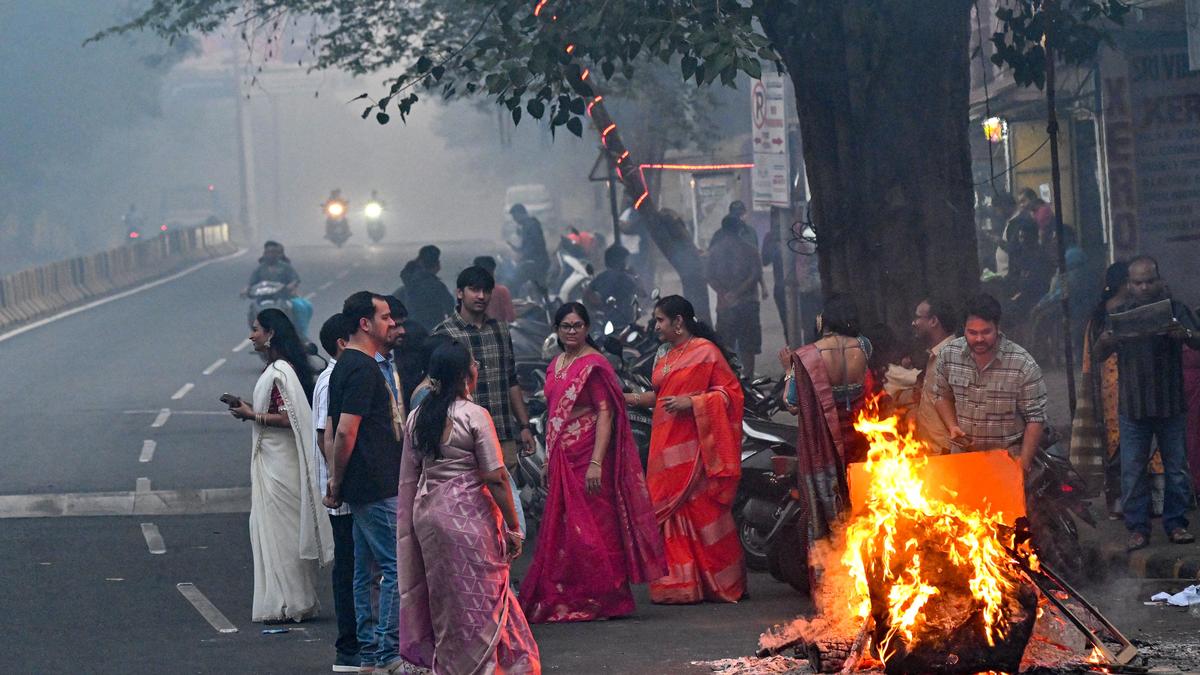
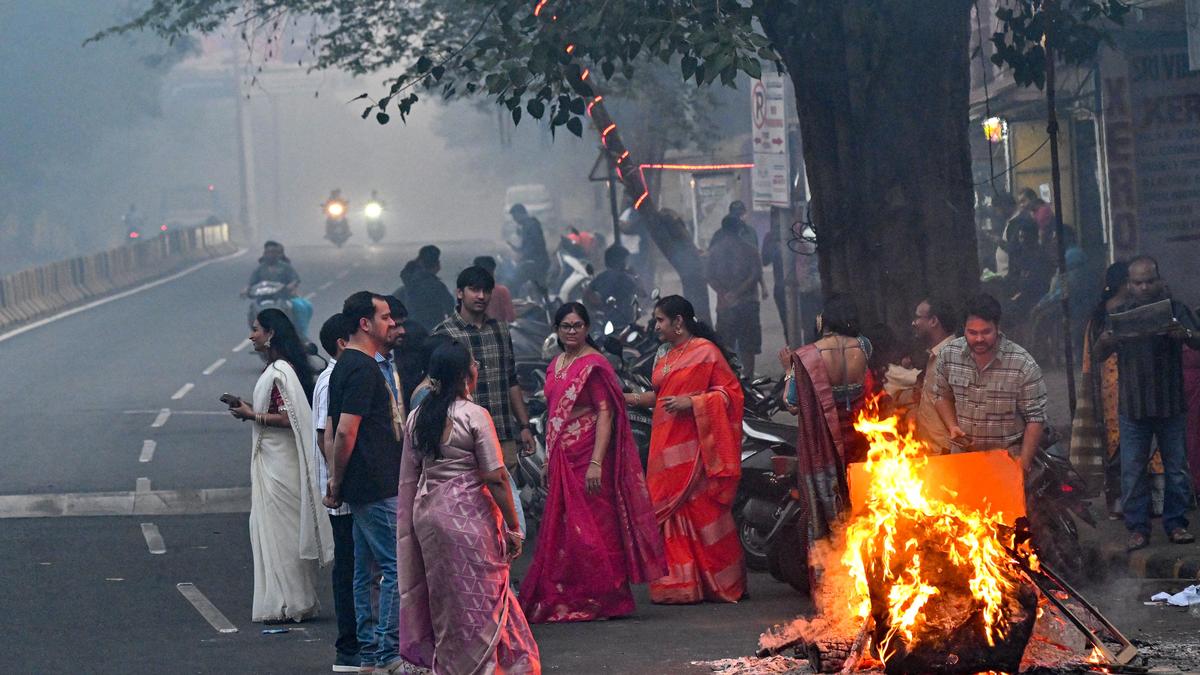
People gather around a Bhogi fire as part of the Sankaranti celebrations at AU road in Visakhapatnam on Wednesday
| Photo Credit: K. R. DEEPAK
The traditional Bhogi celebrations on Wednesday saw Visakhapatnam citizens light bonfires across the city to mark the start of the harvest festival. However, the ritual drew concern from environmentalists and officials as air quality levels fluctuated due to the burning of wood, cow-dung cakes, and old household articles.
Despite the Greater Visakhapatnam Municipal Corporation (GVMC) warnings against lighting fires on public streets, the rituals continued unabated in most neighbourhoods, leading to a visible increase in smog.
Data recorded on January 14 revealed a significant spike in pollution levels. The Air Quality Index (AQI) in the city was categorised as ‘moderate’ on average, but specific timelines showed high concentrations of suspended particles.
According to monitoring reports, the PM10 (coarse particulate matter) levels hit a maximum of 411 mg/m³, with an average of 180 mg/m³. Similarly, the PM2.5 (fine particulate matter) levels reached a peak of 305 mg/m³, maintaining an average of 136 mg/m³. Environmentalists noted that during the winter season, these particles remain trapped near the ground in the form of smog, posing a direct threat to public health.
In a latest statement, the Andhra Pradesh Pollution Control Board (APPCB) chairman P. Krishnayya called for a shift in how festivals are celebrated. He urged citizens to adopt eco-friendly practices and refrain from burning hazardous waste materials, which release toxic fumes into the atmosphere.
“Celebrating Bhogi in an eco-friendly manner is the need of the hour to prevent further deterioration of our environment,” Mr. Krishnayya said.
Officials observed that the suspension of dust and smoke particles is particularly harmful during the current cold spell, as the lack of wind prevents the dispersal of pollutants, creating a lingering haze over the city.
Published – January 14, 2026 08:16 pm IST