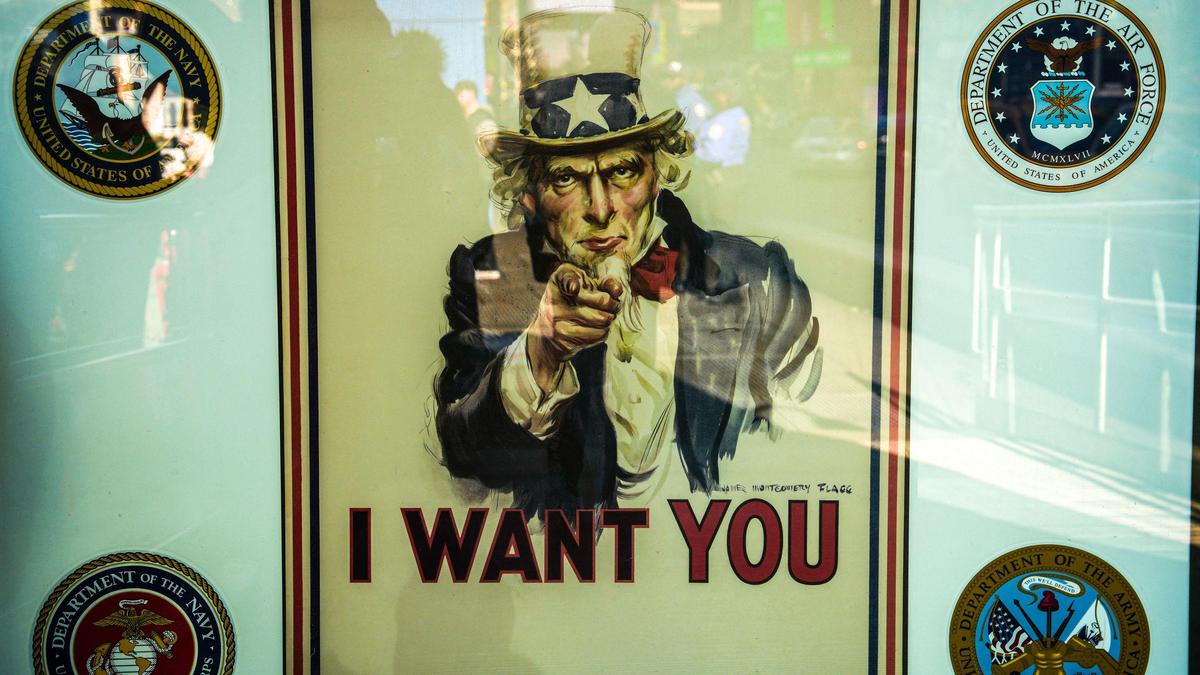
An Uncle Sam American military recruitment poster is seen in Times Square as the nation reacts to “major combat operations” in Iran on February 28, 2026 in New York City.
| Photo Credit: AFP
A ceremonial event to honour American veterans at the White House, and the war of nerves between the Pentagon and AI giant Anthropic over the control and deployment of autonomous weapons systems amid the new West Asia war launched by the U.S. and Israel are connected by a shared question — where to find the fighters.
On March 2, three soldiers — Retired Command Sgt. Maj. Terry P. Richardson, honoured for saving 85 fellow soldiers under enemy fire in Vietnam; Master Sgt. Roderick W. Edmonds, posthumously recognised for shielding Jewish prisoners of war from Nazi guards in the Second World War; and Staff Sgt. Michael H. Ollis, posthumously honoured for absorbing a suicide bomber’s blast to save a Polish officer in Afghanistan — were awarded the Medal of Honor by President Donald Trump.
Editorial | West Asia on fire: On the Israeli-American war against Iran
However, the classic transfiguration of a soldier’s death into an act of valour depends on a society willing to receive it. In the U.S., the cult of individualism is celebrated by the state and society alike. Social media has made the cost-benefit analysis of wars more democratic, and the loss of American lives is difficult to defend.
The question of who fights and who profits from wars has become an open public argument in the U.S. The manner in which war supporters were skewered by online influencers after many of them praised the sacrifice of the six American soldiers killed in ‘Operation Epic Fury’ is instructive. The vertical propaganda of sacrifice for the nation — spoken by strategic elites in the name of national interest — is severely challenged, and there is no restoring that narrative in the U.S. In contrast, consider the death of Ayatollah Ali Khamenei, the Supreme Leader of Iran, who possibly wanted it that way: in Shia theology, revenge, sacrifice and martyrdom are integral.

Size of U.S. military
After the U.S. discontinued mandatory draft in 1973, the staffing of its voluntary military has gone through many policy questions and challenges. Currently, the size of the U.S. military is the lowest in its history — from 12.2 million during the Second World War to 1.4 million at the end of the Cold War to 1.1 million now. In 2018, a study estimated that 77% of young adults in the U.S. are ineligible to serve, disqualified by obesity, educational deficits, criminal records, or drug use. After several years of falling short of recruitment targets, the U.S. military had a good year in 2025, meeting them only after substantial pay increases and the introduction of preparatory courses for recruits who could not meet baseline academic or fitness standards.
Among the measures the U.S. tried in order to work around its recruitment challenges was privatisation of war itself: more than half of the personnel the U.S. deployed in Iraq and Afghanistan were contractors — their casualties not even tracked by the Pentagon. The U.S. has long offered non-citizens an expedited path to naturalisation through military service; between 2011 and 2015, the Army would have failed its active-duty recruitment goals in nearly every year without non-citizen enlistments. As of early 2024, more than 40,000 foreign nationals were serving in active and reserve components of the armed forces, with an estimated 115,000 foreign-born veterans living in the U.S. — soldiers who had already paid the price of membership without receiving its full guarantees. From 2008 to 2016, under the Military Accessions Vital to the National Interest programme, the U.S. recruited non-citizens with critical language and medical skills from abroad in exchange for an expedited path to citizenship, enlisting over 10,000 before it was wound down on national security grounds.

Motivating people to give up their lives is no easy task, and capitalist societies find it harder than most. It is the lower end of the middle class who enlists, and it is poorer regions and communities that recruiters target — American scholarship on military recruitment is consistent on this point. The richest are not sending their children to the battlefield. An individual in a capitalist, individualistic society must make the risk-reward analysis along a material metric before deciding to enlist. The state pins the virtues of patriotism and sacrifice on soldiers, and conducts a mix of religious and secular rituals to maintain an aura around the loss of lives. At the recent White House ceremony, a uniformed officer read aloud from the Bible. Religious warriors fight for the afterlife, currency that individualism lacks. Where the pursuit of individual happiness is both means and end, a soldier’s work becomes, in material terms, just a job — like any other. Secular military ceremonials seek to add a veneer of glory and the work is presented as the defence of ideals such as freedom, liberty, a way of life. Social media has possibly brought to American public consciousness the chasm between the worlds of soldiers and the beneficiaries of war within domestic society, and made the greed and profiteering that go along with war more transparent.
An atomic tug of war
The mechanisms of war become a matter of public interest and domestic politics primarily through human casualties. This question — of American soldiers fighting wars they do not necessarily need to, or benefit from — has been central to the anti-war argument that now turns out to have been mere theatre in Mr. Trump’s America First nationalism.
America First nationalism complicated the soldier identity in U.S. society by undermining non-citizen drafting. The fusion of citizen and soldier has been a classic American ideal, but capitalism had dealt with reality through its own mechanisms of reward — war contracting, and the drafting of non-citizens with the promise of citizenship. The prospect of machine soldiers offers the possibility of completely delinking the fighter from the domestic political process, making war a wholly technological, capitalist enterprise. Nobody will mourn for the machines; the President will not be required to read speeches in their honour.
Published – March 06, 2026 10:45 pm IST