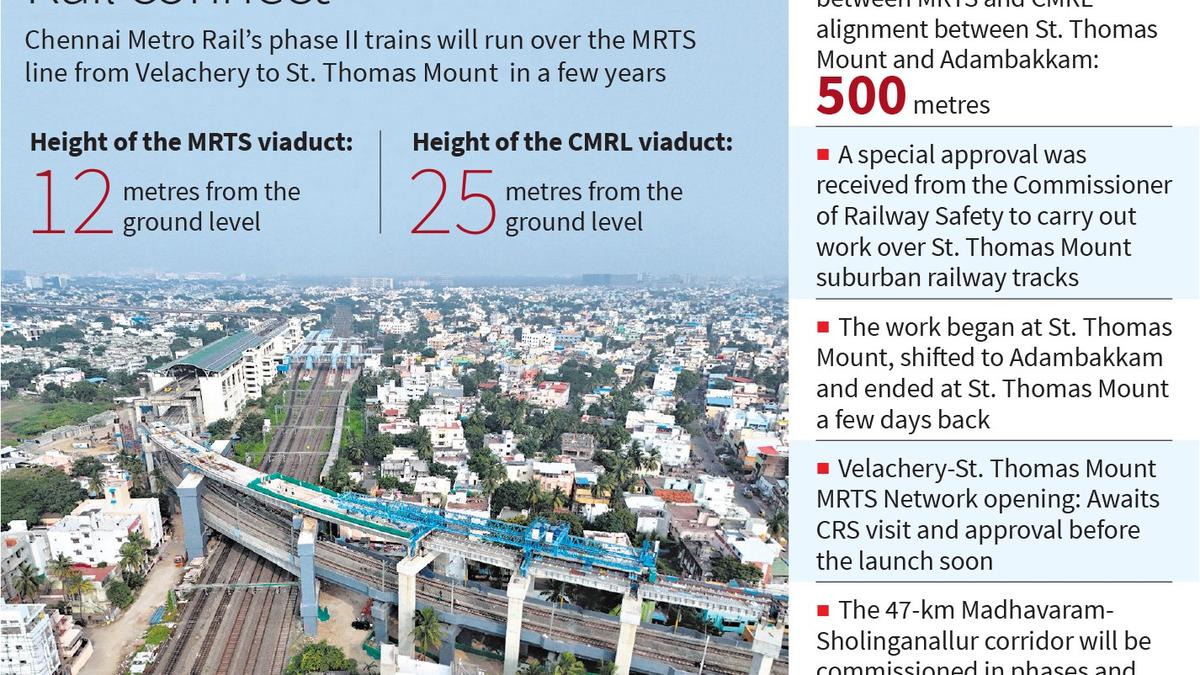
In a few years, with suburban trains snaking their way through the ground level and Velachery-St. Thomas Mount MRTS network on the first, Chennai Metro Rail’s phase II trains from Madhavaram to Sholinganallur will run on the second level.
The MRTS network from Chennai Beach to Velachery is being extended to St. Thomas Mount with three stations — Puzhuthivakkam, Adambakkam, and St. Thomas Mount.
The Chennai Metro Rail’s phase II network’s corridor 5 from Madhavaram passes through Retteri, Anna Nagar, Koyambedu, Thirumangalam, Virugambakkam, Alandur, crosses St. Thomas Mount and Adambakkam, and terminates at Sholinganallur, covering 47 km in total.
From St. Thomas Mount to Adambakkam, the MRTS and Metro Rail networks share a common elevated alignment for a short stretch of 500 metres. The trains of both networks will cross each other at two levels.
T. Archunan, director (projects), Chennai Metro Rail Limited (CMRL), said the construction of this section was completed a few days ago. “Initially, it was decided that Railways will build the viaduct for MRTS and CMRL networks. Then, plans changed. After constructing their viaduct, Railways handed over the work to the CMRL, who built their viaduct on the second level. The work that went behind building this alignment was nothing short of a challenge,” he said.
“Be it building the viaduct over the suburban track or on top of the upcoming MRTS line, we constructed this 500-metre line amid extreme space constraints. It turned out to be a time-consuming process and was carried out by L&T. We had to specially customise and manufacture a light-weight launching girder for building this stretch,” he added.
For four days between June and July last year, suburban train services were stopped from passing through the St. Thomas Mount station for over two hours around midnight to carry out the construction of this stretch. Officials said they had sought special approval from the Commissioner of Railway Safety for the same.
“Since cranes couldn’t be deployed for construction over railway tracks, a lightweight launching girder was brought in to erect and place the I-girders (a horizontal support beam). While the launching girders used in the phase II project for placing U-girders weigh nearly 400 tonnes, the one used in the small section was 100 tonnes due to the nature of the work. This was the first time they were used for I-girders,” Mr. Archunan added.
The CMRL usually uses precast structures for the phase II project. Here, an exception was made. “We had to carry out what is known as a ‘cast in-situ portal’ (a structure or frame used in construction), wherein the portals were joined together, piece by piece, at the site. We developed a unique suspended support system in which structural supports were derived from the existing piers of the MRTS network,” he added.
Published – January 10, 2026 12:27 am IST