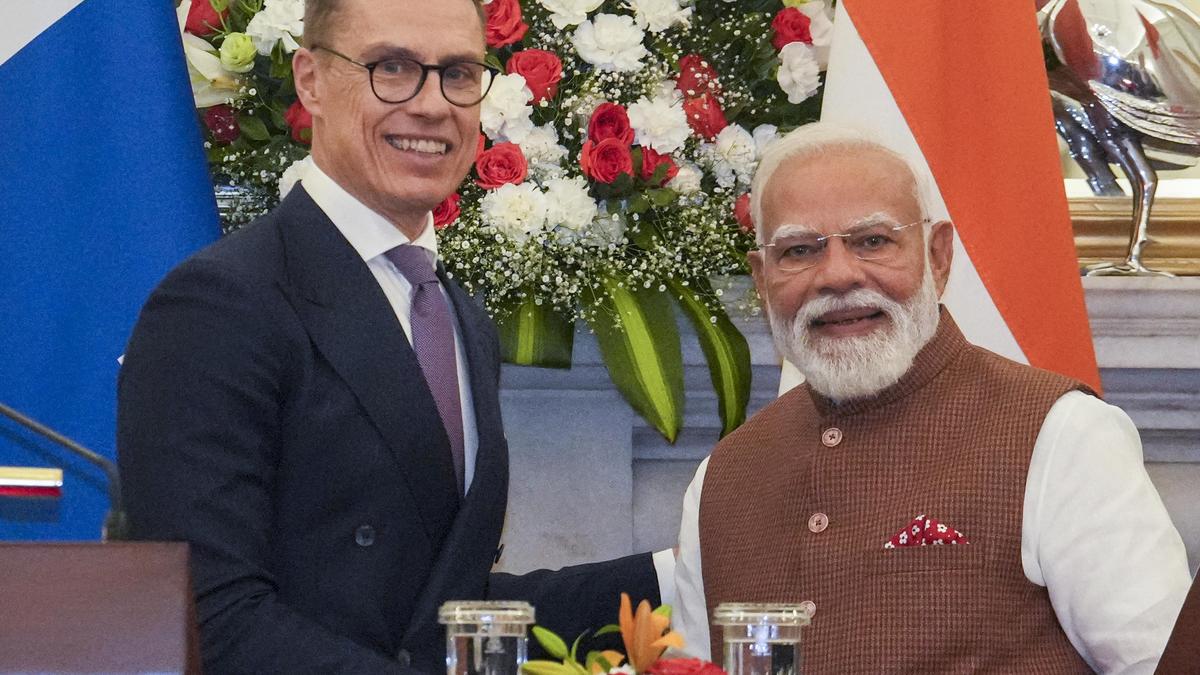
Prime Minister Narendra Modi, right, with Finland President Alexander Stubb during a joint press meet, at Hyderabad House in New Delhi, Thursday, March 5, 2026.
| Photo Credit: PTI
India and Finland would support all efforts to end the conflicts in West Asia and Ukraine at the earliest, said Prime Minister Narendra Modi after talks with Finland’s President Alexander Stubb, stressing that there are no military solutions to any conflict.
The two leaders met on Thursday (March 5, 2026) and announced a ‘Strategic Partnership in Digitalization and Sustainability’, an MoU on Mobility for Indian professionals particularly for jobs in innovation and technology, and a partnership on 6G telecommunications.

The visit by Mr. Stubb, who was here as chief guest for the Raisina Dialogue organised by the External Affairs Ministry, came weeks after the finalisation of the EU-India Free Trade Agreement, and both sides committed to doubling current bilateral trade levels of $1.5 billion-$2 billion as a result of the FTA.
“India and Finland both believe in the rule of law, dialogue, and diplomacy,” said Mr. Modi during a ceremony to exchange agreements. “We are in agreement that no issue can be resolved solely through military conflict. Whether in Ukraine or in West Asia, we will continue to support every effort aimed at the early end of conflict and the restoration of peace,” he added.

Briefing the media, Ministry Secretary (West) Sibi George confirmed that the two leaders had discussed developments in West Asia, where a U.S.-Israeli operation killed Iranian Supreme leader Ali Khamenei and his family and advisors in Tehran on February 28, setting off retaliatory strikes by Iran across the region. While the joint statement referred to the need to establish a “comprehensive, just, and lasting peace in Ukraine through dialogue and diplomacy, based on the principles of the UN Charter and international law, including independence, sovereignty, and territorial integrity”, it did not refer to the situation in the Gulf, Iran or Israel.
Delivering the inaugural keynote address at the Raisina Dialogue, Mr. Stubb said that international politics was unpredictable, where ‘might is right’ and violence have once again become a “foreign policy tool” of choice, criticising Russia for the invasion of Ukraine. Without naming the U.S. and Iran, he said there was a “rapid escalation” between countries who were “pushing for diplomatic solutions”.

Praising India for not having any “illusions” about the world, Mr. Stubb said that since 1947, India has based foreign policy on a “pragmatic and realistic worldview”.
“You’ve (India has) shown the rest of the world what strategic caution and safeguarding autonomy means, all the while championing multilateralism and global cooperation… it is time that we all became a little bit more India,” he said, adding that non-alignment and multi-alignment had made India more independent from “one partner or bloc”.
He said that the world’s “power balance” has shifted from a ”Western-dominated” world to the Global South, and said India’s growth rate and large democracy made it a candidate for a permanent membership in the UN Security Council, as he pitched for two seats for Asia, two for Africa and one for South America.
The India-Finland joint statement also called for “comprehensive reform of the UN Security Council to make it more efficient, representative, inclusive, and reflective of contemporary geopolitical realities”, with Finland’s support for the “permanent membership of India in a reformed UNSC.” In his speech, Mr. Stubb suggested a “New Delhi moment” for a conference on reforming the UN and multilateral system and rules-based order hosted by India.
The two sides also exchanged agreements on environmental cooperation in renewable energies, including bioenergy, green hydrogen, as well as wind, solar and small hydro power, where Finland has a technological edge.
| Video Credit:
The Hindu
Published – March 05, 2026 03:17 pm IST