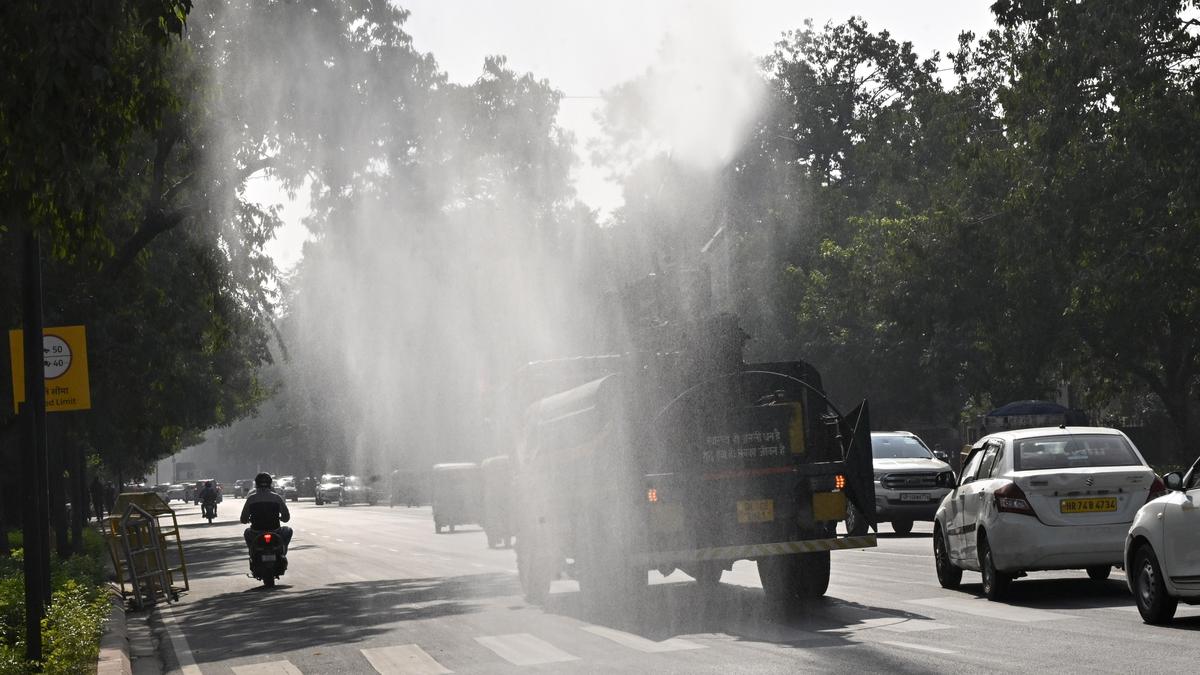
An anti smog gun sprinkles water on roads and pavements to reduce dust and air pollution and improve air quality, in Delhi on December 10, 0225.
| Photo Credit: Shiv Kumar Pushpakar
The overall air quality of Delhi continued to be in the ‘poor’ category on Wednesday (December 10, 2025) and it is likely to worsen to the ‘very poor’ from Thursday (December 10, 2025), according to official data.
“The air quality is likely to be in the Very Poor category from 11.12.2025 to 13.12.2025. The outlook for the subsequent 6 Days: The air quality is likely to be in the Very Poor category,” said the Central government’s ‘Air Quality Early Warning System for Delhi’.

Delhi’s 24-hour average air quality index (AQI) was 259 (poor) at 4 p.m. on Wednesday (December 10, 2025), slightly down from 282 (poor) a day earlier, as per the Central Pollution Control Board’s (CPCB) daily official bulletin, which is considered as a day’s official AQI. A higher AQI means an increase in air pollution.
An AQI between 51 and 100 is “satisfactory”, 101 and 200 is termed as “moderate”, 201 and 300 “poor”, 301 and 400 “very poor”, and 401 and 500 “severe”, as per the CPCB.

Every winter, air pollution spikes in Delhi-NCR and many parts of the larger Indo-Gangetic Plains (IGP), mainly due to meteorological factors such as lower wind speed and a drop in temperature. And pollution from stubble burning during October-November and bursting of firecrackers worsens it.
‘High dust intensity’
Meanwhile, the Commission for Air Quality Management in the National Capital Region and Adjoining Areas (CAQM) said that 15 out of 79 road stretches maintained by different government authorities were found to have “high dust intensity” during inspections, and authorities have been directed to fix them.

“A total of 79 road stretches were inspected across the roads of the three agencies (Delhi Metro Rail Corporation (DMRC), Delhi State Industrial and Infrastructure Development Corporation (DSIIDC) and Delhi Development Authority (DDA)). Geo-tagged, time-stamped photographs were collected and submitted to the Commission as part of the consolidated inspection report. As per the final compiled data, 15 road stretches exhibited high visible dust levels, 36 showed moderate dust, 22 recorded low dust intensity and 6 stretches were found to have no visible dust,” the CAQM said in a statement.

The Commission said that road dust continues to significantly impact particulate matter levels in Delhi and emphasised the need for strengthened on-ground action, including regular mechanical sweeping, timely disposal of collected dust, maintenance of road shoulders and central verges in addition to deployment of water-sprinkling or dust-suppression systems across all stretches maintained by these agencies.
The Chief Minister’s Office (CMO) said in a statement that CM Rekha Gupta and the entire Cabinet are working in “action mode” to provide relief to the city’s residents.

“Following the directions of the Chief Minister, the Delhi Pollution Control Committee (Environment Department) has issued three strict orders aimed at effectively curbing air pollution and controlling dust across the capital. These include stringent prohibitions as well as penalties. The orders impose a strict ban on the use of coal and wood in tandoors, prohibit roadside storage, sale and transportation of construction materials, and mandate immediate fines for open burning of waste and other materials,” the CMO said in a statement.
Most of these measures are already recommended by the CAQM as part of the Graded Response Action Plan (GRAP), a set of short-term emergency measures to control air pollution
Published – December 11, 2025 07:21 am IST