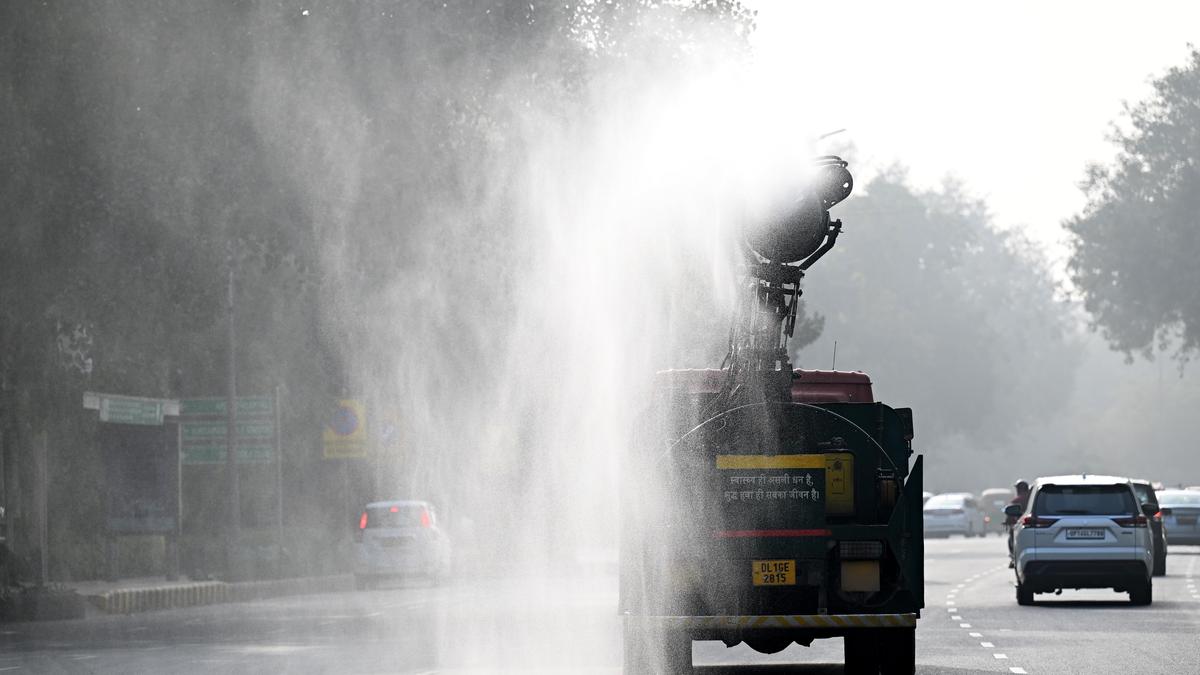
An anti-smog gun is being used to sprinkle water to curb pollution in New Delhi. File
| Photo Credit: Shashi Shekhar Kashyap
Delhi continued to grapple with a severe air pollution crisis on Sunday (January 18, 2026) morning as air quality in the national capital remained in the ‘severe’ category, with the Air Quality Index (AQI) recorded at 439 at 7 a.m., according to data released by the Central Pollution Control Board (CPCB).

The situation worsened overnight, with the AQI recorded at 432 at 10 p.m. on Saturday (January 17), placing it in the ‘severe’ category, before deteriorating further by early Sunday morning.
The persistent high pollution levels have raised serious health concerns, particularly for children, the elderly and people suffering from respiratory and cardiovascular ailments.
Also Read | Dense fog blankets New Delhi; air quality index at 376
Several areas across the city reported alarmingly high pollution levels, reflecting the widespread nature of the pollution crisis. Anand Vihar recorded an AQI of 489, Ashok Vihar 463, Bawana 467, Chandni Chowk 464, Dwarka Sector 8 469, ITO 448, Narela 412, Punjabi Bagh 476, RK Puram 467 and Wazirpur 478.
All these locations fell under the ‘severe’ category, indicating extremely poor air quality and heightened health risks.
As per AQI classification, a reading between 0 and 50 is ‘good’, 51 to 100 ‘satisfactory’, 101 to 200 ‘moderate’, 201 to 300 ‘poor’, 301 to 400 ‘very poor’ and 401 to 500 ‘severe’.
Furthermore, visibility across the city remained poor as cold wave conditions continued and dense fog covered large parts of Delhi.
The India Meteorological Department (IMD) reported that dense fog persisted in the morning hours, with moderate fog observed at several locations and dense fog at isolated spots.
Minimum temperatures on Sunday (December 18) hovered between 5 and 7°C, remaining below normal by 1.6 to 3°C. In response to the deteriorating air quality, the Commission for Air Quality Management (CAQM) on Saturday (December 17) reinvoked Stage-IV measures under the Graded Response Action Plan (GRAP) across Delhi and the National Capital Region (NCR).
“Keeping in view the prevailing trend of air quality and relevant factors and in an effort to prevent further deterioration of air quality in the region, the CAQM Sub-Committee on GRAP unanimously decides to invoke all actions as envisaged under Stage-IV of the extant GRAP – ‘Severe+’ Air Quality (DELHI AQI > 450), with immediate effect, in the entire NCR, as a proactive measure.
This is in addition to the actions under Stages I, II & III of the extant GRAP already in force in NCR,” the order from the CAQM read.The order further added, “NCR Pollution Control Boards and other agencies concerned have been asked to escalate the preventive measures to prevent further deterioration of air quality in the region.”With severe pollution, cold wave and dense fog persisting, authorities have urged citizens to limit outdoor activities, follow health advisories, and take precautions against the hazardous air quality.
Published – January 18, 2026 08:58 am IST