The Delhi government on Monday launched a drive to identify polluting industries and units, Environment Minister Manjinder Singh Sirsa said, adding that establishments found violating norms will be sealed promptly. “The Delhi government’s mission to clean city air allows no room for complacency. Units found violating air pollution norms will be sealed immediately without further notice. We will not spare any industry found polluting the environment,” he said.
The Municipal Corporation of Delhi (MCD) and the Delhi Pollution Control Committee (DPCC) are working to identify illegal and unauthorised industrial units, he said.
Later in the day, he said in a post on X: “DPCC inspected 2,688 industries in notified and redevelopment industrial areas, out of which 411 units were found to be spreading pollution, and orders for their immediate closure have been issued.”
This is in addition to the action being taken by the MCD, Mr. Sirsa added.
The drive to identify and shut down polluting industries is part of the government’s ongoing efforts to ensure compliance with the heightened anti-pollution measures under Stage IV of the Graded Response Action Plan announced by the Centre on December 13.
‘Efforts paying off’
Sharing details about the impact of the order to deny fuel to vehicles without valid pollution under control (PUC) certificates, which came into force on December 18, the Minister said over 2 lakh vehicles underwent the PUC test, of which 10,000 failed to meet the standards. “This clearly indicates that the enforcement measures are being implemented seriously and that they are yielding results,” he said.
All PUC certificate-issuing centres, which are over 15 years old, are being rehauled and equipped with modern, high‑capacity equipment to reduce delays and ensure accurate emission testing, said Mr. Sirsa, adding that a third‑party audit mechanism is also being introduced to strengthen credibility and transparency in certification.
“Teams from the Transport Department are conducting continuous monitoring to prevent malpractice at the centres,” he said.
To tackle dust, he said that roads are being washed and cleaned 24×7 and large‑scale biomining operations are under way at landfills with nearly 35,000 metric tonnes of waste being processed and removed daily as part of the government initiative to dismantle legacy garbage mounds.
Jibe at AAP
The Minister took potshots at former Chief Minister and Aam Aadmi Party (AAP) national convener Arvind Kejriwal, accusing him of indulging in “political tourism” while staying away from the “real issues of Delhi”.
“Those who ruled Delhi for 10 years and left behind a legacy of pollution, mismanagement, and corruption now appear in the city only for photo opportunities and movie screenings. They have no moral authority to speak on Delhi’s environment when they abandoned its people in crisis,” Mr. Sirsa said.
‘Poor’ air days ahead
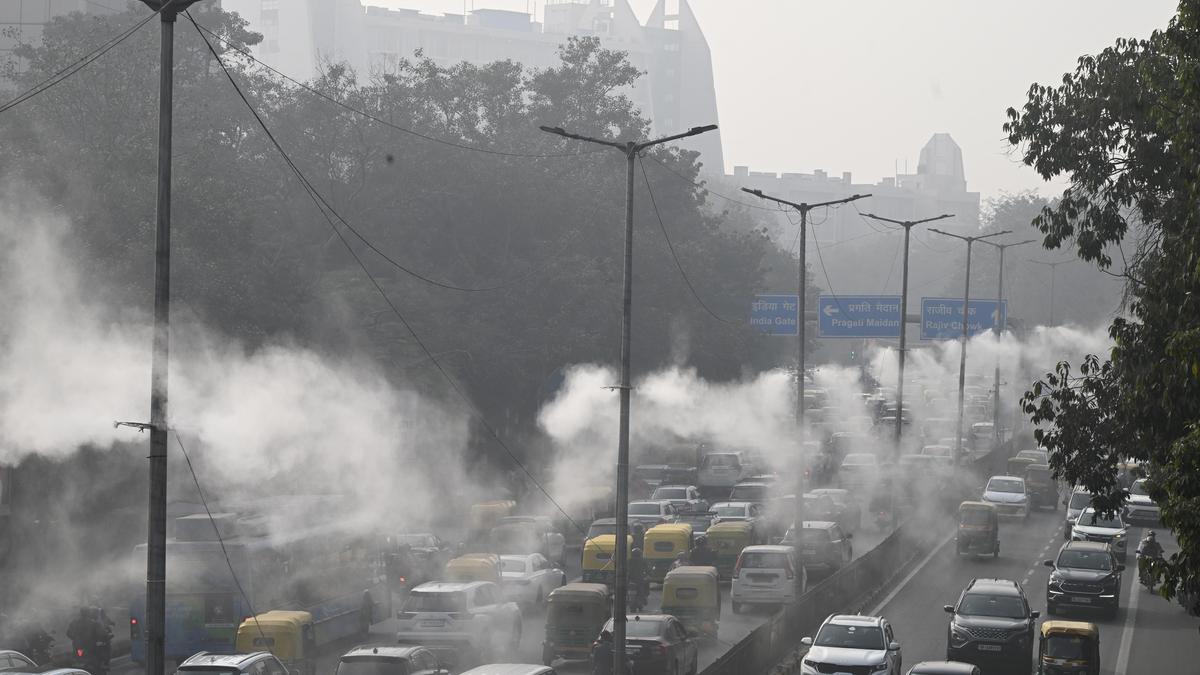
Delhi registered ‘very poor’ category air on Monday. The quality is unlikely to change over the next six days, as per the Central government’s Air Quality Early Warning System for Delhi.
The Capital’s 24-hour average air quality index (AQI) was 373 (‘very poor’) at 4 p.m. on Monday, slightly down from 377 (‘very poor’) a day earlier, as per the Central Pollution Control Board’s official bulletin.
AQI is a measurement of air pollution on a scale of 0-500. A higher value suggests an increase in toxicity. An AQI reading between 201 and 300 is considered ‘poor’, 301 and 400 ‘very poor’, 401 and 450 ‘severe’, and 451 and 500 ‘severe plus’.
Every winter, air pollution spikes in Delhi-NCR and many parts of the larger Indo-Gangetic plains, mainly due to meteorological factors such as lower wind speeds and a drop in temperature. Pollution from stubble burning during October and November and bursting of firecrackers during the festive season worsen air quality and add to the emissions from vehicles and dust.
Pollution-free mobility
Meanwhile, CM Rekha Gupta held a review meeting on air pollution and said that to promote pollution-free mobility through private-sector participation, the Delhi government will soon initiate discussions with companies such as Ola and Uber.
“The proposal aims to explore the operation of pooled and shared electric or non-polluting buses in the Delhi–NCR region. Such initiatives are expected to reduce dependence on private vehicles and strengthen environment-friendly public transport,” read the statement from the Chief Minister’s Office (CMO).
The statement added that the unregulated movement of e-rickshaws has emerged as a major cause of traffic congestion, leading to higher fuel consumption and increased pollution. To address this issue, the government will issue comprehensive new guidelines to regulate the operational areas and routes of e-rickshaws, ensuring smoother traffic flow and better road management.
Ms Gupta said that the government has also decided to rationalise DTC bus routes so that services reach every area and neighbourhood of Delhi. “Scientific and rational route planning will improve last-mile connectivity and encourage citizens to opt for public transport instead of private vehicles,” the statement added.
Published – December 23, 2025 01:18 am IST