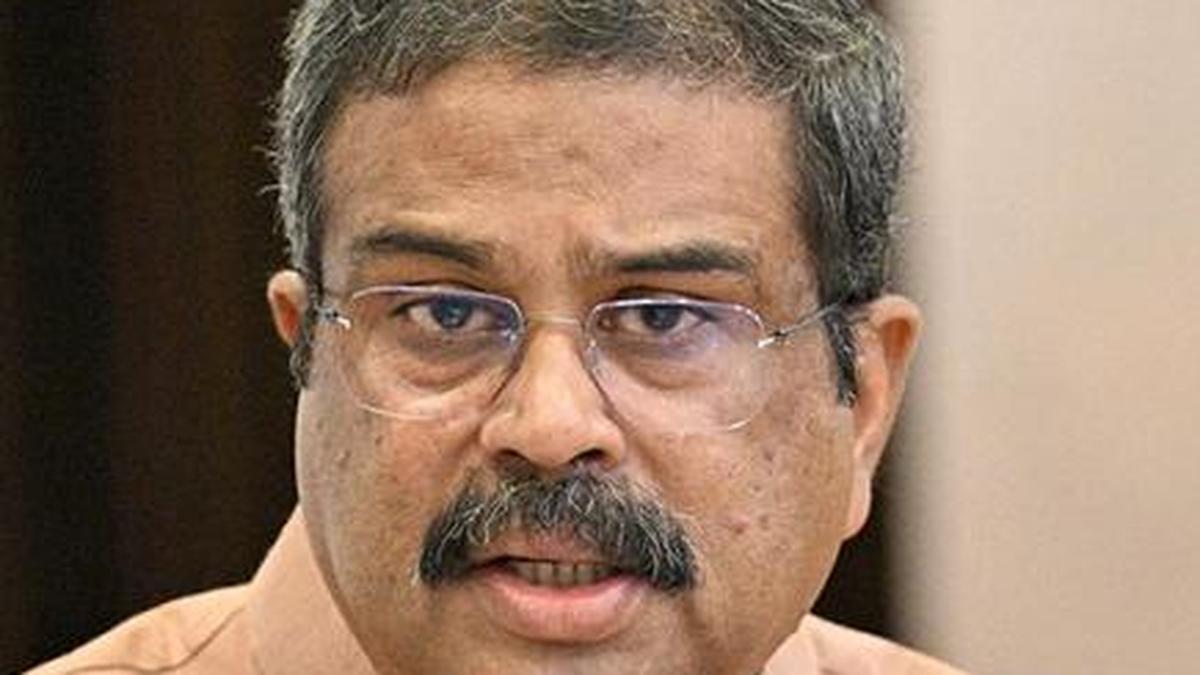

Union Education Minister Dharmendra Pradhan. File
Union Education Minister Dharmendra Pradhan on Tuesday (January 13, 2026) called for premier technological institutions across India to come under the Centre’s national accreditation framework. Mr. Pradhan was speaking at the 13th meeting of the Council of National Institutes of Technology, Science Education, and Research (NITSER), with a focus on aligning curricula with national priorities. The discussions also revolved around “360 degree PhD reforms”.
“Our curriculum must be aligned to national priorities. Our PhD programmes must be industry-centric,” the Minister said, suggesting industry-led curriculum committees for preparing curricula based on new and emerging job roles and 21st century needs.
The NITSER is the supreme governing council of the 31 National Institutes of Technology (NITs); the Indian Institute of Engineering Science and Technology (IIEST) at Shibpur, West Bengal; and Indian Institutes of Science Education and Research (IISERs).
At the meeting of the Council in New Delhi, Mr. Pradhan emphasised the need for top technological institutes of the country to be brought under the national accreditation framework, also noting that the NITs and IIESTs were “poised to serve as vibrant hubs of applied education research, innovation, and future-ready workforce development”.
A statement from the government said that all NITs and IISERs would complete their external peer review in one year, and agreed on “the importance of accreditation as a key quality assurance mechanism — with the institutions resolving to actively participate in the national accreditation framework (the National Assessment and Accreditation Council or NAAC)”.
While top technological institutes appear in different national and international ranking frameworks, often quite high, institutions such as the Indian Institutes of Techonology (IITs) and several NITs do not have accreditation from the NAAC.
“Reviewed presentations on elevating academic and research standards, enhancing governance efficiency and further boosting innovation and entrepreneurship at our NITs and IIESTs. Also, discussed the way forward,” Mr. Pradhan said in a post on social media.
The meeting of the Council discussed various measures suggested over the curriculum, innovation at the institutes, and the promotion of “inclusivity through the use of Bharatiya Bhashas and adopting artificial intelligence for multilingual learning”, according to a statement from the Education Ministry.
The Ministry said that the Council discussed aligning the curricula, assessment, and academic programmes and research with critical and emerging technologies, including, “Industry 4.0, green hydrogen, manufacturing, artificial intelligence, data analytics, cybersecurity, quantum technologies, and semiconductors”. Specialised postgraduate or M.Tech programmes aligned with specific industry requirements were also discussed.
The meeting also spoke of “360 degree PhD reforms”, which would include “industry-led and industry-funded PhDs”, “product-based PhDs”, and “PhD assignment to faculty based on their performance”, according to the government’s statement.
At the meeting, there was a call for setting up incubation centres at 13 NITs that do not yet have one, along with the call for 10 NITs to “immediately set up” research parks, and plan for a pitching conclave to be held in July this year for start-ups incubated in NITs in collaboration with investors and industry stakeholders.
The meeting of the NITSER was attended by top officials of the government from the Education Ministry, the Science and Technology Ministry, Directors of top technology and science research institutes across the country, along with Prof. Anil D. Sahasrabuddhe, Chairman, Executive Committee of the NAAC, and former University Grants Commission Chairperson Prof. M. Jagadesh Kumar.
Published – January 13, 2026 09:19 pm IST


