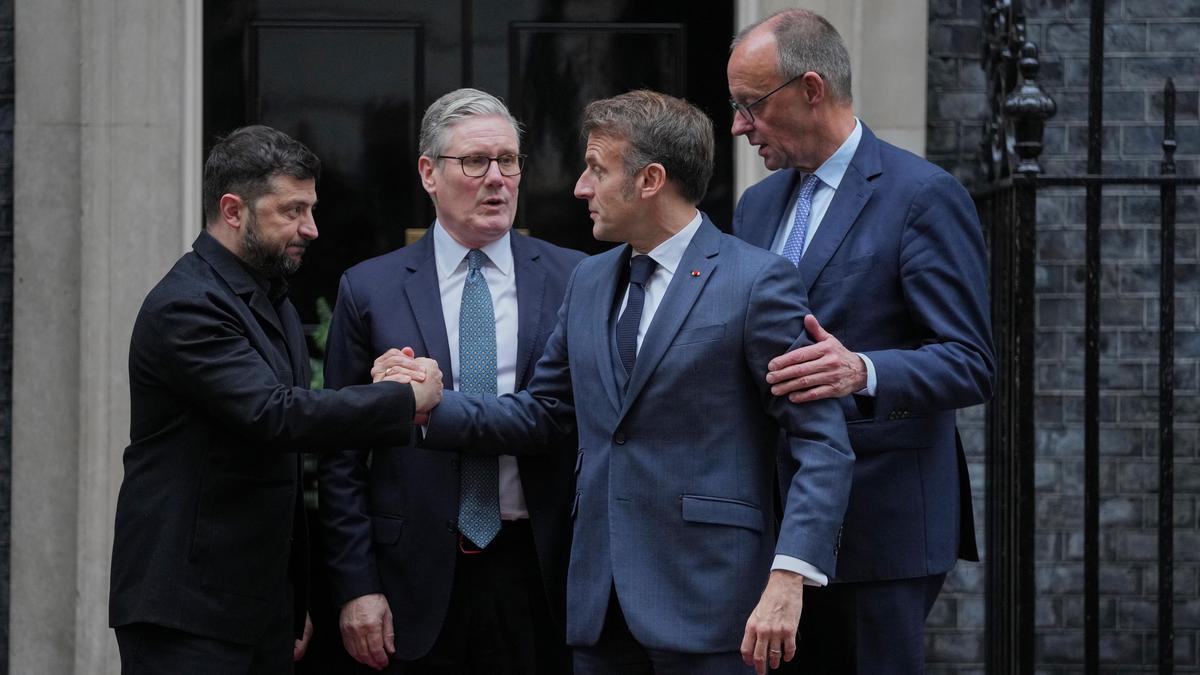
While Germany, Europe’s largest economy and Britain and France have pledged to raise their military assistance for Ukraine in 2026, Italy has scaled back its contribution.
| Photo Credit: AP
On October 23, European Union leaders pledged to finance Ukraine for the next two years. But that immediately raised a pressing question: where would the money come from? EU leaders will meet in Brussels on December 18, where they are expected to take a final decision.

Most EU governments are already grappling with high public debt. Raising more funds from financial markets would be both economically burdensome and politically unpopular.

Since Russia invaded Ukraine in February 2022, EU governments have spent roughly $230 billion on assistance. Last year, the bloc raised $54 billion for Ukraine using its budget as collateral. But the loan appeared as additional debt on the EU’s books. Any new loan would add to the EU’s collective debt burden, worsening the bloc’s borrowing position. Moreover, new market borrowing requires unanimous approval from all 27 member states. Hungarian Prime Minister Viktor Orban has already ruled it out.

Individual European countries, meanwhile, are showing signs of hesitation. While Germany, Europe’s largest economy and Britain and France have pledged to raise their military assistance for Ukraine in 2026, Italy has scaled back its contribution. Spain, which provided $1.2 billion to Ukraine in 2025, has made no commitment for the year ahead.

With limited options, Europe has turned to the $244 billion in frozen Russian assets held in the continent. The proposal is to use these assets to fund a $104 billion loan to Ukraine that would be disbursed in the next two years. For the scheme to work, the Russian assets must be immobilised indefinitely, rather than the temporary freezing enforced currently. Once the war ends, it would be up to Ukraine, which is seeking reparations from Russia, for repaying the loan. Ukraine has welcomed the proposal, while Russian leader Vladimir Putin has warned against the “EU theft”.

But there are two major problems. First, almost all of the frozen Russian assets are held in Euroclear, the central securities depository in Belgium. Brussels has opposed the EU’s plan, citing legal and financial risks. Belgium fears it would get embroiled in legal troubles if Russia retaliates or if sanctions are lifted. It demands guarantees that other EU members share any potential costs. Second, the Trump administration of the U.S. also opposes the EU approach. According to Donald Trump’s 28-point peace plan, the frozen Russian assets should go into a joint investment fund for Ukraine’s reconstruction, once a peace deal is clinched.
Europe, sidelined from the peace process by the U.S., opposes the Trump plan. In marathon meetings held in Geneva and London in recent weeks, European leaders reiterated their commitment to support Ukraine. But Kyiv is running out of money, and Europe is struggling to raise more. That leaves Europe with the frozen Russian assets. If Europe immobilises the assets permanently and uses it to fund Ukraine, it risks enhancing tensions with Russia and deepening rifts with Washington. Such a move would also raise questions about the safety of parking reserves in the euro. But if it doesn’t do that, Ukraine, which is already losing ground on the battlefield, would be in deep peril. There are no good options for the EU’s leaders.
Published – December 11, 2025 06:17 pm IST