We met but rarely, and I have no business writing about her when others who knew Geeta Doctor can do so with credentials I cannot lay claim to.
But when, at the start of January 2026, I was asked to write something about her, I could not understand why. I had not heard that she had passed away. And on the last day of the last month of last year. Ayyo, I said. Ayyo, ayyo.

Geeta would have understood. She knew inner lives, inner feelings. She has been described as a writer, journalist, which of course she was. But Geeta was to me a person who knew, who felt, who was real.
In the beginning of 2025, when she was unable to join my wife and me over dinner at our home, she sent a message saying she had mobility issues and so was sending flowers to represent her. And what a bouquet she sent! It was the most beautiful we have ever received anywhere, and stayed unwilted for days. I sent her a picture of the flowers looking resplendent in a vase and she was delighted.
Better after a while, she began going out again, and the last time I saw her towards the end of April last year, she reminisced about her younger days. Her father was posted in the High Commission of India in Karachi, then the capital of Pakistan. Geeta vividly remembered the occasion when, on December 19, 1960, Prime Minister Jawaharlal Nehru and Pakistan’s President Ayub Khan signed the Indus Water Treaty. She described Nehru as looking ‘luminous’ and his words explaining the Treaty as ‘lyrical’. There are those who today would regard that as an instance of Nehru’s idealistic, visionary, un-pragmatic temper, and say ‘lyrical indeed, that was downright naïve of him’. Geeta would demur. Rivers and their waters have a natural course, as does neighbourliness. Terrorism has mutilated that for us.
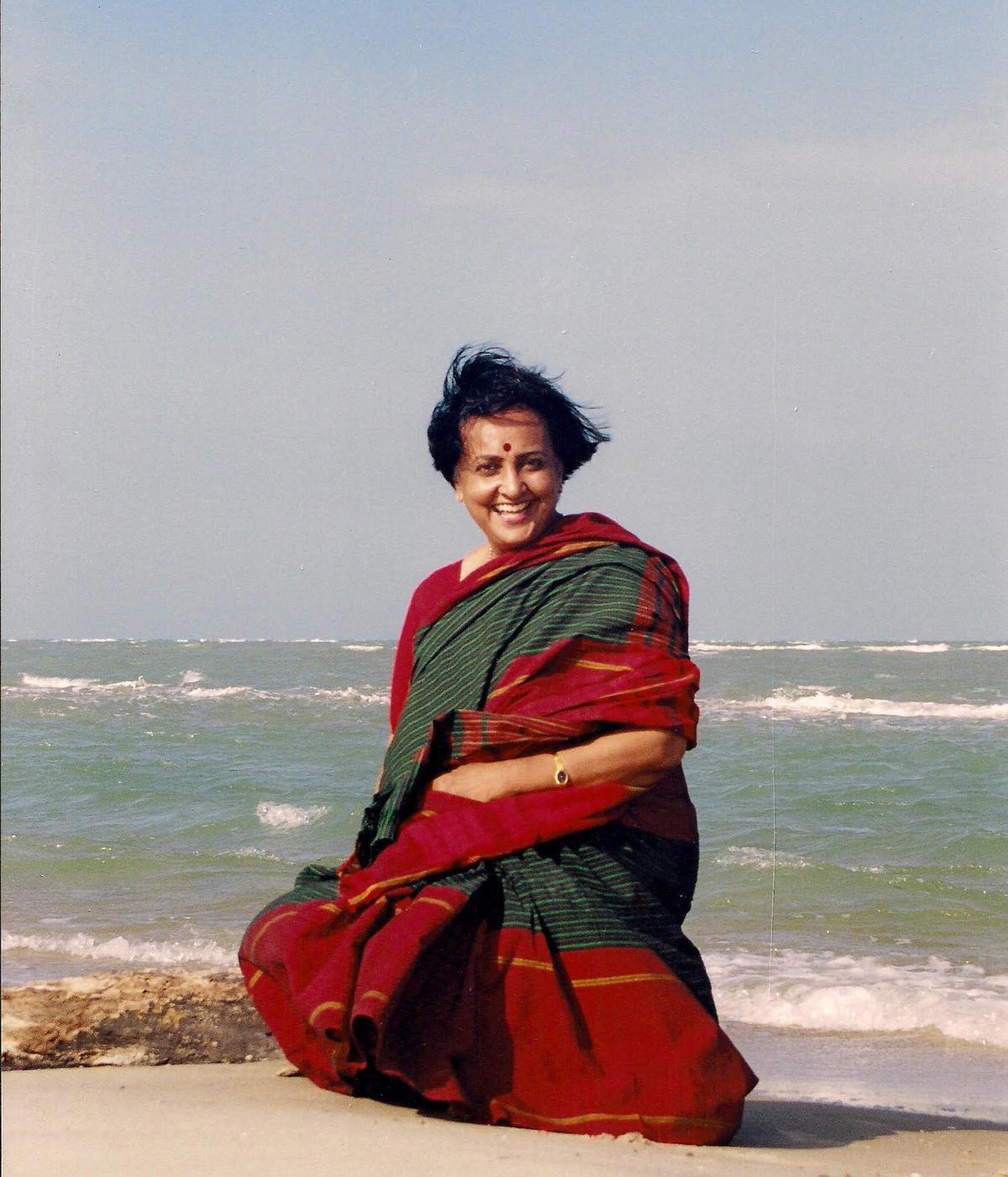
Geeta Doctor at Dhanushkodi
| Photo Credit:
Special arrangement
Posted earlier at the Indian embassy in Paris, her father gave Geeta and her sister Manjula a different set of experiences which included hosting visitors from India. Many came. Geeta wrote to me about those who came: “Everyone did, the Maharanis and princesses almost by custom and tradition. Many years later, I met one of the Jodhpur princesses who had also been to Paris at the time, she too was unmarried but determined to have a good time at the Races. The Sardar Maliks, the Indian Ambassador (early 1950s), at the time was formerly attached to one of the princely courts, maybe Kapurthala, so had links with all the Indian princes and royalty like Dinesh Singh, who I think was the cultural attaché, or maybe just a PA to the Ambassador. The other woman I recall my Dad telling us about was Dr. Sushila Nayar (Pyarelal’s sister). She turned up without proper papers like a visa or maybe not even a passport. Our Dad said she covered herself with her saree pallav at the airport and refused to move, or be questioned, until the Embassy had to intervene and rescue her.”
That was satyagraha, no less. That it was not conducted for a public cause is a matter of detail. And doubtless Sushila Nayar, personal physician to Mahatma Gandhi, would have her side of the story to relate.
Geeta was turning to humour from the caves of sadness. Not long before the end, she wrote to me in a mail on living long: “Since now I am in my 80s, I find many of my contemporaries, or those a little older, are in a similar state of limbo. There are now three hospitals that specialise in knee replacement surgeries and other forms of treatment for mobility issues. And the Apollo group has opened a special unit to assess what a person needs to avoid surgical procedures related to mobility. As you know, spas and wellness modules in remote places — one, believe it or not, in Karaikudi — are in vogue. These are being serviced by young people from the Northeast. Our Kerala nurses are for export. There’s a very weird Prime television series called Nine Perfect Strangers that serves as a spin-off on the trend. Again, ageing adults are being cared for by the young, for a price. I prefer to imagine that the old Eskimo solution that allowed Grandma to be left on a remote ice floe to be consumed by the wildlife or the elements was a better option. But with the ice melting so rapidly, even that is no longer viable.”
In her very last mail to me, Geeta sent me this verse:
On Mystics
What is to be done, O Muslims? For I do not recognize myself.
I am neither Christian nor Jew nor Zoroastrian nor Muslim.
I am not of the East, nor of the West, nor of the land, nor of the sea;
I am not of Nature’s mint, nor of the circling heavens.
I am not of earth, nor of water, nor of air, nor of fire;
I am not of the empyrean, nor of the dust, nor of existence, nor of entity.
I am not of India, nor of China, nor of Bulgaria, nor of Saqsin;
I am not of the Kingdom of Iraquain, nor of the country of Khora-san.
I am not of this world, nor of the next, nor of Paradise nor of Hell.
I am not of Adam, nor of Eve, nor of Eden and Rizwan.
My place is the Placeless, my trace is the Traceless;
’Tis neither body nor soul, for I belong to the soul of the Beloved.
I have put duality away. I have seen that the two worlds are one;
One I seek, One I know, One I see, One I call.
He is the first, He is the last, He is the outward, He is the inward.
I know none other than “Ya Hu”1 and “Ya man Hu.”
I am intoxicated with Love’s cup, the two worlds have passed out of my ken.
(These letters in Arabic spell the Hebrew name of God.)
— From the lessons of Shunryu Suzuki, Zen master (1904-1971)
This was pure Advaita that Geeta was sharing with me, via a Zen master. There was something very Zen about her. Beneath her amazing smile, her laughter and her checked tears, there was something very mystical, placeless, timeless.
The writer is a former administrator, diplomat and Governor.