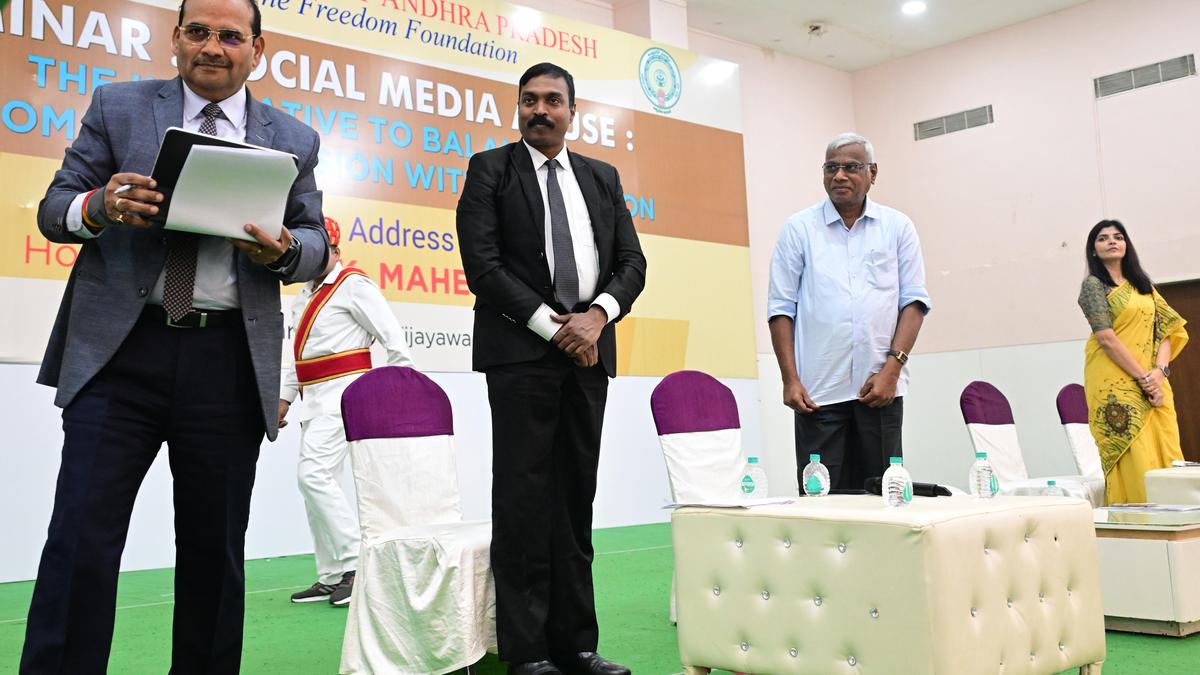
Supreme Court judge Justice J.K. Maheshwari, Inspector General of Police and head of EAGLE Ake Ravi Krishna, C. Raghavachari Media Academy Chairman Alapati Suresh Kumar and Andhra Pradesh Women’s Commission Chairperson Rayapati Sailaja at a seminar in Vijayawada on Saturday.
| Photo Credit: G.N. Rao
Freedom of speech and expression carries responsibility, and what is liberty for one person can become a liability when it causes harm to others, Supreme Court judge Justice J.K. Maheshwari has said.
Addressing students at a seminar on social media abuse and the need to balance freedom of expression with regulation, organised by the C.R. Media Academy of A.P. and Swetcha The Freedom Foundation in Vijayawada on Saturday, Justice Maheshwari, former Chief Justice of the A.P. High Court, said that navigating the space between liberty and liability is not the task of judges and legislators alone, but a shared civic responsibility.
He stressed the need for introspection while exercising freedom on digital platforms. Illustrating the point, he said that if a user posts a harmful video, the user is liable. However, if a platform’s algorithm identifies that the content keeps users angry and engaged and pushes it to a million more feeds to maximise advertisement revenue, the question of moral and legal responsibility becomes more complex.
Justice Maheshwari observed that social media platform owners often prioritise commercial interests over potential harm, making it essential for individuals to act responsibly while using such platforms.
Referring to the Supreme Court judgments in Anuradha Bhasin v. Union of India 2020 and Shreya Singhal v. Union of India 2015, he said there is a clear distinction between offensive speech, harmful speech and illegal speech. The law, he noted, does not step in merely because someone is offended, but intervenes when speech amounts to incitement or violates legal limits.
Inspector General of Police, EAGLE, A.P., Ake Ravikrishna, underlined that debates, satire, reporting and dissent are vital to democracy and must be protected. However, the Constitution does not shield abuse, hate speech or calls to violence, he said.
He cautioned that while complete suppression of online content could prove counter productive, unchecked social media platforms could undermine the very purpose for which they were created. A victim centric response is essential to address instances of online abuse effectively, he added.
A.P. Women’s Commission Chairperson Rayapati Sailaja recalled instances in which women of Amaravati were targeted on digital platforms. She said the government is contemplating a ban on social media access for children below 16 years, clarifying that the objective is not to curb expression but to prevent exploitation.
A.P. Press Academy Chairman Alapati Suresh Kumar told students that social media platforms, which significantly shape opinions and lifestyles, operate primarily for profit rather than public welfare.
Published – February 28, 2026 08:21 pm IST