“Gorgeous!” shouted 12-year-old Nithin from Yelahanka in Bengaluru as he feasted on the majesty of the Gandikota canyon in Kadapa district. Hewed out by the mighty Penna river over aeons, the massive gorge stretched on for as far as his eyes could reach. Nithin’s reaction, however, is not much different from what Gandikota draws from any tourist.
The geological wonder is India’s answer to the Grand Canyon in the U.S. The steep red sandstone cliffs, hemming in the river as it flowed its serpentine course, make both sunrise and sunset a sight to behold. Similarly, historical structures like a fort, a temple and a mosque cast another layer of attraction, especially for those into art, architecture and archaeology.
Kadapa’s history
Kadapa is steeped in history: of rulers, dynasties, empires and human civilisation itself. It speaks through archaeological evidence such as inscriptions and ancient coins as well as philosophy, literature, music and dance. The use of several historical surnames by the residents of Kadapa today hints at the unbroken historical relevance of the region.
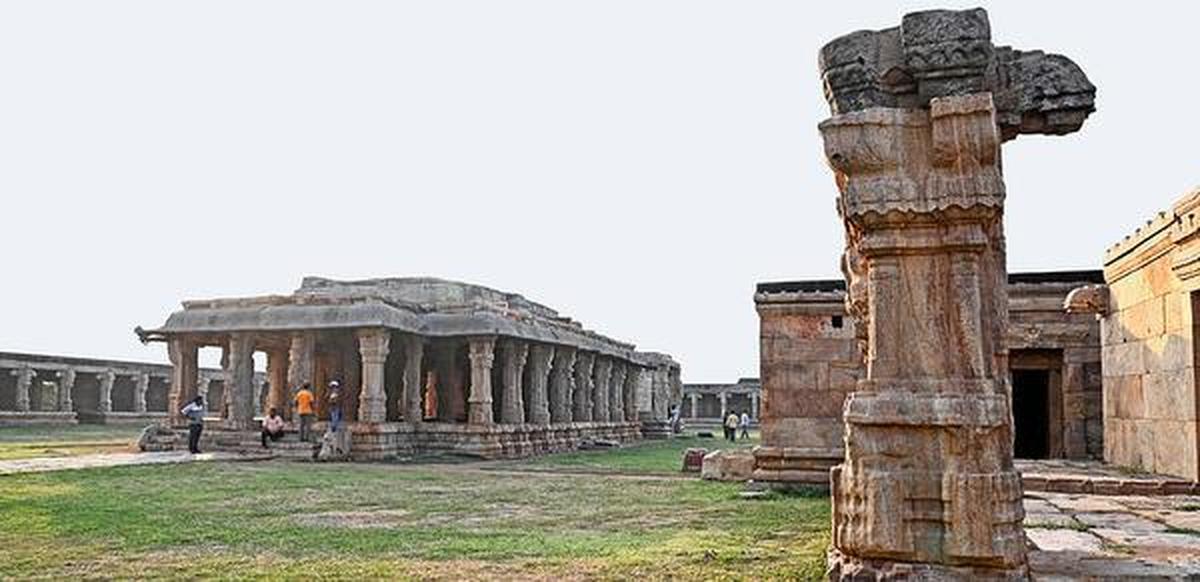
The Madhavaraya temple within the Gandikota fort premises
| Photo Credit:
K.V. Poornachandra Kumar
The district’s cultural heritage, however, is grossly underrated, so much so that rare inscriptions, dilapidated step wells, ramshackle forts continue to be discovered in the district’s hinterland. Mackenzie Kaifiyat (an Arabic term for narration or explanation), a compilation of manuscripts by the first Surveyor-General of India Colonel Colin Mackenzie (1754-1821), throws light on the rich and eventful history of the district.
These details were collected by people appointed by him during 1780-1820 to understand local dialects, cultures and socio-economic conditions of the time. The Kaifiyats of Cuddapah district were published by noted scholar the late Janumaddi Hanumath Sastry, whose centenary year is currently under way.
Pemmasani Nayaks
Gandikota Fort, an imposing 12th century edifice, has withstood the test of time. It was built by the Pemmasani Nayaks, feudatories of the Kakatiya dynasty, using red granite. “Strategic gateways that appear out of nowhere make it hard for enemies to breach the fort. Moreover, the Penna river and the gorge to the north and west act as natural barriers,” observes historian and writer Tavva Obul Reddy, whose book on Gandikota is considered a traveller’s guide.
The fort changed several hands over centuries, withstanding attacks and witnessing the rise and fall of numerous dynasties. Between 14th and 17th centuries, the region flourished under the Vijayanagara empire, when it became a key military outpost. The 17th century saw the fort changing hands to the Qutb Shahi dynasty of Golconda. In the 18th century, the Mughals captured it, and, later, the Kadapa Nawab ruled it. During the British rule in the 19th century, it was under the Madras Presidency. The structures are currently maintained by the Archaeological Survey of India (ASI).
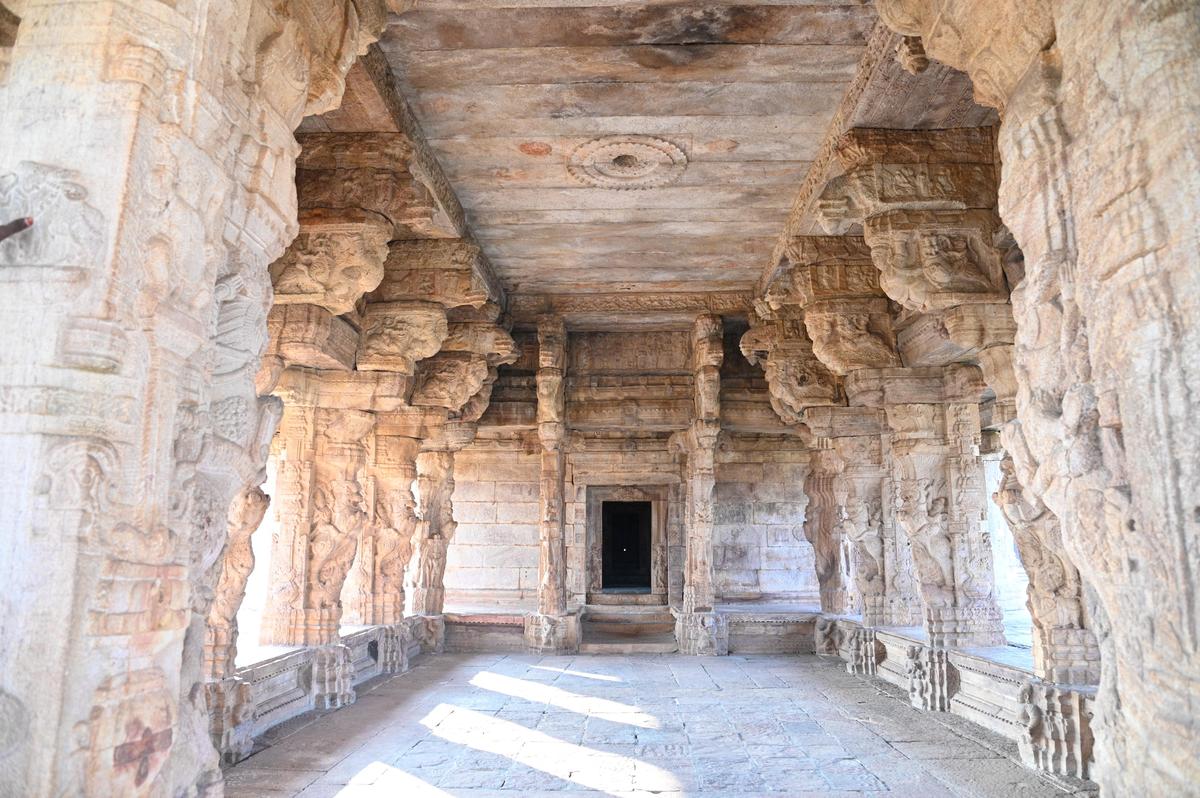
A view of the ornately chiselled ‘Mukha Mandapam’ of Sri Madhavaraya temple located within the Gandikota fort precincts.
| Photo Credit:
K V Poornachandra Kumar
The Madhavaraya temple, the Ranganatha temple, Jama Masjid, granary, jail, step well, King’s palace, Rani Mahal and the gun foundry form an integral part of the fort. The Gandikota village, which depends on tourists for livelihood, also falls within the precincts of the fort walls.
The Madhavaraya temple, built during the reign of Vijayanagara ruler Sri Krishna Devaraya in the 16th century, is an architectural marvel, offering deep insights for connoisseurs of art and history.
The ‘Mukha Mandapa’, the pillared portico, has 24 pillars with ornate carvings and magnificent sculptures of the mythical lion-like creature ‘Yali’, found on the pillars of most Hindu temples in the past. After the Nizam’s forces captured the fort, the idol of Madhavaraya (Krishna) was carefully shifted to the nearby Mydukur town, where a new temple was built later.
The distinctive architectural style of Vijayanagara rulers is once again evident on the Sri Ranganatha temple, dedicated to Lord Maha Vishnu in the reclining posture. Lord Narasimha’s triumph over the demon king Hiranyakasipu is depicted on one of the walls of the temple, which also showcases the ‘Dasavataras’, the ten incarnations of Maha Vishnu.
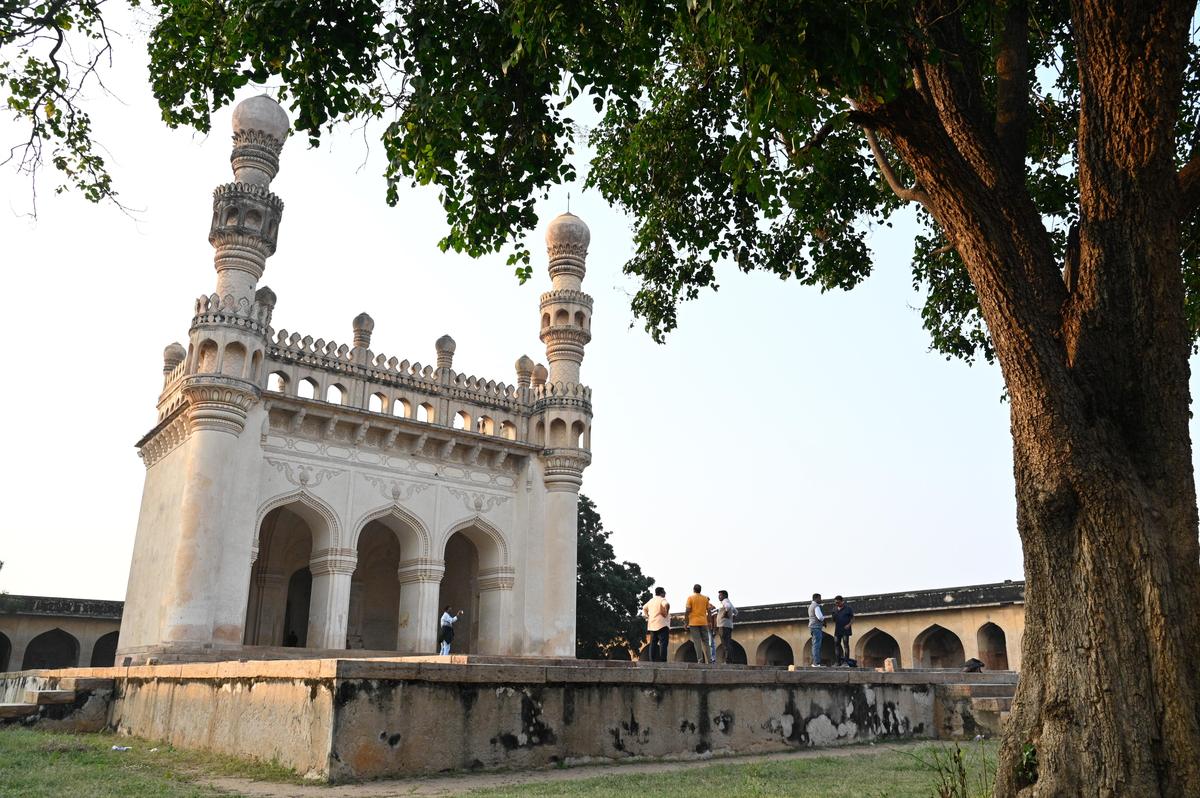
The Jama Masjid within the Gandikota fort precincts.
| Photo Credit:
K.V. Poornachandra Kumar
After conquering the fort, General Mir Jumla built the Jama Masjid in 1650 under patronage from the Qutb Shahi kings. For this reason, the Masjid’s architecture style resonates with the Charminar in Hyderabad, though the former has only two minarets. The expansive courtyard once featured a fountain, which received water from the Rayalacheruvu waterbody via a conduit.
The gun foundry, the granary and a jail reflect the fort’s ability to withstand a siege. Believed to have been built during the Qutb Shahi or the Mughal regime, the three-storey granary features Indo-Islamic architectural style and is supported by two rows of twelve huge pillars. Constructed at such a high elevation and inside a fort, the granary kept heat, moisture and pests away from the massive quantities of grains it held in its heyday.
Tourist footfall
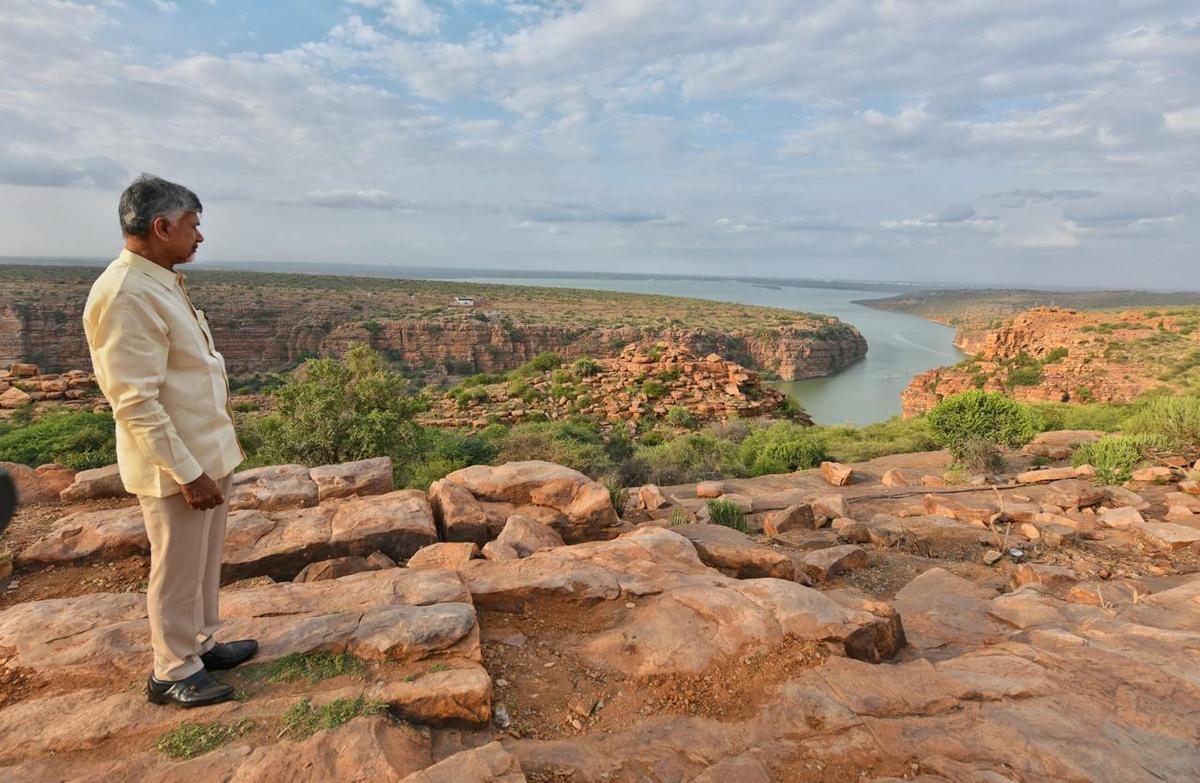
Chief Minister Nara Chandrababu Naidu at Gandikota
| Photo Credit:
Special Arrangement
Today, visitors from Chennai, Bengaluru and Hyderabad flock to Gandikota. Residents of Bengaluru, around 300 km away, find it a promising weekend getaway, followed by those in Hyderabad and Chennai, both approximately 380 km away.
Since the famed temple city of Tirupati is around 225 km away, devotees coming from far-off places can combine pilgrimage with adventure, by adding Gandikota to their itinerary. The spot generally witnesses significant footfall during weekends, which touches up to 3,000 a day.
According to government sources, average daily footfall in 2023 was 830 visitors per day. The Department of Tourism has set for itself an ambitious target of attracting 1,920 visitors a day by 2027 and enhance it to 3,288 visitors a day by 2035.
The government led by Chief Minister N. Chandrababu Naidu recently launched a series of development projects and held a meeting in Gandikota to discuss ways to improve infrastructure under Special Assistance to States for Capital Investment (SASCI) scheme.
The SASCI’s Gandikota master plan contemplates construction of star hotels, gorge illumination, sound and light show, pathway around the monuments, a solar power system, a heritage trail, viewing points and a stepped promenade at the gorge viewpoint, an amphitheatre and a boating jetty.
A tent city will be developed soon to make the tourists spend the night. According to Kadapa District Collector Sridhar Cherukuri, a helicopter-ride to view the gorge from the sky and deployment of caravans for tourists are also on the anvil.
Challenges galore
The place currently lacks designated viewpoints, pathways and guidance for visitors. Access points are unsafe, and visitors embark on a risky trek up to the view point. It also lacks adequate information boards, drinking water facilities, public toilets and garbage bins. Visitors littering even heritage spots is also a cause of concern. The spot has also witnessed an unregulated mushrooming of private resorts that encash on the weekend rush.