V. Menaka, a 29-year-old mother, wasn’t entirely aware that her two-year-old son was not as active as other children his age. “He used to keep to himself, wasn’t very playful, and always stayed close to me. But I thought that was normal,” she said. However, her perspective changed when workers from the Bala Mandir Research and Resource Centre’s (BMRRC) Early Childhood Care and Development and Education (ECCDE) programme visited her.
“The staff briefed me about brain development and how crucial the early years are for a child to mingle and play with others. They told me there are various ways to help a child grow and learn, and that both my role as a parent and the role of the community are very important. They also explained the importance of enrolling my child in the anganwadi,” she said.

Ms. Menaka, a resident of Lachivakkam in Tiruvallur district, said that months later she witnessed her son playing with other children at the anganwadi, which made her very happy. The child, who is now six years old, has been enrolled in Class 1 at a private school and is thriving. “He now makes friends so easily and is eager to go to school,” she added.
Ms. Menaka’s sentiments were echoed by other parents who have benefited from the research centre’s ECCDE programme. Initiated in 2014 in five villages in Gummidipoondi, with assistance from Michelin Tyres, the programme sought to raise awareness among parents about child and brain development.
“At the outset, anganwadis existed primarily as centres for nutrition for pregnant and lactating mothers. Later, the concept of early childhood care and development was introduced. Rural residents were initially hesitant to send their children there,” said Bindu R., director, BMRRC.

The ECCDE programme discusses brain development, noting that 25% of it occurs at birth and the remaining development takes place during the first six years of a child’s life. “We need to make use of this small window for the child’s development,” she added.
“A needs assessment was conducted in 2014, as anganwadi workers were overworked. Later, in association with the Integrated Child Development Services, we trained staff to work with anganwadi teachers to ensure that children are adequately stimulated,” Ms. Bindu said.
The BMRRC also developed training and introductory materials for staff as well as parents. The materials briefed parents on the concept of SPRUC – namely, sense of self, physical development, relationships, understanding, and communication. The activities and developmental needs change as a child grows, and the material outlines the kinds of activities parents can take up to engage the child – from building self-confidence to encouraging outdoor play and responsibility.

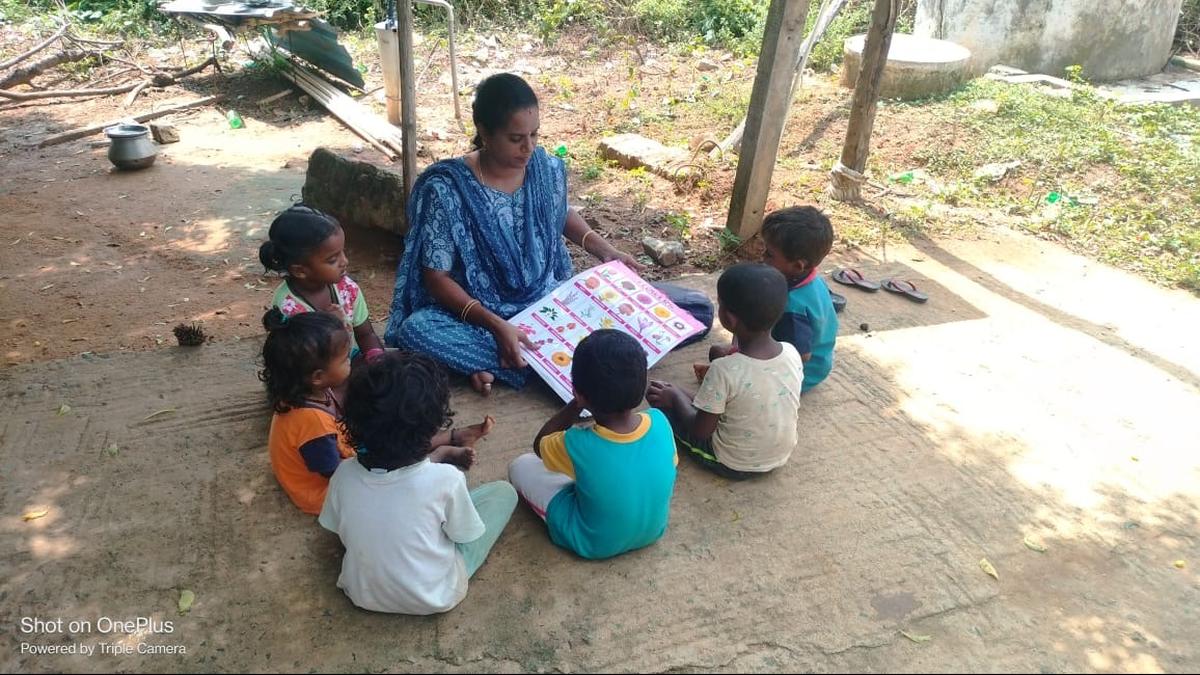
The staff, who are usually women from local villages, are trained in these concepts. They conduct activities at anganwadis in line with the curriculum. Further, during home visits, they interact with pregnant women and their families about the need to keep expectant mothers happy, provide them with nutritious food, and ensure regular check-ups.
“The staff explain to parents what child and brain development are. Parents often don’t understand how important it is to spend time with their children and engage them in simple activities. Everybody knows what to do with children, but they don’t always know why they are doing it, why it is important, or how it contributes to a child’s development,” said Ms. Bindu.
The programme personnel train anganwadi staff in the mornings and afternoons and conduct door-to-door visits for non-anganwadi children, their parents, pregnant women, postnatal mothers, and others caring for children. Additionally, community programmes are held every three months, along with parenting sessions conducted with women’s self-help groups.

Today, the programme has expanded to 134 villages in Gummidipoondi and Ellapuram blocks, Tiruvallur. Over 2,500 parents and caregivers are supported each year, and as many as 132 women staff members have been employed in these villages.
An anganwadi teacher from Lachivakkam noted that admissions to her centre have increased recently. “It has been great to have more help in teaching the children,” she said, referring to the ECCDE staff. “Even if we are called for duty elsewhere, we are at peace knowing that the children’s education is not disrupted. We can also complete our administrative duties, and there is greater community support now,” she added.
Published – January 27, 2026 02:34 pm IST