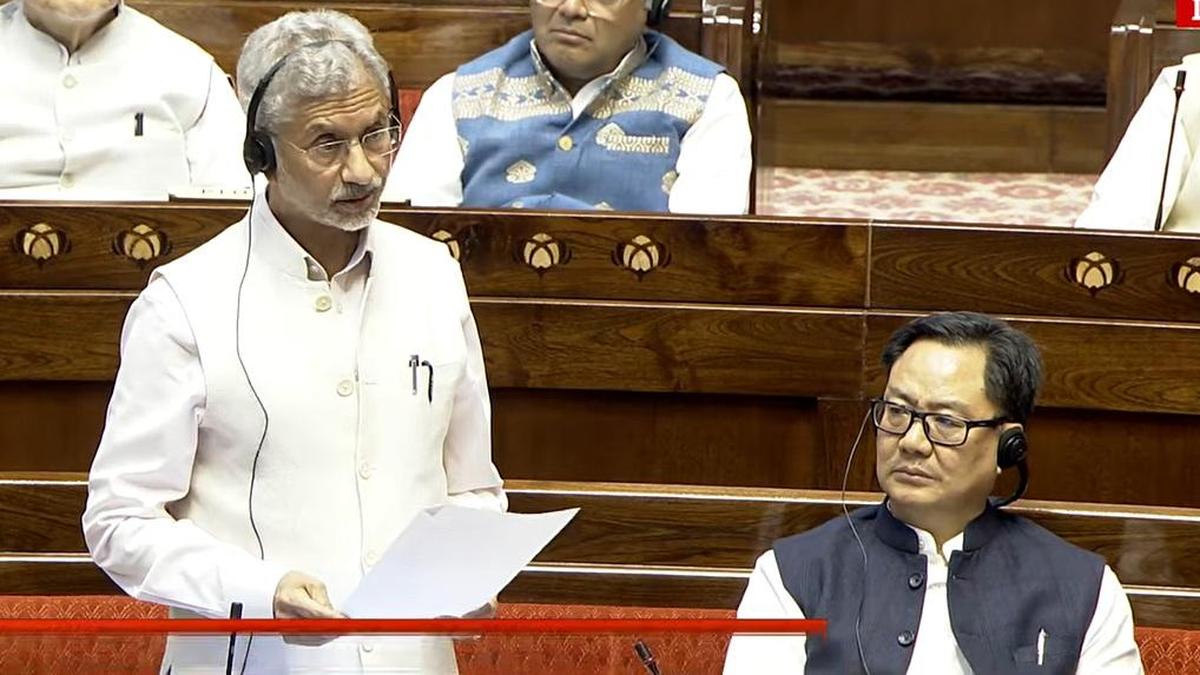
Speaking on the developments in West Asia, External Affairs Minister S. Jaishankar on Monday (March 9, 2026) said India remains in favour of peace, return to dialogue and diplomacy. India also advocates de-escalation, restraint, and ensuring safety of civilians, he said.
Parliament Budget Session: Follow LIVE updates on March 9, 2026
Mr. Jaishankar, who was making a suo moto statement on the conflict in Rajya Sabha and the Lok Sabha on Monday, said the developments in West Asia are a deep cause for concern for all of us, saying the government continues to believe dialogue and discussion should be used to resolve all issues. “It is also imperative that the sovereignty and territorial integrity of all states in the region be respected,” he said.
Follow | Israel-Iran war LIVE
He added that the well being and security of the Indian community in the region remains the government’s priority.
The External Affairs Minister said Prime Minister Narendra Modi continues to closely monitor the developments in West Asia. “The government has been assessing situation in West Asia continuously since the conflict broke out,” he said adding that the Cabinet Committee on Security, chaired by Mr. Modi, was concerned of the regional conflict and the difficulties faced by Indians in the region and Indian travellers.
The region is important for energy security, oil and gas supply, and the Gulf region is a major trading partner for India, accounting for almost $200 billion annually, Mr. Jaishankar noted. “The committee focused on the implications for regional security and for economic and commercial activities,” he said.
The Minister said attacks on merchant shipping have affected Indian seafarers, with casualties reported and one Indian mariner still missing. Mr. Jaishankar said the government had issued a series of travel advisories since January, urging Indian nationals to avoid non-essential travel to Iran and advising those already there to remain in contact with the Indian embassy and follow safety precautions.
Mr. Jaishankar said this war is of particular concern to India. “There are almost one crore Indian citizens who live and work in the Gulf nations and in Iran too, there are a few thousand Indians, who are there for study and employment. Every effort is being made to bring back Indians stuck in West Asia,” he said.

India has spoken to the Heads of State of all countries in the region, Mr. Jaishankar said. The government has received assurances about the well being of the host governments. India also maintained regular contact with the U.S. via diplomatic channels, he added.
He said Indian diplomatic missions have assisted citizens with relocation and evacuation efforts, including helping some Indian nationals travel to neighbouring countries such as Armenia for onward return to India. According to the Minister, nearly 67,000 Indian nationals have returned from the region so far as the government facilitated additional commercial flights and other travel arrangements amid partial airspace openings.
The Ministry of External Affairs has also set up a dedicated control room to monitor the situation and respond to requests from Indian nationals, while the Directorate General of Shipping has created a quick response team to assist Indian seafarers, he told both the Houses.
Mr. Jaishankar said the Indian government has remained in close contact with regional leaders, with Prime Minister Modi speaking to the leaders of the UAE, Qatar, Saudi Arabia, Kuwait, Bahrain, Oman, Jordan, and Israel, all of whom assured the safety of the Indian community.
The Minister also informed the House that an Iranian vessel, IRIS Lavan, was docked at Kochi on March 4 after India granted permission for humanitarian reasons.
Mr. Jaishankar also noted that there have been numerous casualties, including at the leadership level in Iran, as well as destruction of infrastructure in the region.

“While attempts have been made, contacts with Iran at the leadership level are obviously difficult at this time. I have, however, spoken to Foreign Minister Araghchi on February 20, 2026 and March 5, 2026. We will continue this high-level conversations in the coming days,” he said.
Mr. Jaishankar also added in the end, “For us, the interest of Indian consumers has and will always be in the overriding priority. Where required, Indian diplomacy has supported the endeavours of our energy enterprises in this volatile situation.”
Published – March 09, 2026 12:01 pm IST