
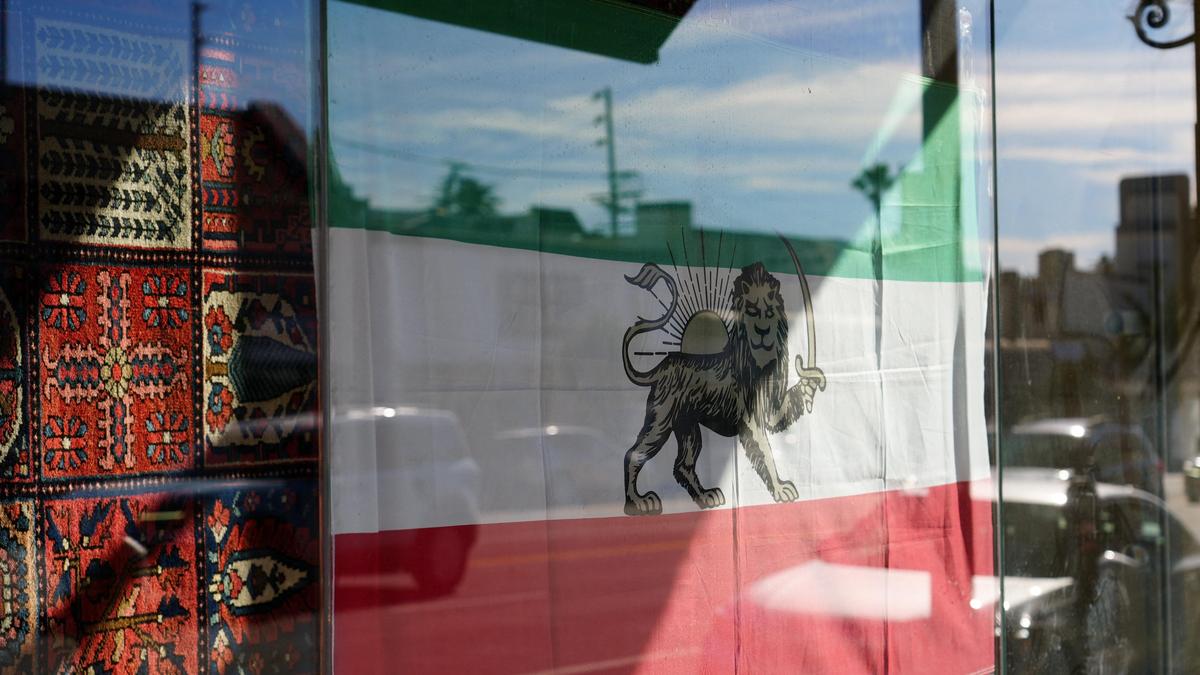
The “Lion and Sun” pre-Iranian Revolution national flag is displayed at the entrance of a store along Westwood Boulevard in Los Angeles on January 12, 2026.
| Photo Credit: Reuters
Mobile phones in Iran were able to call abroad on Tuesday (January 13, 2026) after a crackdown on nationwide protests in which the internet and international calls were cut. Several people in Tehran were able to call The Associated Press and speak to a journalist there. The AP bureau in Dubai, United Arab Emirates, was unable to call those numbers back.
Iranians said, “text messaging appeared to remain down, and witnesses said the internet remained cut off from the outside world.” Iran cut off the internet and calls on Thursday (January 8, 2026) as protests intensified.

U.S. President Donald Trump has said that Iran wants to negotiate with Washington after his threat to strike the Islamic Republic over its crackdown on protesters that activists said had killed at least 646 people.
Iranian Foreign Minister Abbas Araghchi, speaking to the Qatar-funded satellite news network Al Jazeera in an interview aired Monday (January 12, 2026) night, said he continued to communicate with US envoy Steve Witkoff.
The communication “continued before and after the protests and is still ongoing,” Araghchi said. However, “Washington’s proposed ideas and threats against our country are incompatible.”
White House Press Secretary Karoline Leavitt said, “Iran’s public rhetoric diverges from the private messaging the administration has received from Tehran in recent days.”
“I think the President has an interest in exploring those messages,” Ms. Leavitt said. “However, with that said, the President has shown he’s unafraid to use military options if and when he deems necessary, and nobody knows that better than Iran.”
Meanwhile, pro-government demonstrators flooded the streets Monday (January 12, 2026) in support of the theocracy, a show of force after days of protests directly challenging the rule of 86-year-old Supreme Leader Ayatollah Ali Khamenei. Iranian State television aired chants from the crowd, which appeared to number in the tens of thousands, who shouted “Death to America!” and “Death to Israel!” Others cried out, “Death to the enemies of God!” Iran’s attorney general has warned that anyone taking part in protests will be considered an “enemy of God,” a death penalty charge.
Trump imposes tariffs on Iran’s trading partners
Mr. Trump announced on Monday (January 12, 2026) that countries doing business with Iran will face 25% tariffs from the United States. Mr. Trump announced the tariffs in a social media posting, saying they would be “effective immediately.” It was action against Iran for the protest crackdown from Mr. Trump, who believes that exacting tariffs can be a useful tool in prodding friends and foes on the global stage to bend to his will.

Brazil, China, Russia, Turkiye and the United Arab Emirates are among the economies that do business with Tehran. Mr. Trump said on Sunday (January 11) that his administration was in talks to set up a meeting with Tehran, but cautioned that he may have to act first as reports of the death toll in Iran mount and the government continues to arrest protesters.
“I think they’re tired of being beaten up by the United States,” Mr. Trump said. “Iran wants to negotiate.” Iran, through the country’s Parliamentary Speaker, warned Sunday (January 11) that the U.S. military and Israel would be “legitimate targets” if Washington uses force to protect demonstrators.
More than 10,700 people have been detained over the two weeks of protests, said the U.S.-based Human Rights Activists News Agency, which has been accurate in previous unrest in recent years and gave the latest death toll early Tuesday (January 13). It relies on supporters in Iran cross-checking information. It said 512 of the dead were protesters and 134 were security force members.
With the internet down in Iran, gauging the demonstrations from abroad has grown more difficult. The Associated Press has been unable to independently assess the toll. Iran’s government hasn’t offered overall casualty figures.
Published – January 13, 2026 01:20 pm IST

