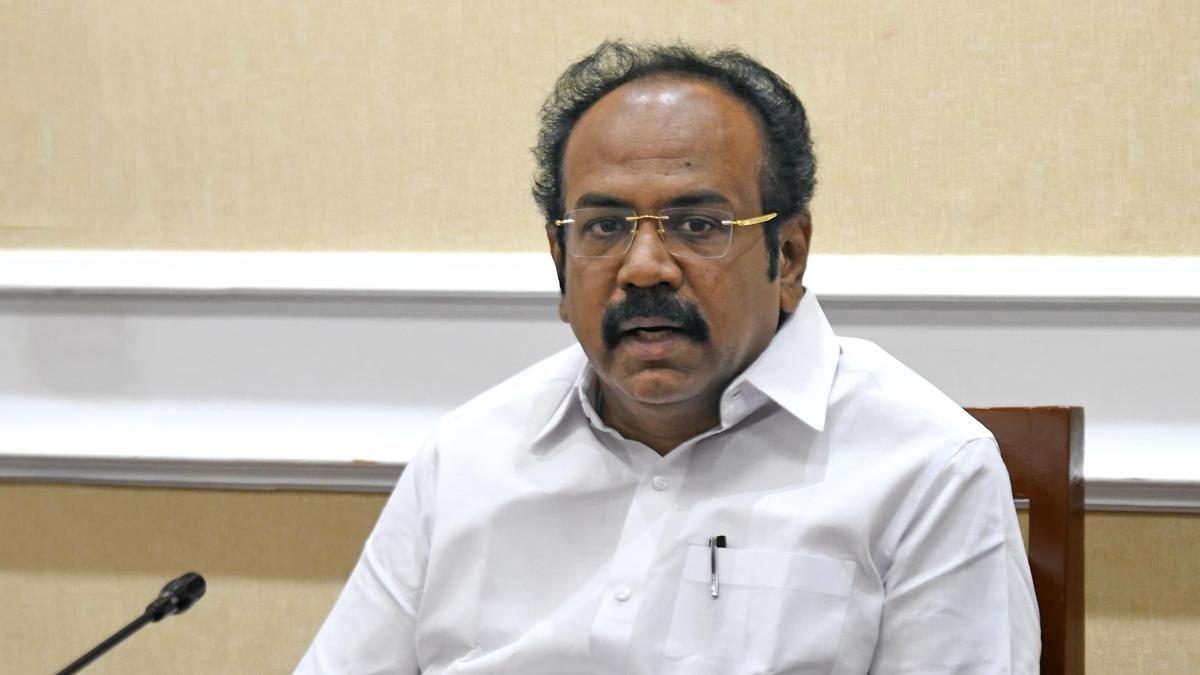
With the Assembly election set for April 23, the debate on welfare spending, public debt, and fiscal priorities has moved to the centre of political discourse. In an interview to The Hindu, senior DMK leader and Finance Minister Thangam Thennarasu explains the rationale behind the welfare model and addresses criticism over cash transfer schemes. Edited excerpts:

Critics have dubbed as politically motivated the DMK government’s recent act of transferring a lump sum to the bank accounts of beneficiaries of welfare schemes ahead of the election. They are also pointing to the increased debt burden. What’s your response?

Welfare spending in itself is not a negative. If the benefits of economic growth are not broad-based, the fruits of development will inevitably be cornered by a small section of society. Our approach in Tamil Nadu has always been to ensure that growth is inclusive and its benefits reach every household. Cash transfer schemes, at one point of time, were widely regarded as one of the most effective policy interventions. Economists and development experts across the world have recognised that such a direct transfer reduces leakages, provides autonomy to beneficiaries in deciding how best to utilise the support, and stimulates local and rural economies through increased consumption. The Union government came up with the PM-KISAN scheme. There are 15 States that are implementing cash transfer schemes for women. It is somewhat ironic that when such policies are implemented in Tamil Nadu, they are suddenly portrayed as fiscally irresponsible or politically motivated. Over the last five years, this government has spent more than ₹4 lakh crore on welfare programmes and social support measures.
So what has been the economic return or social impact of major welfare programmes introduced in the last five years?
The monthly entitlement given to women under the Kalaignar Magalir Urimai Thogai scheme has strengthened their financial independence and improved household financial stability. The Pudhumai Penn scheme has led to a significant improvement in college enrolment among girl students of government schools. If you look at Vidiyal Payanam Thittam, there is a clear increase in the number of bus trips made by women passengers, reflecting improved mobility and greater access to employment and educational opportunities. According to a 2023 study, households have been able to save around ₹888 a month, on an average, owing to the reduced transport cost.
Can Tamil Nadu continue such a welfare model without pushing future generations into deeper debt?
I don’t believe we are getting into a debt-trap. The growth in debt over the last five years has been about 96%, whereas during the previous five-year period, it was about 128%. At the same time, our debt-to-GSDP ratio remains within manageable limits and broadly within the trajectory recommended by the Finance Commission of India.
When it comes to welfare spending, I would like to place it in the broader context of the growth model of Tamil Nadu. History teaches us that the most important factor of production is human capital. As economies develop and the demographic dividend gradually diminishes, the central economic challenge shifts towards improving productivity. Ensuring individuals are healthier, better educated and economically empowered, therefore, becomes essential.
Our welfare and social sector programmes are designed precisely with this objective in mind. The scale of this investment has been substantial. Our expenditure on health, education, and social welfare over the last five years has been significantly higher than in the earlier periods, reflecting the government’s commitment to strengthening human and social capital. In that sense, the resources we are deploying today should not be viewed as a burden on future generations. Rather, they are investments that will enable them to inherit a stronger economy, a more productive workforce, and a more capable society.
The DMK government has frequently voiced concern about the Union government’s financial policies. Had Tamil Nadu received a larger share of Central funds, how differently would the State budget have looked?
The numbers would look very different. In fact, we probably would not even be having this conversation. Tamil Nadu’s share in the divisible pool of Central taxes has declined from 7.932% under the Ninth Finance Commission to 4.079% under the Fifteenth Finance Commission. This has largely been due to an excessive emphasis on redistribution that ends up penalising progressive and better-performing states. Had Tamil Nadu continued to receive the same share of Central taxes as during the Ninth Finance Commission period, our debt today would be at least 32% lower. In addition to this, delays or withholding of funds under Central government-sponsored schemes, such as the Jal Jeevan Mission, Samagra Shiksha Abhiyan and MGNREGA, have added to the State’s fiscal burden. If we consider these withheld amounts along with the associated interest cost, they would account for roughly 40%-45% of our current debt. In an ideal scenario, if Tamil Nadu were to receive a larger and more equitable share of Central funds, the State’s debt could be closer to ₹6 lakh crore. That would have created substantial fiscal space for us to invest more in infrastructure, human development, and other key priorities of the State.
The State Economic Survey indicates that Tamil Nadu can achieve a one-trillion-dollar economy milestone by around 2030-31. What are your views?
Tamil Nadu’s economy is currently estimated to be around $450 billion. If the State is to reach the one-trillion-dollar milestone by 2030-31, we require an annual growth rate of approximately 17%-18% in nominal dollar terms. When we factor in an average inflation of around 4%-5% and an expected rupee depreciation of about 1%-2% annually, the economy would need to sustain roughly 10%-11% real growth each year to reach the mark. Given that the State has already achieved a real growth of about 11.19% in 2024-25, I believe this target, while ambitious, is certainly not unachievable if the current growth momentum continues.
Looking back at your tenure as the Finance Minister, what has been your most difficult budget decision?
Every budget inevitably involves difficult choices because resources are limited while expectations and development needs are vast. I wouldn’t call them difficult, but one of the most challenging decisions has been the announcement of the Tamil Nadu Assured Pension Scheme. This was particularly challenging decision because the pension commitments have significant long-term fiscal implications for the government. Any reform in this area is usually a once-in -a-generation measure. It must carefully balance the legitimate expectations of government employees with the need to ensure long-term fiscal sustainability for the State.