When he rose to fame with his comedy talk show in 2013, Kapil Sharma’s jokes had little conscience. With a sharp rhythm in his delivery and a familiar, middle-class appeal in his personality, Kapil often evoked laughs at the expense of others. The powerless bore the brunt of his antics. Yet, there was something special about him. It wasn’t just what he said that landed with precision, but how he said it. Kapil’s comic timing was feverish.

It was put on milder display just years later when he made his film debut with Kis Kisko Pyaar Karoon, a tantalising comedy-drama, where he extended his flirtatious personality into a multi-marriage narrative. Filled with innuendos and some crude generalisations, the film was an extension of the show’s unhinged, reactionary mind, penned by the same writer, Anukalp Goswami. A lot has changed as they return back to the same narrative in Kis Kisko Pyaar Karoon 2 with a surprisignly elaborate course correction. For Kapil and Anukalp, it feels like a timely coming-of-age; the writing now throbs with a clear conscience and the punchlines pulsate with heart.
Kis Kisko Pyaar Karoon 2 (Hindi)
Director: Anukalp Goswami
Cast: Kapil Sharma, Manjot Singh, Hira Warina, Tridha Choudhary, Parul Gulati, Ayesha Khan, Asrani Ji, Akhilendra Mishra, Vipin Sharma, Sushant Singh, Jamie Lever
Runtime: 142 minutes
Storyline: A man converts to different religions to be with the love of his life while being forced to marry three women which leads to confusion and chaos.
Kis Kisko Pyaar Karoon 2 begins with a timeless expression of love that feels like a rare jolt in current times. Kapil’s Mohan Sharma and Sanya Hussain (Hira Warina) decide to get married in court against the wishes of their conservative parents. When their plan fails, Mohan takes it upon himself and agrees to get converted to Islam in order to be with Sanya. Mohan becomes Mehmood. Due to a misunderstanding, however, he gets married instead to her sister. Meanwhile, his parents forcibly get him married to Meera (Tridha Chaudhary). On the other hand, Sanya gets converted to Christianity and tells him that they will get married in a church in Goa. Mohan and Mehmood become Michael. The third time too, he marries another girl, Jenny (Parul Gulati).
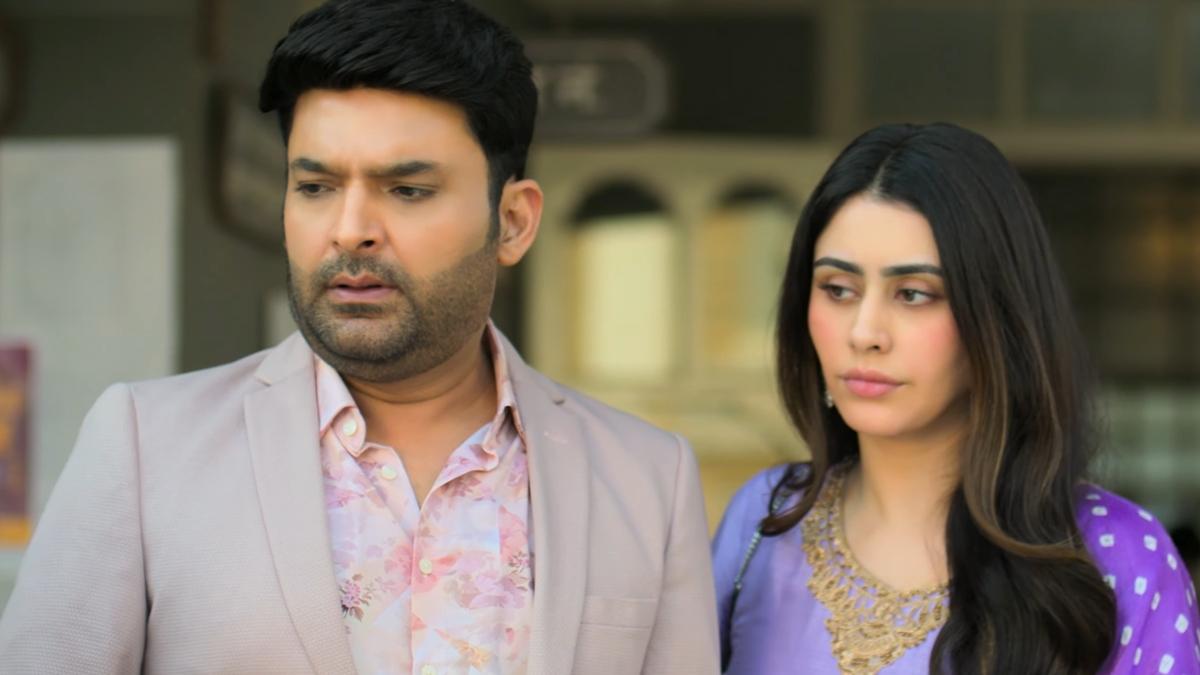
Kapil Sharma and Hina Warina’s still from the film
| Photo Credit:
Venus Movies/YouTube
An understated profundity begins to take shape between these silly, slapstick moments. The writing is acutely self-aware, knowing when to tone down the laughs to give way for an emotive reverberance. When Sanya’s father, Mirza (played cheekily by Vipin Sharma) asks Mohan if he would change his religion for love, the latter says earnestly, “Pyaar badalne ka nahi, apnane ka naam hai (Love is not about changing someone, it’s about acception them)”.
The film uses its over-the-top gags to quietly accentuate its progressive themes. Like the eccentric priest played by the late Asrani, who is made out to be a polyglot. When Mohan makes a confession to him about marrying three women, the father reacts with an Arabic phrase. “Kisi bhi bhasha me God ki prayer ki jaa sakti hai (You can pray to God in any language)”, he reasons with warmth.

It reaches an absurdly allegorical dimension in the second half during the Republic Day celebrations at a school, with kids being dressed as noted freedom fighters. A blood donation camp runs on the side where Mohan unwillingly participates. The gag extends as his other two wives force him to donate blood again as he writes the names of Mehmood and Michael in the register. One man, three names, same blood. Nana Patekar’s angry Indian from Krantiveer (1994) would be proud as the metaphor of communal harmony speaks for itself. Ace poet Rahat Indori’s popular couplet on blood and soil comes to mind. The scene doesn’t just end there as the joke continues spilling its irony. Mohan, an epitome of the idea of India, gives a speech when his cover is blown. He invokes secularism and brotherhood, calling himself ‘Hindustan’. Latching on to his pluralistic Indian-ness saves the day.
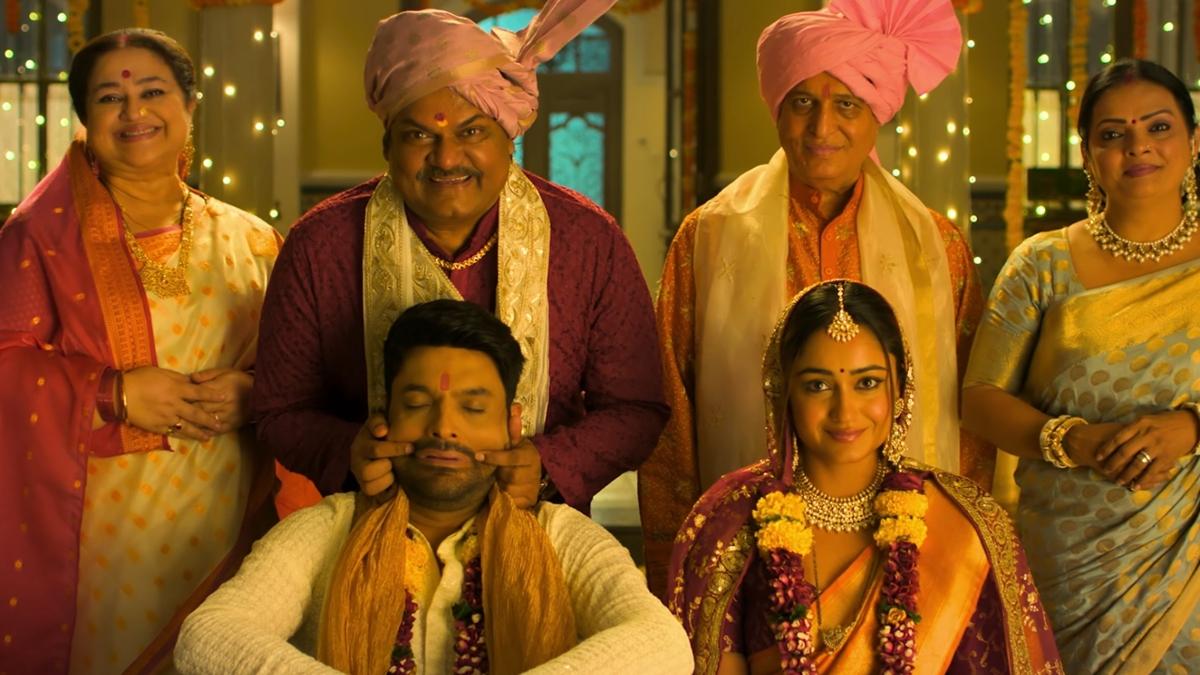
A still from the film
| Photo Credit:
Venus Movies/YouTube
Even the women are written with more care this time around; the gaze is not as lecherous. Although it is still a man’s perspective and the lives of women characters get meaning only when they are married. They are still humanised, made out to be more than just flashy caricatures of their personality. The film also avoids getting into the normalisation of cheating, where the man is rewarded for his manipulation. Even when he is caught in a gamble, Mohan appears visibly uncomfortable going from one house to the next. He is not made out to be a playboy like the first part; rather, there is empathy in his outlook. When his wife asks him to keep a roza together, he agrees and maintains his promise by not eating before the decided time. The crux of Kis Kisko Pyaar Karoon 2 lies in infusing a strong sense of meaning to its old template of a man mistakenly married to three women. The humor is striking, easygoing, reminiscent of a harmless 2000s Priyadarshan comedy-of-errors while lingering in the soul of Amar Akbar Anthony (1977). It is a clever mix. What’s ludicrous becomes insightful.

The film maintains its sensitivity even in a humorous scene involving a bunch of trans-folk who come to Mohan’s place asking for money. This time, we don’t laugh at them, but with them. There’s even a sharp jibe taken at moral policing with Jamie Lever’s hilarious Bengali character creating hassles for Mohan and his buddy, Harbir (the delightful Manjot Singh).
Kapil is the epicentre of all the chaos, maintaining a laudable restraint in his performance which he blends with a charming sensibility. His jokes now drift with a purpose. Anukalp finds his voice too, one that feels deeply personal. Even when the filmmaking appears to be rather clunky and awkward, the scenes crackle with energy due to the sharp writing. Years of working for Kapil’s show seems to have added a muscle memory to his humour. It is more guided and organic now, exploring the world with a child-like innocence; filled with a genuine care about the state-of-affairs while invoking the Nehruvian optimism of 1960s Hindi cinema. In short, a fun time at the movies.
(Kis Kisko Pyaar Karoon 2 is currently running in theatres)
Published – December 12, 2025 10:56 am IST