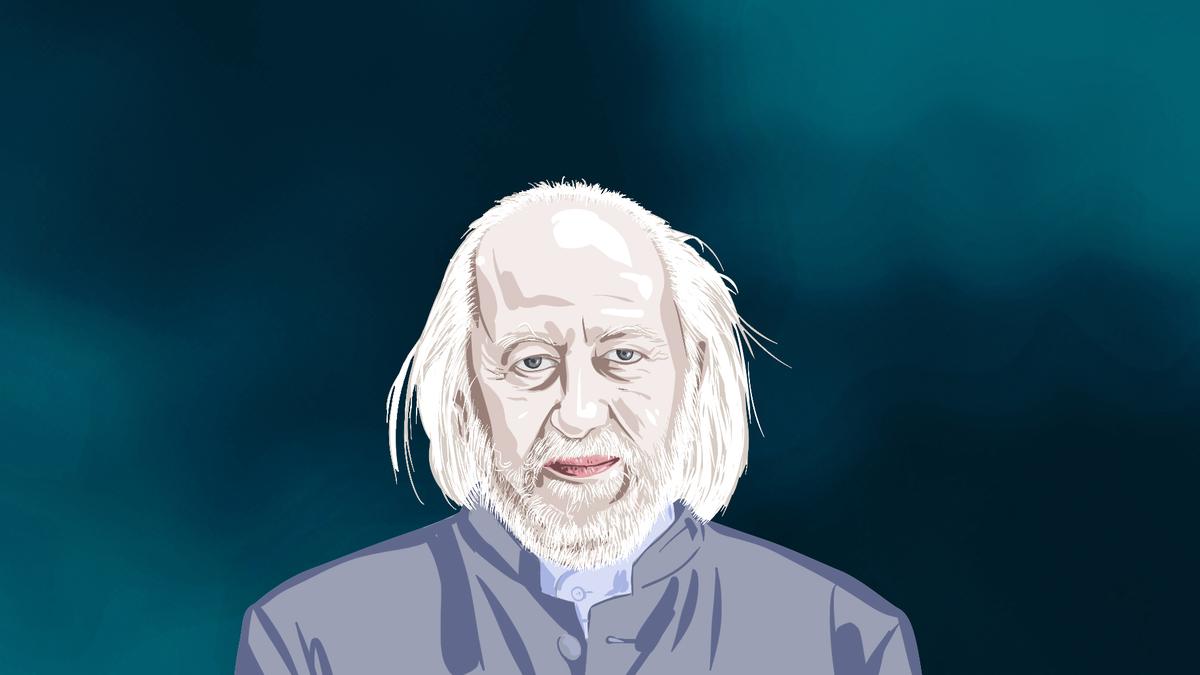
At a “very very difficult time for earth”, the Nobel Prize for Literature for 2025 has been awarded to Hungarian writer Laszlo Krasznahorkai “for his compelling and visionary oeuvre that, in the midst of apocalyptic terror, reaffirms the power of art”.
In his first comments after the win, the 71-year-old author, screenwriter and musician said he was very sad to think of the state of the world now, and yet he felt that the “bitterness” could be an inspiration for writers. Talking to Jenny Rydén of the Nobel Prize, Krasznahorkai hoped writers could “give something for the next generation, somehow to survive this time because these are very, very dark times and we need much more power in us to survive”. Krasznahorkai grew up in Soviet-era Hungary, wrote his first novels under difficult circumstances, and through his experimental prose, imagination of fantasy and philosophical searching, transported his readers to an unsettling world. “I’ve said a thousand times that I always wanted to write just one book,” he had told The Paris Review in 2018. He considers his quartet of novels — Satantango, The Melancholy of Resistance, War and War, Baron Wenckheim’s Homecoming — as one book. A keen observer of life around him, his novels are peopled with myriad characters, some defenceless against a harsh world. Think Estike in Satantango, or that “soft creature, Valuska” in Melancholy, the Baron in Homecoming, all inspired by a character Krasznahorkai admires, Myshkin of Dostoevsky’s The Idiot.
English readers were first introduced to him through Melancholy (1989), translated by George Szirtes in 1998. It begins with a group of passengers waiting for a train in a small town at the Carpathian foothills. The train is late, and may not arrive at all, but to tell the truth, “none of this really surprised anyone any more since rail travel, like everything else, was subject to the prevailing conditions”, that of “all-consuming chaos which rendered the future unpredictable”. In this town where life is “so haphazard” comes a circus, carrying a giant carcass of a whale. It sets off all sorts of reactions. “Who has time for entertainment now, when we’re in a state of anarchy?” rues one resident.
Also Read | Nobel Prize in literature goes to Hungarian author László Krasznahorkai
Existential struggle
His masterly debut novel, Satantango, about the existential struggle of a collective farm on the eve of the fall of communism, came out in 1985, though it was only translated into English in 2012. Three years later, he would win the Man Booker International Prize. Baron Wenckheim’s Homecoming, translated from the Hungarian by Ottilie Mulzet, was published in 2019. In it, there is a recluse, a Professor, who holds forth on life: “The world is nothing more than an event, lunacy, a lunacy of billions and billions of events… and nothing is fixed, nothing is confined, nothing graspable, everything slips away if we want to clutch onto it.”
In a world where nothing is making sense, Krasznahorkai wishes that writers — and readers — “get back the ability to use their fantasy, because without fantasy it’s an absolute different life”. Reading, he says, “gives us more power to survive”. Just like he did. Franz Kafka was in his pocket, and he admired Samuel Beckett, William Faulkner, Herman Melville, Dante, and Homer.
EDITORIAL | Making sense: On Krasznahorkai and the Nobel Prize in Literature for 2025
With no writing desk, Krasznahorkai would frame sentences in his head, adding words as they came along, and writing them down only when he thought they had reached a natural end. The experimental prose with its long sentences flow from his mind. In the 2000s, he ventured out to the east, to Japan and China, writing contemplative novels such as Seiobo There Below and A Mountain to the North, A Lake to the South, Paths to the West and A River to the East. In all his works, one of the central themes is that human life is fleeting and precious. He has collaborated with filmmaker Béla Tarr to adapt several of his books to the screen.
With the Nobel Prize, the demanding works of Krasznahorkai are sure to find new readers. One of the Hungarian great’s favourite reads happens to be Dostoevsky’s White Nights, which is the rage on BookTok.
Published – October 12, 2025 01:33 am IST