“Whenever I dream, my dreams start from the banks of Narmada in Hoshangabad and travel to Khawaja Bagh in Baramulla,” relates Manav Kaul as one tries to make sense of the versatile artist’s creative depth. “As I was born in Kashmir, raised in Hoshangabad and worked in Mumbai, my spectrum became huge, and my stories are different because of the life I have lived.” A national-level swimmer in his teens, Manav is a thinking woman’s crush, a youth’s go-to writer for love and longing and a theatre practitioner who draws new lines every time he takes the stage.
A compulsive solo traveller, he has, of late, been playing parts that have rekindled his association with the Valley. Recently, he was seen as a Kashmiri Police officer in Baramulla, which was a kind of antidote to Ghoul, a miniseries he led many summers ago. Up next is Real Kashmir Football Club on Sony LIV, loosely based on the rise of the first professional football club from Jammu & Kashmir, which competes in the Indian football league system. Founded by a Kashmiri Pandit businessman and a Kashmiri Muslim journalist in 2016, the Club uses football glue to bring the youth together in the Valley scarred by years of disquiet.
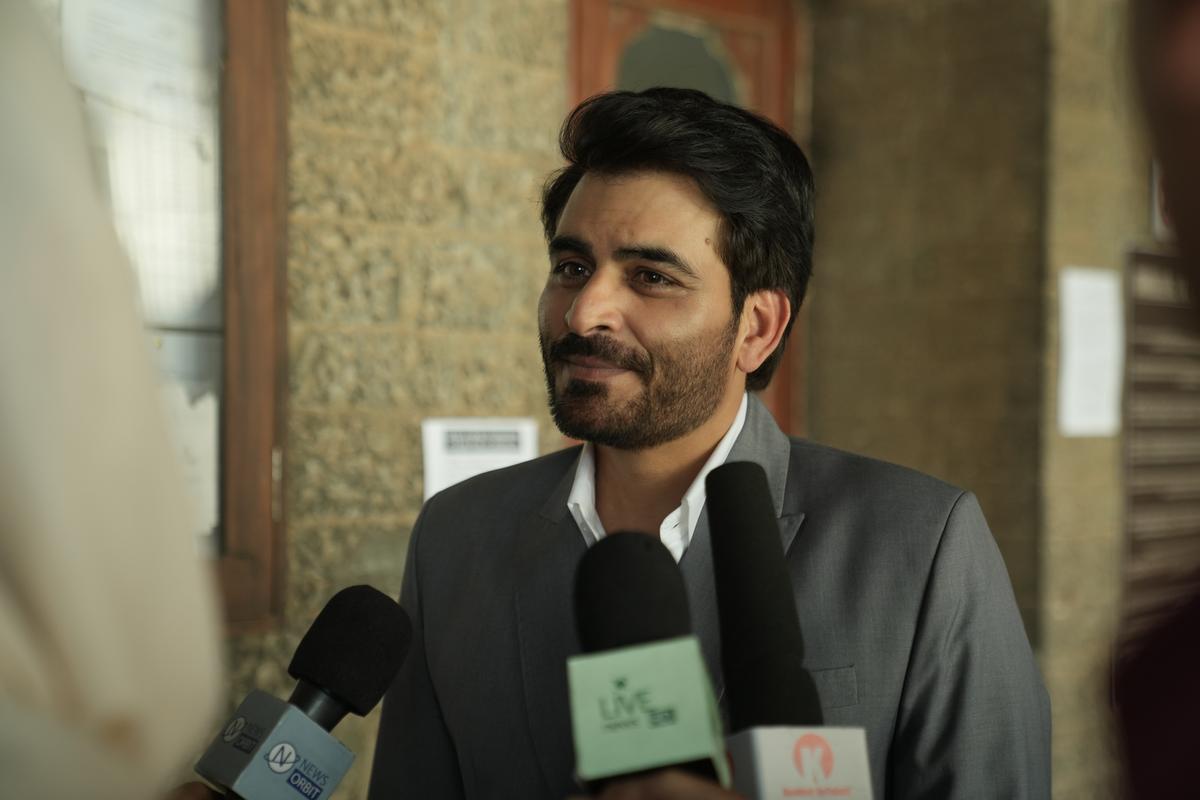
Manav Kaul in RKFC
| Photo Credit:
Sony LIV
Edited excerpts from the interview:
We already have ‘Inshallah Football’ and an acclaimed documentary on RKFC. What value will the series add to the bond between football and Kashmir?
I like fiction, and there is this fictional element that director Mahesh (Mathai) and writer Simaab (Hashmi) have brought in to make it a very interesting series from a real story. It allows you to talk not only about the club and the people involved, but also about the stories of the lives of people in Kashmir and puts them in context.
You have been a sportsperson. How did this help in shaping the character of Shirish?
I had nothing to do with football, and I had no idea there was a real Real Kashmir Football Club. When I learned about it through the script and did my research, I realised it’s such a stunning story. I was surprised that people took so long to tell this story. I was ready to play any role because when you’re part of one discipline, you understand sport, per se. We call it sportsman’s spirit. I understand how important winning is to the team. Sports teaches you how to lose; how to lose well. In life, when you don’t know how to lose well, there is a huge problem.
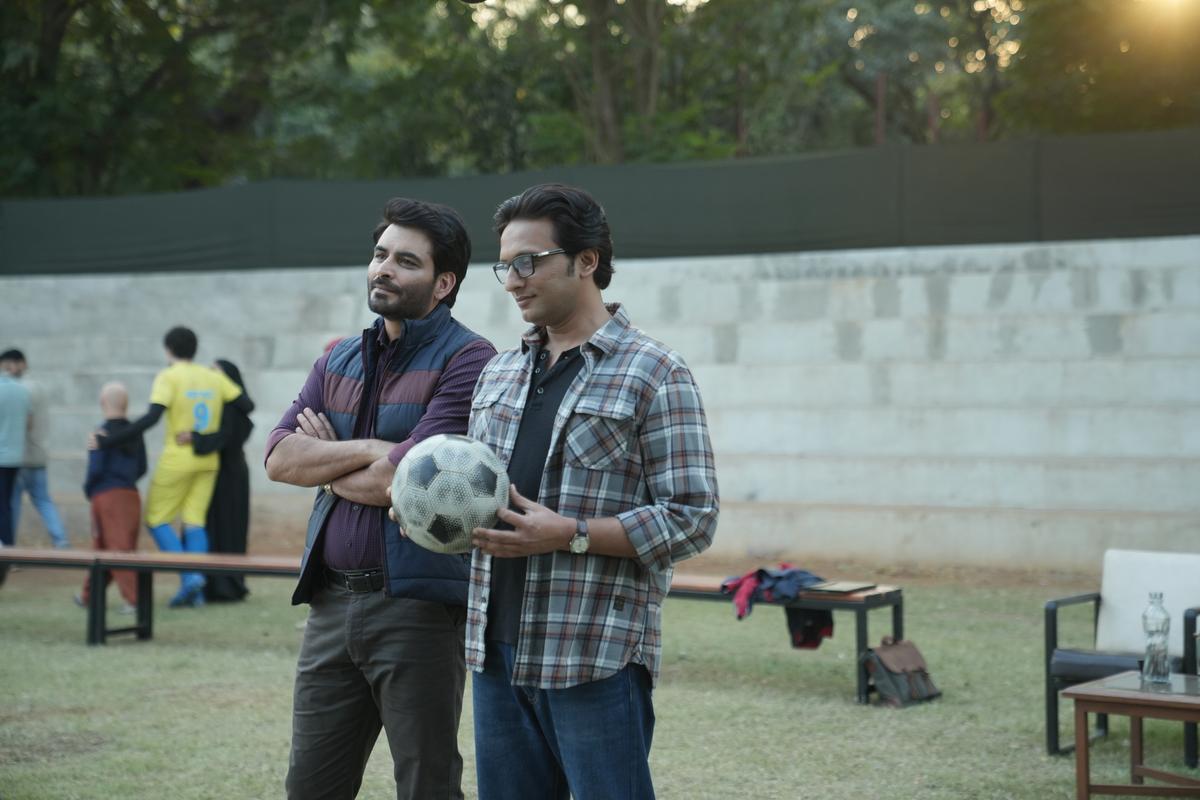
Manav Kaul and Mohammed Zeeshan Ayyub in RKFC
| Photo Credit:
Sony LIV
After ‘Rooh’ and ‘Baramulla’, you again have a project with a Kashmiri connection in ‘RKFC’…
I have been very lucky in a way, because Baramulla and RKFC are the kinds of Kashmir stories I really wanted to tell. As for Rooh, it was in my head that I should write something completely about Kashmir because when my father passed away, it left a huge void in me. I felt that I needed to talk about my father, and I couldn’t talk about my father without talking about Kashmir. I had no idea that I had so much of Kashmir inside me. When I was talking about Kashmir, it was about my father, and when I was talking about my father, it was about Kashmir. I found that complex situation very intriguing. Eventually, it took the shape of Rooh. Interestingly, when Mahesh and Kilian Kerwin, the producer, met me, they had both read Rooh. I liked that.
As someone for whom Kashmir is a personal matter, how do you deal with different points of view as an actor, especially as your roles frequently cross perspectives?
There is a kind of empathy and perspective that I bring to all the characters I play. In RKFC, I am playing a Kashmiri Pandit, while in Baramulla, I am a Kashmiri Muslim. They both have a gaze that is kind of like mine. Like the officer in Baramulla, Shirish faces many obstacles….
But he is not bitter about it….
You can’t be. As a human race, we have been part of so many atrocities. How you deal with it while respecting life and others is the crux of the story, I feel.
Both ‘Ghoul’ and ‘Baramulla’ are in a supernatural space. While ‘Ghoul’ blames one side, ‘Baramulla’ holds the other side responsible. How do you negotiate the complex space?
Different perspectives have to be there. You can’t keep looking at the world through the same lens. Everyone has the right to tell their stories. As an actor, I have to follow the character’s perspective. Through my writing, I do ask questions.
Turning to your writing, your fiction is very personal, almost invasive, and yet universal…
I find fiction amazing. If I write about the experience of this conversation, it will be fiction because your participation is not there. My point is, whatever you write, even history is actually a fictional account. Fiction lets you say things you can’t in an autobiography. Like my latest play, Traasdi is about my mother’s death. But my mother has seen around 8 to 10 performances of the play. Every time people come and say, ‘Oh! We are sorry for your loss.’ I tell them to at least meet my mother. People don’t understand that it is my craft as a writer. It sounds very personal, but it is also fiction. It also allows me to say things. Like my mother, who is an atheist, I could say everything about atheism through my mother. However, if I say anything about atheism as I am saying it, people will get offended. But because it’s my mother saying, nobody gets piqued.

Recently, ‘She & Hers’ (English translation of Manav’s ‘Tooti Hui, Bikhri Hui;) has come out. How did it take shape?
I come from a small town, and my understanding of sex, sexuality, and same sex love was very limited. I regretted it and also felt guilty about not understanding the other sex, and not understanding two people of the same sex in love. So I thought I should write about it and the whole world around it. For that, I had to read a lot because in India, we don’t have stories about love and its different shades. The word love means to like a little. It’s been love or gay love. So I started reading (Radclyffe Hall’s) The Well of Loneliness. Then, of course, I read (Virginia Woolf’s) Orlando and works of Sappho, and gradually I started weaving the story of She and Hers. I think it is one of my very important writings. I hope people read it.
When you ventured into theatre, how did the old guard react to your kind of sparse, experimental theatre?
The reason I started theatre was because of Habib Tanvir. When I watched his Mudrarakshas, it touched me. Then I worked with Satyadev Dubey. My theatre comes from literature, and my gaze is very childlike. When I used to watch traditional theatre, I would ask myself why they don’t experiment, why they don’t break the boundaries and walls. As there is a limitation of stage in the theatre, you could do anything. I can say I am standing next to a river, and I can make you believe. I don’t need to show the river. I take the word experimental very seriously. In the experiment, the chances of failure are 50% and I want to take that risk. I don’t want to write a successful play. I want to write an experimental play.
Tell us about your long association with Kumud Mishra.
When I met Kumud, we were both going through a lull phase. We both were struggling to find our voice. We were in a state where we were constantly telling each other we needed to do something. I wrote Shakkar Ke Paanch Dane for him. A partnership and friendship happened during the play, and I ended up writing seven or eight plays for him. When you are working with the same actor, it becomes very difficult to surprise him. I took it as a challenge and improved in the process. I became a better artist and human being because of him.
How do you plan your travel, and how does it inform your writing?
I find travelling therapeutic. I was travelling even when I had no money. You are more interested in other people than yourself. It makes you feel light. Mostly, I don’t travel to a tourist place. I travel to secluded places and then sit in a cafe and read. My travelling and writing are interconnected. When you are in a country where food and language are different, you react differently. That reaction takes the shape of a book.
What’s next?
I’ve just directed a film called Jolly Joker. It is about three writers and is based on my novel Sakshat Sakshatkar. Kumud is part of it. I can’t work without Kumud!
(RKFC will stream on Sony LIV from December 12)
Published – December 11, 2025 09:21 am IST