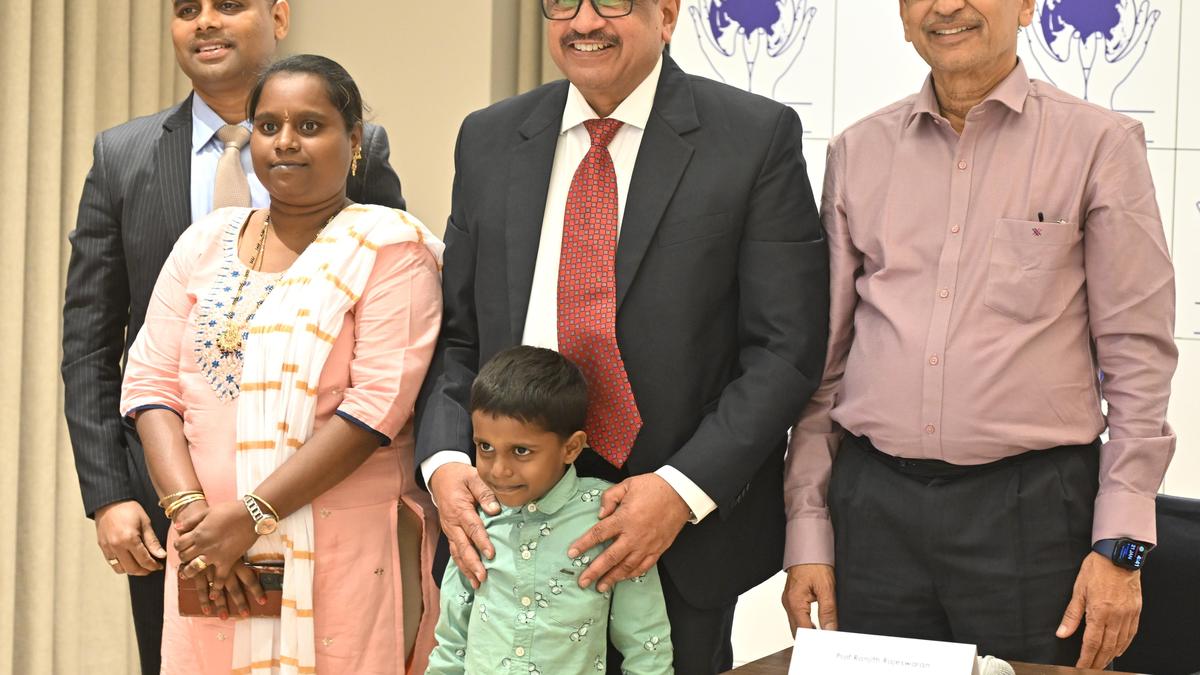
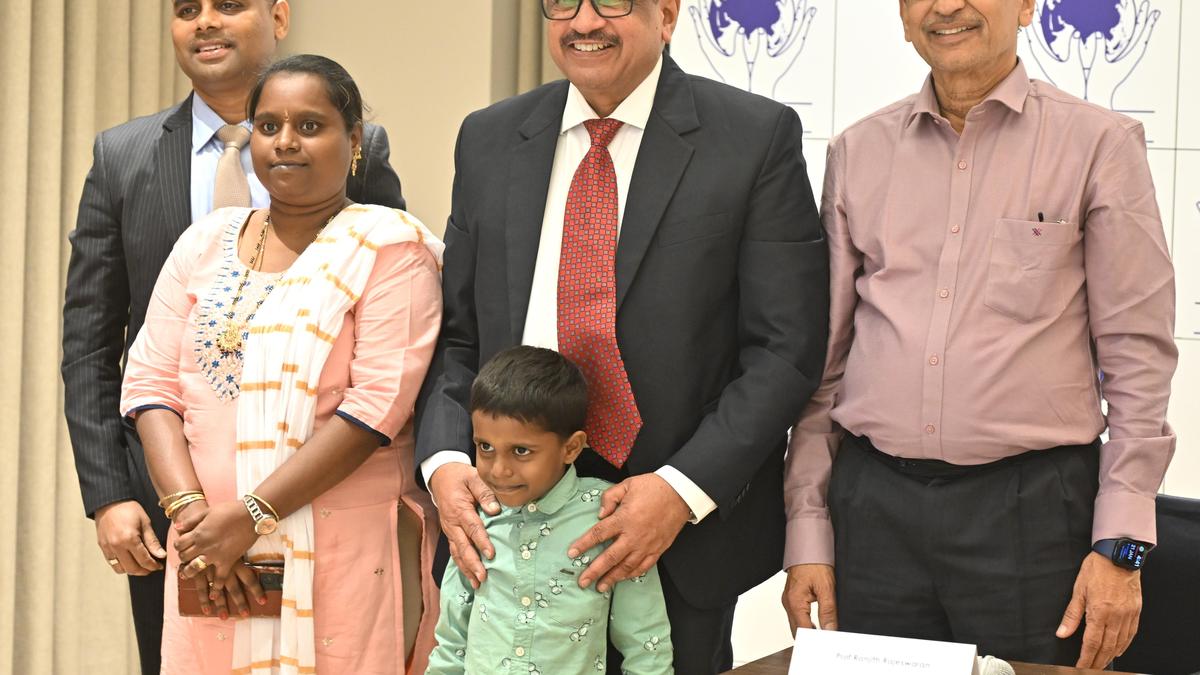
(From Left) Mohan Kameswaran, Ranjith Rajeswaran, and M.C. Vasudevan at a press conference in the city on Wednesday. Also seen is patient Ruthvik Sai and his mother.
| Photo Credit: R. Ravindran
The Madras ENT Research Foundation (MERF) has completed 100 paediatric auditory brainstem implants (ABI) since 2009.
The institute’s first ABI was performed on a 13-year-old girl in 2004, who lost hearing due to a tumour in the auditory nerve on both sides of the brain. Its first ABI in children was performed in 2009, according to a press release.
Noting that the commonest congenital anomaly in children is deafness, and cochlear implants could benefit majority of them, Mohan Kameswaran, managing director and consultant ENT Surgeon, MERF, said, in a small percentage of children — about four to five per cent — no inner ear (cochlea) or auditory nerve is developed as a result of which they cannot receive a cochlear implant.
“As a next step, we bypass the ear, and keep a chip in the brainstem,” he said.
The ABI is a bionic device. Its internal component has an electrode, which is placed over the hearing area of the brain — the cochlear nucleus — in the brainstem.
The external component, worn behind the ear, receives sounds and transmits the same to the internal device. The electrodes will deliver the sound as electrical signals directly to the cochlear nucleus in the brainstem, bypassing the inner ear and the auditory nerve, M.C. Vasudevan, chief neurosurgeon, VHS Hospital, said in the release.
Dr. Kameswaran added that this was a complex surgery in small children, and involved ENT surgeons, neurosurgeons, and audiologists. MERF has been performing ABI along with VHS. “We usually wait for the child to reach 18 months to perform ABI,” he said. In Tamil Nadu, ABI is covered under the Chief Minister’s Comprehensive Health Insurance Scheme, he added.
Ranjith Rajeswaran, director and chief audiologist and speech language pathologist, MERF Institute of Speech and Hearing, said rehabilitation is very important to achieve outcomes after ABI.
New frontier
Dr. Kameswaran went on to outline a new frontier in hearing restoration — Hearing and Structure Preservation (HSP) — for persons with partial deafness and auditory neuropathy spectrum disorder. In this, the goal is a cochlear implant with preservation of residual function in the cochlea. This, he added, has distinct advantages of enabling the person to appreciate music and have much better hearing in noise.
A person receiving a cochlear implant with hearing structure preservation will have electric hearing and natural hearing in the same ear. This is called electro-acoustic stimulation hearing, the release said.
The team performed bilateral simultaneous HSP in a patient with auditory neuropathy spectrum disorder.
“We have reached a stage of individualised medicine. There is software to measure the length/dimensions of the cochlea and appropriately choose the electrode,” he added.
Published – January 22, 2026 12:40 am IST