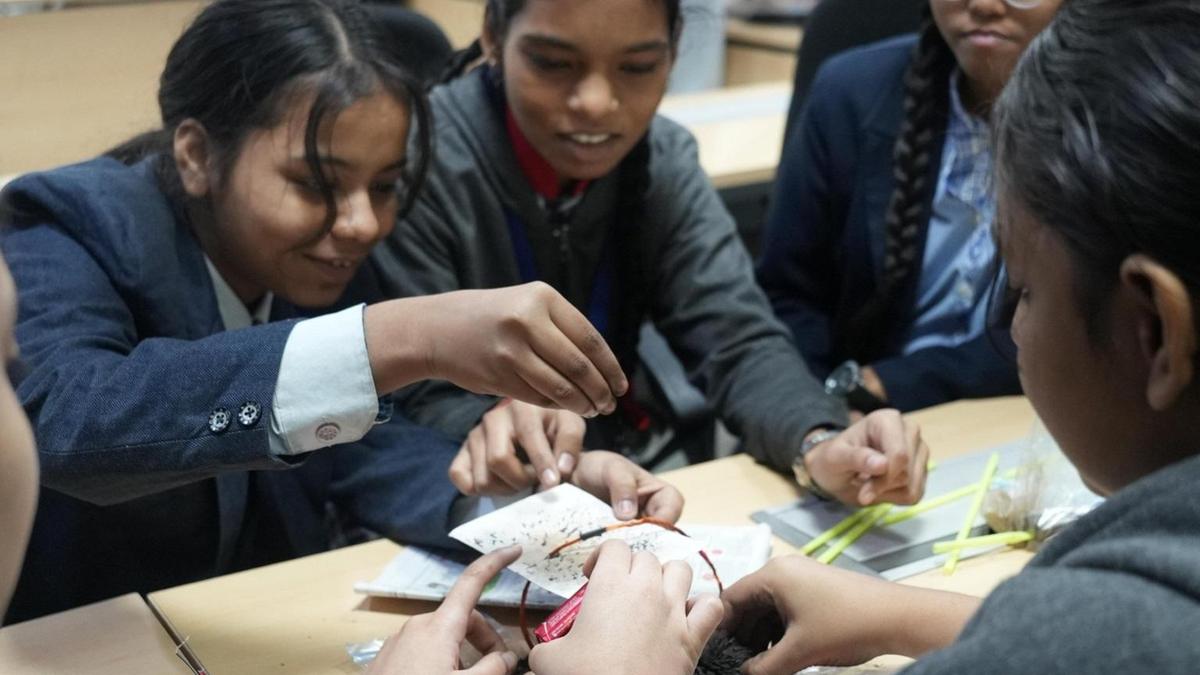
The programme aims to address the skewed gender ratio in STEM and equip girls with the skills and mindset needed to pursue STEM subjects.
| Photo Credit: Special Arrangement
Nearly 100 high school students participated in the fourth edition of Indian Institute of Technology (IIT) Delhi’s mentorship programme aimed at exposing girls to science, technology, engineering and mathematics (STEM) subjects, the institute said on Tuesday.
The multi-phase learning journey ran from May to December, with the final ceremony held on December 5. The summer phase of the ‘Manasvi: STEM Mentorship Programme for High School Girls’ was academically oriented and featured lectures by faculty members and researchers. The autumn and winter phases focused on hands-on learning, with activities ranging from chemistry experiments to physics projects. In the final phase, students presented innovative ideas aligned with the Sustainable Development Goals (SDGs).
IIT Delhi said that 80% of participants were from government schools. Priyanshi, a Class 11 student from Dwarka, said the programme helped her discover a new side of science and technology. “The ecstatic feeling of making solar lamps and doing things with our hands cannot be described in words,” she said.
The programme aims to address the skewed gender ratio in STEM and equip girls with the skills and mindset needed to pursue STEM subjects. Applications for the next edition will open in February-March 2026 on the institute’s website. “The upcoming edition will onboard an entirely government-school cohort, after the fourth edition recorded over 80% participation from government schools,” the institute said in a statement.
For the previous cohort, selections were made after schools in Delhi and nearby areas nominated four female students each from Classes 9 and 11 in the science stream. The programme ran for five days in May, two days each in September and October, and three days in December.
Published – December 10, 2025 01:18 am IST