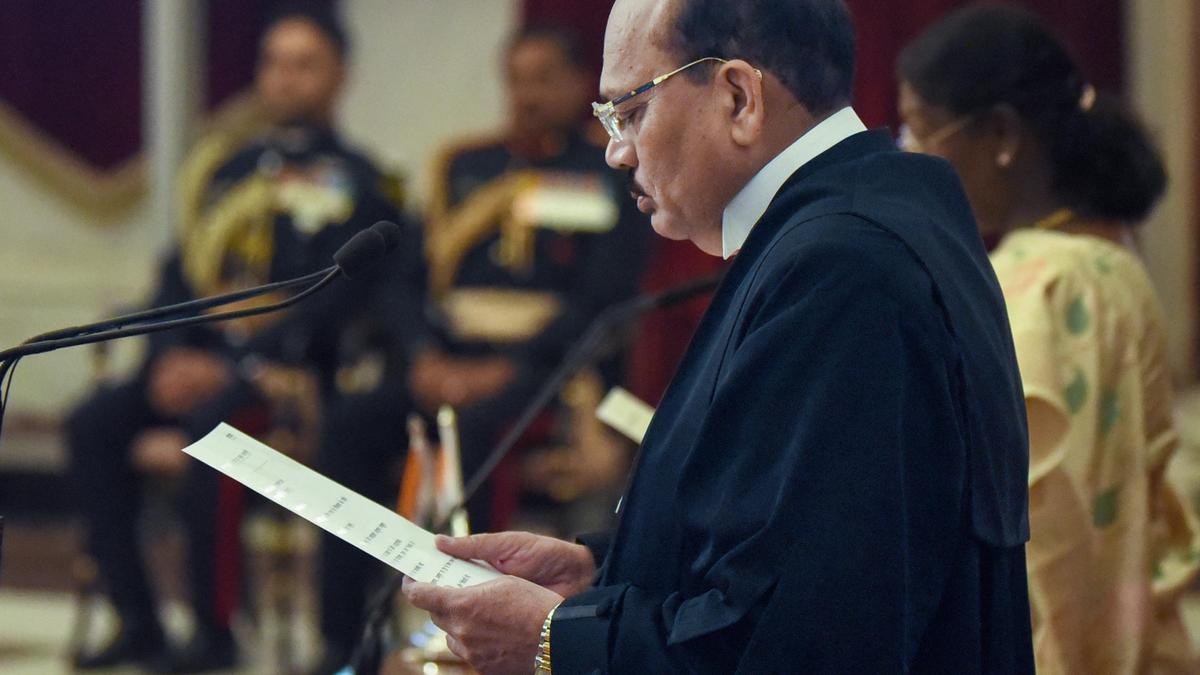
Chief Justice of India Surya Kant. File
| Photo Credit: ANI
Chief Justice of India Surya Kant on Friday (December 12, 2025) advised against the publication of articles on sub judice cases which may create an “impression” outside, while at the same time assuring that judges are immune to narratives aimed to generate publicity and drive opinion.
“Never write on anything sub judice. Why should one create an impression? You can be assured that we do not accept ‘pleadings’ from outside the courtroom,” Chief Justice Kant addressed Solicitor-General Tushar Mehta orally.
Mr. Mehta was indignant about the “concurrent, narrative building” that certain “tabloids” engage in about sub judice cases. These articles, the law officer said, inevitably appear proximate to the day of the court hearing.
The verbal exchange came in the backdrop of a newspaper article on Friday about a pregnant woman, Sunali Khatun, and her eight-year-old son, who were pushed into Bangladesh. The court’s nudge saw the Centre arrange the return of the mother and son to India on “humanitarian grounds”.
Senior advocate Kapil Sibal, appearing for the State of West Bengal, which is currently taking care of the mother-son duo, tried to persuade the court that commentary on judicial orders and proceedings were part of the public discourse globally.
Cannot stop media reports on court observations, says Supreme Court
“But half-baked truths and distorted facts given by ill-informed people through their writing and commenting affect public perception,” Chief Justice Kant observed.
Justice Joymalya Bagchi, on the Bench, said judges were “completely immune to publicity” as long as these narratives did not affect the lives of individuals.
Chief Justice Kant remarked that writers ought to wait till the pronouncement of judgment by the court, and then engage in constructive criticism. This way, the court could also make improvements in justice administration.
Mr. Mehta found nothing wrong in clear, level-headed reportage. “Reporting a matter, nothing wrong with that, because you are bringing to the public domain that matters. But if you thrust your opinion and try to infuse a motive, which is not factually true…,” he explained.
But Mr. Sibal said ‘commentary was part of free speech so long as they did not impute motives. “As long as motives are not ascribed, it is not sacrilege to comment,” Mr. Sibal said.
This is not the first time the top court has witnessed discussions about putting curbs on the media reporting of judicial proceedings.
In 2018, the late Fali Nariman had advised then Chief Justice of India, Justice Ranjan Gogoi against prohibiting media from reporting petitions and pleas on the ground they contained scandalous allegations.
In 2012, a five-judge Bench headed by the Chief Justice of the time, Justice S.H. Kapadia, had suo motu launched proceedings to frame guidelines on court reporting based on 11 complaints from senior advocates claiming they were misquoted by the reporters in the court. However, a galaxy of senior advocates, including Mr. Nariman and the likes of Soli Sorabjee, had disagreed with the idea of the court framing across-the-board guidelines for the press.
“We do not need to curb but expand the freedom. We too have to be responsible as judges. I have a great apprehension. I do not want freedom of the media to go,” Mr. Nariman, who was called on to assist the court, had objected.
As a result, the Supreme Court had finally concluded that framing universal guidelines on court reportage was indeed unfeasible.
Published – December 12, 2025 08:55 pm IST