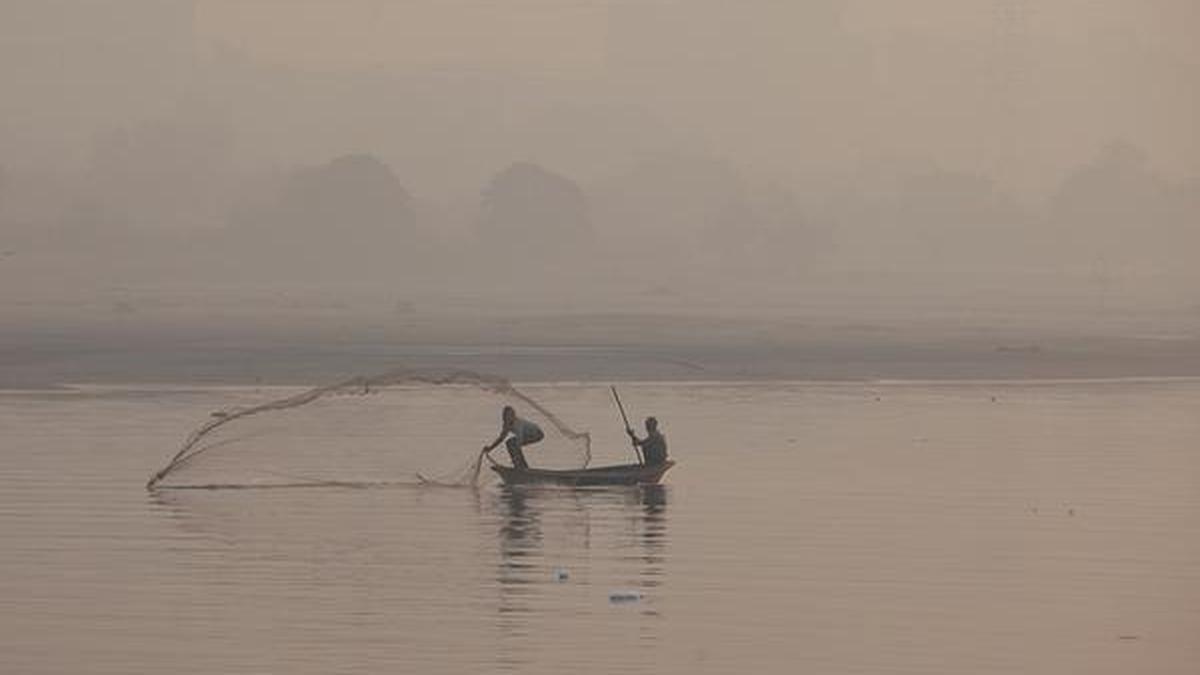
Fishermen throw a net through dense smog over the Yamuna River at Kalindi Kunj, in New Delhi. File
| Photo Credit: ANI
The National Green Tribunal (NGT) has issued directions to the State Governments of Uttarakhand, Himachal Pradesh, Delhi, Haryana, and Uttar Pradesh, and other authorities to take a slew of measures to fix falling native fish populations in the Yamuna River and control exotic fish species.
The green court also directed authorities to take strict penal action against people responsible for the illegal introduction of exotic species in the river.
The order was passed following a suo-motu registration based on a news report highlighting the decline of native fish and the increase of exotic species in the river. The 2024 news report had cited a study by the Central Inland Fisheries Research Centre (CIFRI), Prayagraj, which said that fish in the Yamuna were affected by climate change and the number of Indian species of fishes have decreased, while foreign species have gone up.
The Principal Bench of the NGT, comprising Chairperson Prakash Shrivastava and Expert Member A. Senthil Vel, also directed authorities to control pollution in the river, which is the main cause for the reduction of fish population.
“The CPCB (Central Pollution Control Board), NMCG (National Mission for Clean Ganga) and DJB (Delhi Jal Board) are directed to ensure strict enforcement of the effluent standard and compliance of norms by the ULBs (Urban Local Bodies) discharging treated/untreated sewage and throwing solid waste in river Yamuna and the industries which are discharging treated/untreated effluents in river Yamuna,” read the NGT order dated January 29.
The order also directed to accelerate installation and operationalisation of the sewage treatment plants in the areas abutting Yamuna River to ensure that the treated water meets the standard fit for aquatic life.
“The MoEF&CC (Ministry of Environment, Forest and Climate Change), Central Water Commission and State Irrigation Departments are directed to maintain the minimum flow level in the river Yamuna to support breeding and migration of native fish species. They are directed to regulate/prohibit sand mining that disturbs the spawning beds. They are further directed to remove obstruction or construct fish ladders at Barrages like Wazirabad, Okhla, Hathnikund to facilitate migration of native fish species such as Mahasheer,” the order said.
The NGT also directed to prohibit and ensure effective implementation of the prohibition of farming of highly invasive species like Thai Mangur (Clarias gariepinus), and also promote native fish aquaculture by providing incentives for culture of Catla, Rohu, Mrigal, Chital, Mahasheer and Eel through subsidised seed and feed supply.
“The ICAR-CIFRI, National Bureau of Fish Genetic Resources and State Fisheries Department are directed to release fingerlings of native species into identified river stretches, especially post monsoon season. They are also directed to consider establishing Mahasheer and Indian carp hatcheries along the Yamuna basin to maintain genetic diversity and declare biodiversity-rich stretches as fish conservation zones,” the order said.
The NGT also directed the MoEF&CC, Department of Animal Husbandry & Dairying, Ministry of Agriculture and the State Governments to take steps to implement the national inland fisheries policies effectively by integrating Yamuna specific fish conservation plans within river basin management.
Published – January 31, 2026 04:17 am IST