
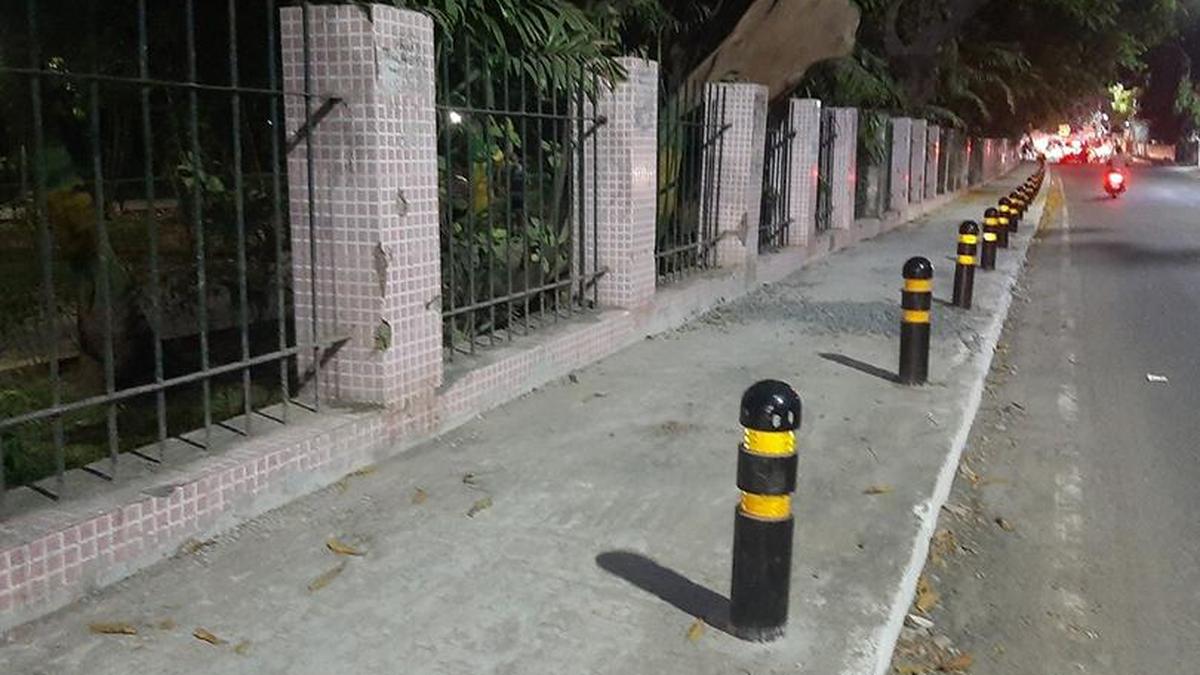
Vaishnavi Jayakumar, a disability rights activist, said that bollards were originally intended to protect pedestrians and meant to be placed adjacent to the carriageway.
| Photo Credit: cueapi
Persons with disabilities (PwDs) activists have raised concerns over the manner in which bollards would be installed on pavements, after the Greater Chennai Corporation (GCC) floated tenders . The activists stated that the current approach obstructs pedestrian access, particularly for wheelchair users, and underminines pedestrian safety.

Vaishnavi Jayakumar, a disability rights activist, said that bollards were originally intended to protect pedestrians and meant to be placed adjacent to the carriageway. “The intent of bollards appears to have shifted to only preventing unauthorised parking and vehicular movement,” she said. She noted that many roads in Chennai still do not have pavements, while those that do, are often damaged or encroached upon by parked vehicles. In the absence of proper regulation, bollards are installed indiscriminately across footpaths, making them difficult or impossible to navigate for wheelchair users, senior citizens and children.
She pointed out that there is no height difference between the road and the pavement on Khader Nawaz Khan Road, and in the event of a vehicle going out of control, the bollards would not offer any real protection to pedestrians. “Where is road safety? Where is equity in any of this?” Ms. Vaishnavi asked. “Instead of ensuring clear pedestrian passages, bollards and paver blocks are often laid around trees or electric poles without considering accessibility. This is like the adding insult to injury” .
She also pointed out that in 2023, following a Madras High Court order in a public interest litigation, bollards were required to be placed and designed in a manner that ensured easy passage for wheelchair users. Even after more than two years, the bollards identified in the PIL for being obstructive have not been rectified by either the GCC or the Highways Department.
Recommendations submitted by the Disability Rights Alliance, include a minimum 1,000 mm clear width for wheelchair access and layouts that prevent two-wheelers from encroaching onto pavements. However, she said that the new tenders floated by the GCC do not disclose any details regarding bollard placement, spacing or design specifications, giving the impression that the Corporation is proceeding with routine tenders without drawings or accessibility standards.
The GCC proposed the installation of 24,400 bollards for a total estimated cost of ₹8.68 crore. This includes 2,000 bollards each in Zones I, II, III and VII at a cost of ₹71 lakh, 2,700 bollards each in Zones IV, V, VI, VIII, IX, X and XIII at ₹96 lakh per zone, 1,500 bollards in Zones XI and XV at ₹54 lakh, and 2,000 bollards in Zones XII and XIV at ₹71 lakh.
Sathish Kumar, another PwD activist, said that ramps and clearly designated entry and exit points are essential for wheelchair users to access footpaths. A perpendicular bollard design, similar to those used in Malaysia, had been proposed to the GCC two months ago, as it would allow wheelchair movement while preventing two-wheelers from entering pavements. However, he said, no response has been received so far.
Mr. Sathish also suggested wider use of table-top or continuous footpaths, with speed-breaker-like structures at intersections to ensure seamless pedestrian movement, similar to the facility already tried near the Ranjith Road signal close to the Anna Library in Kotturpuram by GCC. Standing Committee Chairperson (Works) N. Chitrarasu said he was not aware of the design and would check on the issue as soon as possible.

Published – January 04, 2026 12:50 am IST


