Rabi Lamichhane was a television personality until a few years ago, known for his confrontational talk show Sidha Kura Janata Sang (Direct talk with the people), in which he frequently criticised politicians and highlighted public grievances.
Buoyed by his popularity, he launched a political experiment. In June 2022, he founded the Rastriya Swatantra Party (RSP). He strategically included “Swatantra”, meaning “independent”, in the name to signal that the party was distinct from the established parties. The elections were just six months away.

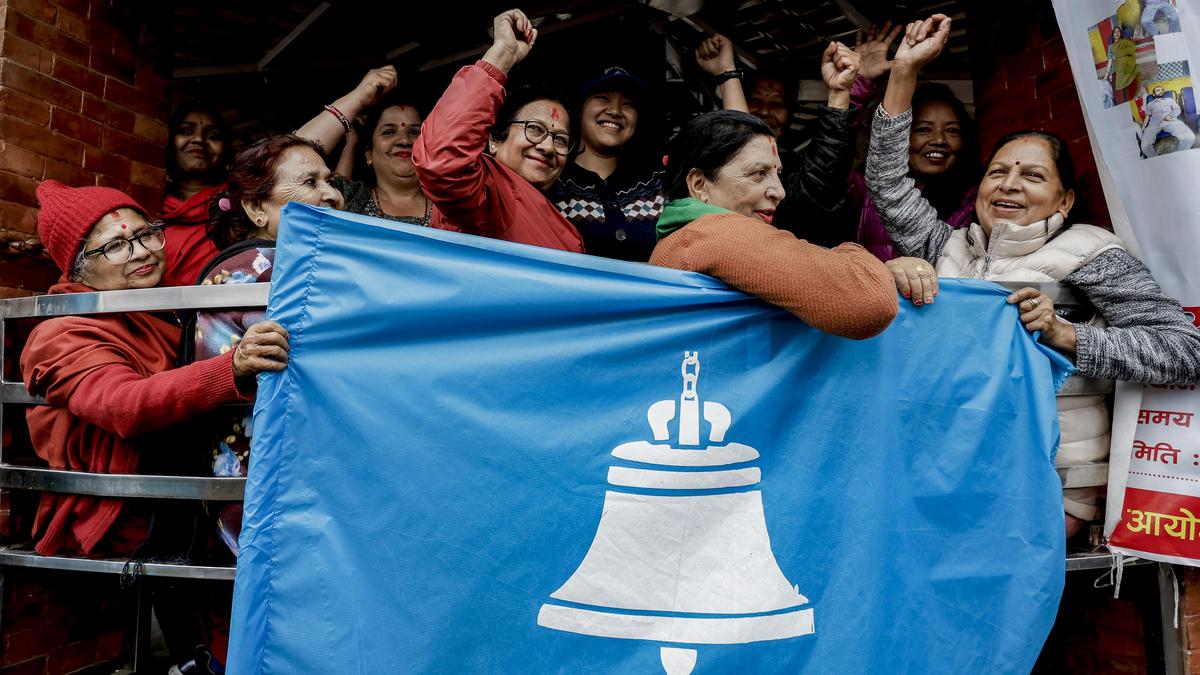
When Nepal went to the polls in November that year, the RSP surprised everyone — it finished fourth. A key challenge for the RSP, however, was that despite being the fourth-largest party and enjoying public support, few saw it as a formidable force capable of challenging established parties. First, it lacked a clear ideology. Second, the party was synonymous with “Rabi” or “Ghanti” — the bell, the party’s election symbol.
Many viewed its rise with scepticism, saying it was a fleeting success driven by public frustration with Nepal’s old guard — Nepali Congress, CPN-UML, and CPN (Maoist Centre). Mr. Lamichhane’s controversial moves as Minister — the RSP had joined the government twice between 2022 and 2024 — and his brushes with the law dented the party’s image. He has been in and out of jail multiple times over charges of embezzling cooperative funds.
As it evolved, the party worked on its ideological clarity and now calls itself a pluralistic democratic party that espouses a liberal economy with social justice — centrist liberal in short. The party’s views on the current federal structure remain unclear, with multiple leaders making different public statements about the form of governance. In July 2024, when the two biggest parties — the Nepali Congress and the CPN-UML — joined hands to form a government, the RSP was pushed into a meek opposition.

Last September’s Gen Z protests, which the RSP supported, did further damage. Some influential leaders deserted the party. Mr. Lamichhane faced allegations of escaping jail during the chaos on September 9, the second day of the protests. He, however, turned himself in. The protests, which claimed 77 lives — including 19 in police firing — toppled the K.P. Sharma Oli government, triggering election.
Anti-corruption mood
The RSP, which was almost on the verge of implosion, suddenly became the beneficiary of the protests against corruption and misrule — what the party claims as its own agenda — with public anger directed mostly against the Nepali Congress and the UML. In late December, then Kathmandu Mayor Balendra Shah, known as Balen, joined the RSP as the party’s prime ministerial candidate.
In the run-up to the March 5 election, the RSP saw growing public support — many calling it a ‘Balen effect’. The party, once synonymous with ‘Rabi’, became synonymous with either ‘Balen’ or ‘Ghanti’, resonating with a larger electorate, beyond party lines.
The four-year-old party, once criticised for lacking an ideology, has dealt a major blow to the established parties in the March 5 election. The RSP is set to secure a majority of 138 seats, with trends suggesting it could even reach a two-thirds majority of 184 in the 275-member House. As of now, the party has won 57 seats under the first-past-the-post system and is leading in 64 out of 165 constituencies. It is ahead under the proportional representation system, in which 110 members are elected, securing a 53% vote share.
Balen is set to defeat Mr. Oli by a huge margin. Gagan Thapa of the Nepali Congress is set to suffer a loss in Sarlahi-4, a constituency in the Madhesh plains, at the hands of an old Congress member now running on RSP ticket.
Chandan Goopta, a data analyst following the polls in Madhesh, says this time the election was about Balen versus the rest. “It’s not Gagan vs Amaresh Singh [the RSP candidate], it’s Gagan vs Balen,” he said. “It’s the same for all constituencies [in Madhesh].”
Swarnim Wagle, an economist and former vice-chair of Nepal’s National Planning Commission who left the Nepali Congress to join the RSP three years ago, told The Hindu in March 2023 that the RSP was “a movement in the making”.
“Come next elections, we will emerge as a major political force,” he said then.
The “next elections” came two years ahead of schedule. And the RSP surpassed everyone’s expectations.
Published – March 08, 2026 01:00 am IST