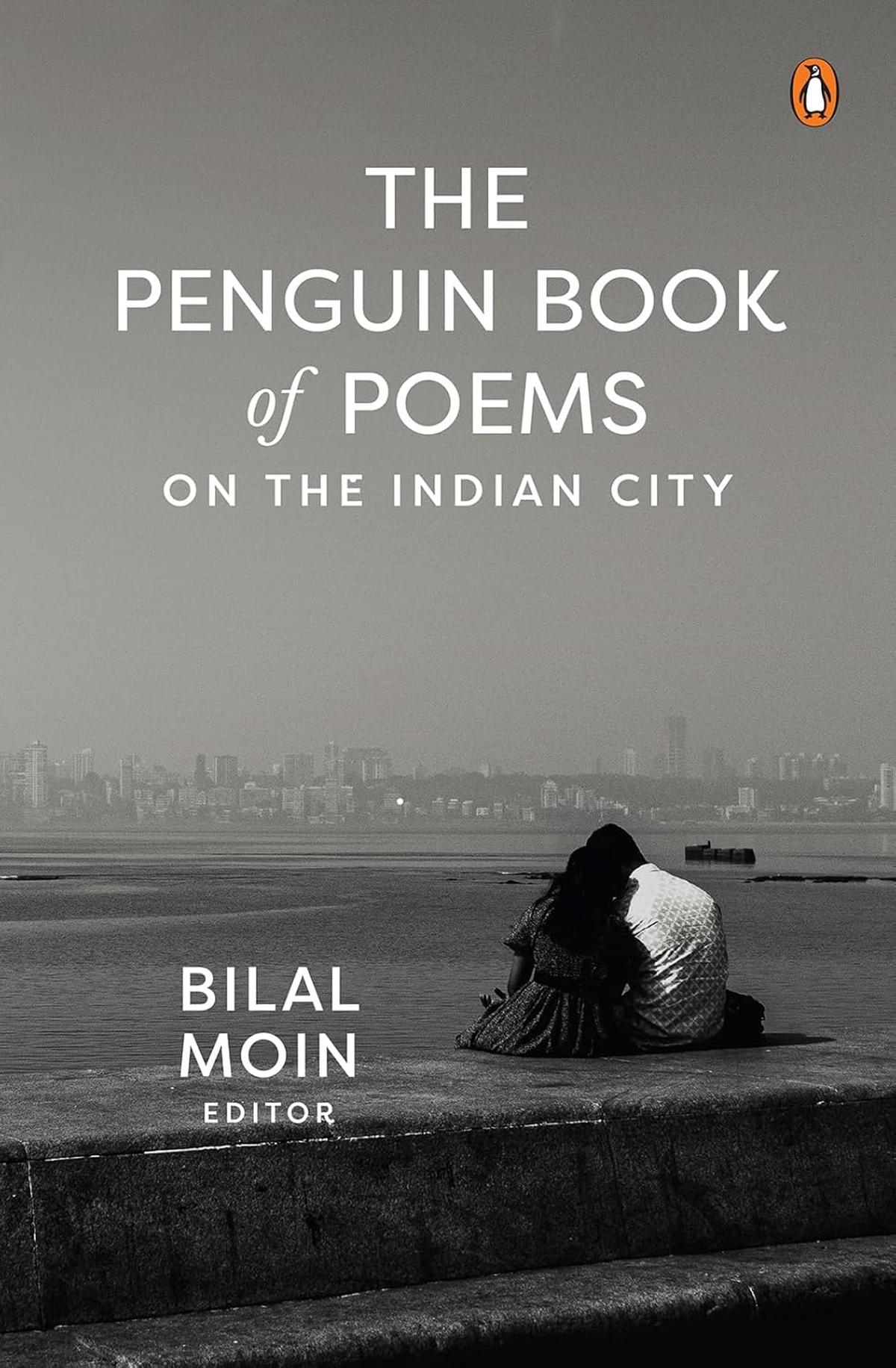
Poet-economist Bilal Moin’s edited volume The Penguin Book of Poems on the Indian City is the sort of heavy object that you are advised to place on a low shelf in earthquake-prone areas because it might strike you like a lethal weapon when seismic waves unleash their fury.
Running into a 1,000-odd pages, this anthology is both an audacious undertaking and a tremendous labour of love. It “spans 37 Indian cities, featuring 375 poems by 264 poets, translated by 90 translators across 20 languages” as Moin points out in his introduction to the tome.
Thankfully, he lets us in on what transpired behind the scenes. He writes, “The role of an anthologist demands wearing many hats: the aesthete while reading poetry, the hawker pitching the manuscript to publishers, the detective tracking down copyright, the therapist and negotiator with estates, and finally, the curator, assembling it all into a coherent edition.”
The book is structured by city: Mumbai-Bombay, Pune-Poona, Ahmedabad-Amdavad, Kochi-Cochin, Bengaluru-Bangalore, Delhi-Dilli, Kanpur-Cawnpore, Kataka-Cuttack, Kolkata-Calcutta, and so on. Through this poetic mapping of India, Moin gives us a chance to marvel at how vast and diverse this land is.
A majestic spread
While approaching a work that is so encyclopaedic in scope, it seems better to sample and savour than gobble so that one is able to do justice to the flavours, textures and aromas on offer. Amir Khusrau, Narayan Surve and Amrita Pritam share space with Agha Shahid Ali, Imtiaz Dharker and Linthoi Ningthoujam here. Surdas, Bahadur Shah Zafar, and Sarojini Naidu co-habit with Jibananda Das, Tishani Doshi and Kynpham Sing Nonkynrih. The editor has managed to stitch together a majestic quilt from pieces of poetry representing different generations, ideological affiliations, and geographies.
It is tempting to imagine what a mehfil (gathering) with each of these poets in attendance would look, sound and feel like. Would they encourage each other with an “irshaad” here, a “waah-waah” there? Or would they pull out their smartphones to capture short videos of their peers reciting their favourite lines, and then share these as Instagram stories? This is a rather optimistic view perhaps given that poet and English professor Eunice de Souza — in her poem ‘Meeting Poets’ — once cautioned us that it is best to meet them in their poems.
Since most of the poems in this book are fairly short, they reward close reading. A.K. Ramanujan’s ‘Poona Train Window’ juxtaposes the scatological and the sublime. The speaker in the poem is a traveller whose gaze falls upon a man defecating on the railway tracks. This sight inspires the speaker to ponder over the symmetry of human buttocks while sipping railway tea. The poet takes an ordinary occurrence and transforms it into an unexpected source of amusement.
Asiya Zahoor’s ‘What Dal Lake Wants to Tell Me’ is presented as a conversation between a human being and a waterbody. The speaker in the poem, plagued with existential angst, and the weight of culture and history, is told: You are not… a boat, weed, a leaf, a trail in the sky,/ an embroidered almond, or a concubine./ You are a pawn on a chessboard —/ Learn the art of being irrelevant.
A living, breathing entity
Robin S. Ngangom’s ‘Gangtok, February 1998’ evokes the stillness of a monastery that has been the seat of the Karma Kagyu lineage of Tibetan Buddhism for centuries, and witnessed quests for liberation as well as battles for power. The speaker notes: In the aquamarine afternoon/ Rumtek turns slow prayer wheels/ which cuts across the axis of earth/ to generate compassion for a cold-blooded world. Rumtek is where actor Kabir Bedi’s mother Freda Bedi aka Gelongma Karma Kechog Palmo received spiritual instruction from the 16th Karmapa, and laid the foundation for the transmission of Buddhism to the West.
This book reminds us that cities defy standardisation even though the same malls, coffee shops, pizza chains and multiplexes appear to be popping up everywhere. There is more to them than the concrete jungles they are believed to be. They are made and unmade by the people who live in them, daring to live another day despite the cards that life has dealt them. Moin’s book is not just a literary compendium; it is an archive of how urban India thrives and breathes.
The reviewer is a journalist, educator and literary critic.
The Penguin Book of Poems on the Indian City
Ed. Bilal Moin
Hamish Hamilton
₹1,999
Published – October 16, 2025 06:05 am IST