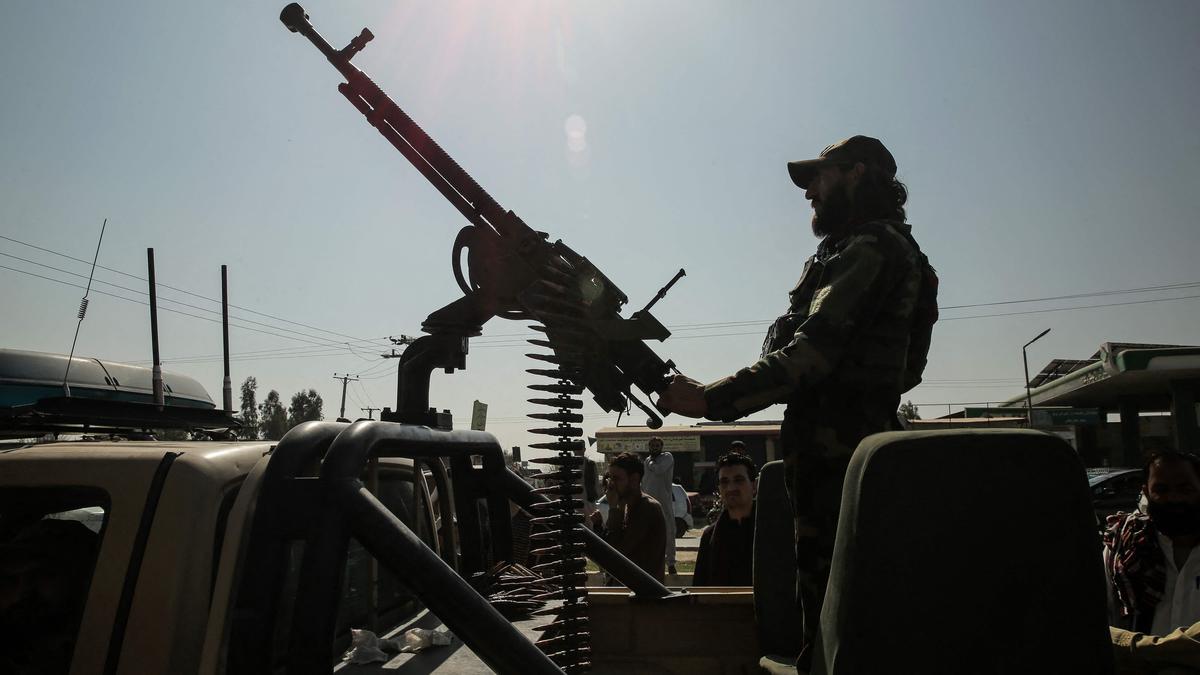
For the second time in six months, Pakistan and Afghanistan have engaged in an intense military clash. Unlike the periodic clashes across the Durand Line during the last two decades when the U.S. was in Afghanistan, the latest clashes — first in October and now again last week — are significant. Pakistan used air and missile strikes deep inside Afghanistan, including in Kabul and Kandahar, while the Taliban targeted multiple Pakistani military posts across the Durand Line. Military and civilian casualties in these two attacks, last year’s and the ongoing one, have been high. The latest attacks come despite a ceasefire mediated by Turkiye and Qatar following the post-October 2025 clashes.
Following the latest military strikes, Pakistan’s Defence Minister declared that it would be an “open war” against Afghanistan. What has happened between Pakistan and Afghanistan during the last six months? After creating the Taliban in the 1990s and nurturing it ever since, even under intense American pressure until August 2021, why is Pakistan’s Deep State now going after its creation? Why has the Taliban, despite being supported by Pakistan and taking refuge within Pakistan during the U.S.-led war on terrorism, turned against its erstwhile mentor?
The cross-Durand rupture
The two rounds of military clashes highlight a rupture in the bilateral relationship at three levels.
First, at the political level, between Islamabad and Kabul. Though the two countries had differences during the U.S.-led war in Afghanistan during 2001-21, they were expected to be bridged when the Taliban captured Kabul immediately after the American exit in 2021. Instead, despite multiple rounds of dialogue, the bilateral relationship has only worsened. Pakistani Defence Minister’s declaration of an “open war” on Afghanistan signifies a political rupture.
Second, there is a rupture between Pakistan’s Establishment and the Taliban leadership. From the mid-1990s, the political and military rise of the Taliban would not have happened without the Pakistan Establishment’s support. Successive military and ISI chiefs supported the Taliban. Today, under new military and ISI leadership in Pakistan, that link remains ruptured. Islamabad would not have declared an “open war” without Rawalpindi’s approval.
Third, there is a widening rupture between the people of Afghanistan and Pakistan. During the last few years, there has been an intense debate over deporting the Afghans, who have arrived in Pakistan during different phases, and made the country their home. Ever since the current Pakistani government began actively pushing them back, there has been an intense resistance from Afghanistan and the Taliban. However, within Pakistan, there was no major societal debate, contrary to the state’s position. Though a small section of Pakistan seeks to build consensus on the issue, it remains a minority voice. Beyond the political and military rupture across the Durand Line, the societal divide will haunt the two nations for generations to come, as this alliance was forged over centuries.
Af-Pak to Af vs Pak: Origins of the divide
In August 2021, when the U.S. left Afghanistan and the Taliban took over immediately after that, the ISI chief was among the first foreign leaders to visit Kabul in September. In Rawalpindi, there was a sense of achievement that finally their boys were back in Kabul, and an expectation that the relationship would rapidly improve. Pakistan expected Kabul would control the Tehrik-e-Taliban-Pakistan (TTP) and that they would even force its leadership to surrender.
On the contrary, as the data would prove, there was an increase in militant activities in the tribal regions of Khyber Pakhtunkhwa during 2022-25. During this period, Pakistan was divided over how to respond to the TTP threat. Under Imran Khan, the political and military leadership pursued a more carrot-and-stick approach towards the TTP. After his exit, and under the current Army chief, Pakistan shifted to a military approach towards the Taliban and the TTP.
Besides this, Kabul’s support, or its inability to control the TTP, is an important factor for the fallout. However, the differences between Pakistan’s Establishment and the Taliban started much earlier, when Pakistan’s Deep State was under pressure from U.S. Admiral Mike Mullen’s hard-hitting statement that the Taliban (the Haqqani network in particular) was the “veritable arm of the ISI.” Though the ISI did not give up the top leadership of the Taliban and al Qaeda, several second-rung leaders got arrested or handed over to the U.S. While the U.S. accused the ISI of playing a double game, similar sentiments grew within the Taliban as well.
When the U.S. wondered why Pakistan was unwilling to give up on the Taliban, many within Pakistan would cite sociological reasons for the long-standing ties. In the tribal regions, they would say, giving refuge and defending that decision was least understood by the West. Perhaps, Pakistan ignores or does not want to appreciate the same reason today. The Afghan Taliban do not want to give up today’s TTP members, who gave refuge to them when they were running and hiding before 2021.
Another factor is the Islamic State in Khorasan for not wanting to give up the TTP. The Taliban — whether in Afghanistan or in Pakistan — has never been monolithic.
Different tribes and sub-tribes fought along the Taliban and the TTP banner then; today, a section sees the Islamic State as a better banner and ideologically closer. For the Afghan Taliban, an expansion of the IS-Khorasan is a bigger threat, hence it does not want to antagonise the TTP.
Kabul also blames Pakistan for externalising its internal threat. Given the terrorist infrastructure and the ideological support base within Pakistan, it is not going to be an easy task for the political and military leadership to address militancy within. However, blaming Afghanistan and India would be an easy strategy to externalise an internal problem that Pakistan had cultivated since the 1980s. What now lies in tatters is both the Pakistan-Taliban relationship and, more importantly, the age-old societal links, along with Pakistan’s carefully cultivated strategic depth narrative. For Pakistan, Afghanistan should now be a strategic trap that it would want to avoid. The Afghan-Pakistan relationship would remain conflict-prone.
An unequal battlefield
There is an inherent asymmetry between Pakistan and Afghanistan in terms of military, economic, and political strength. Militarily, the Taliban is no match to Pakistan’s armed forces. Without an air force or navy, it can never fight an “open war” with Pakistan. While Pakistan’s air force and missiles provide the reach to strike deep inside the Afghanistan territory, the Taliban has a limited arsenal to hit deep inside Pakistan. Though there is an expectation that drone warfare would provide a level playing field for the Taliban, it could only cover a limited geography, east of the Durand.
Though Pakistan’s economy has also been facing challenges, Afghanistan’s is worse. As a landlocked country, it is dependent on the Karachi port for almost everything. On trade, Afghanistan is more dependent on Pakistan and not vice versa. Unless Afghanistan finds alternate routes that could bring goods in substantial numbers, Pakistan can strangulate Afghanistan by closing the passes.
The Taliban’s global outreach is also limited. Pakistan today has a regional clout, especially in West Asia, and the current leadership has a better equation with U.S. President Donald Trump. Perhaps the new status of Mr. Trump’s “good general” in Pakistan provides Rawalpindi with more space to be more adventurous in the region than previous military leaders. This would also mean Pakistan can play tougher in negotiations.
Given these asymmetries, if the Taliban has to respond, it would engage in not-so “open wars” with Pakistan. Besides its willingness to control the TTP, the Taliban’s capacity and its strategic calculation would limit its response vis-à-vis what Pakistan wants on the TTP. What would this mean for the future of Pakistan-Afghanistan relations and stability across the Durand Line? A tough question for the two countries, and for the region.
D. Suba Chandran is Professor and Dean at the School of Conflict and Security Studies at the National Institute of Advanced Studies, Bengaluru, and heads NIAS Pakistan Reader


