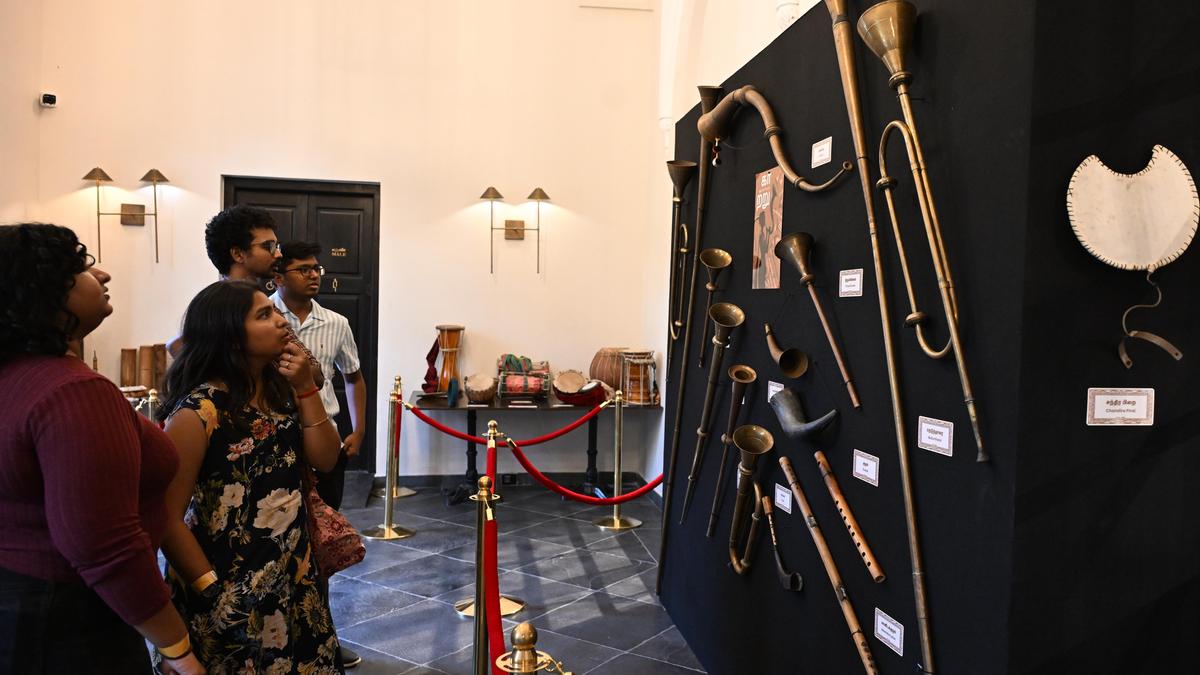
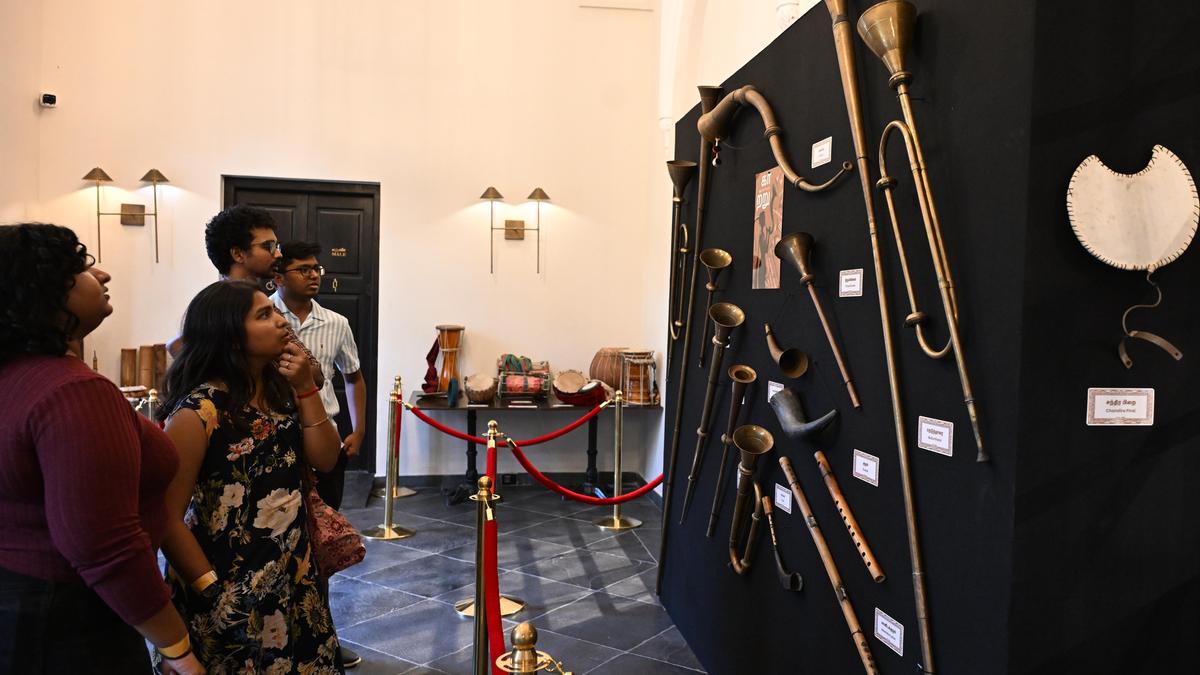
The musical instruments that were used in the Sangam period exhibited in Victoria Public Hall, Chennai
| Photo Credit: B. Jothi Ramalingam
Visitors walking into the restored Victoria Public Hall in Chennai do so with genuine curiosity, which often doubles when they enter the section carrying about 150 musical instruments, including the kinnaram, kokkarai, and kutta tharai. These instruments are not what they would find at a regular music store for they are not in conventional practice anymore.
The exhibit was assembled by a 25-year-old sound engineer and a post-graduate in music, Manikandan, or ‘Sound’ Mani, who divides his time between Erode and Chennai, taking the effort to revive these rare musical instruments. “They were largely part of day-to-day life during the Sangam era,” he says.

Parai isai has always been Mr. Manikandan’s passion, and during the COVID-19 pandemic, he used his time to research on Sangam-age instruments through texts such as Tholkappaiyam, Silappadikaram, Pathuppattu, and others. “These texts contain treasured information. I also travelled to temples in different regions and met plenty of artistes in rural areas. There, I began collecting and recreating rare musical instruments,” says Mr. Manikandan, who plays more than 18 types of native instruments.
Unlike museum exhibits kept behind glass display cases, this artiste plays each instrument for visitors at VPH, including the 12-feet-long musical instrument neduntharai. The exhibit will remain installed on the premises until May 31, 2026. Mr. Manikandan adds that though he once lacked the financial means to learn music, he now conducts native instrument workshops and exhibits in the United States, Australia, and France.

Imparting knowledge
People who come to these exhibits, especially young people, have shown interest in learning some of these instruments, says the musician, who also runs a startup for native instruments, called Aaguli. He says he does not want to teach the younger crowd merely for entertainment or hobby purposes, but wants to impart skill and knowledge-based training.
“We are reviving these instruments at a time when people are engrossed in mindless scrolling, losing their ability to concentrate. They will indeed help, because art as we know, is powerful,” he adds. The instruments are also made in bronze, brass, and copper so that they are easy to handle.

As the visitors move through the membranophones, chordophones, and idiophones section at VPH, the atmosphere palpably shifted when Mr. Manikandan blew into the neduntharai at the aerophones section, as no other instrument reverberated louder through the hall than that.
Published – January 10, 2026 11:31 am IST