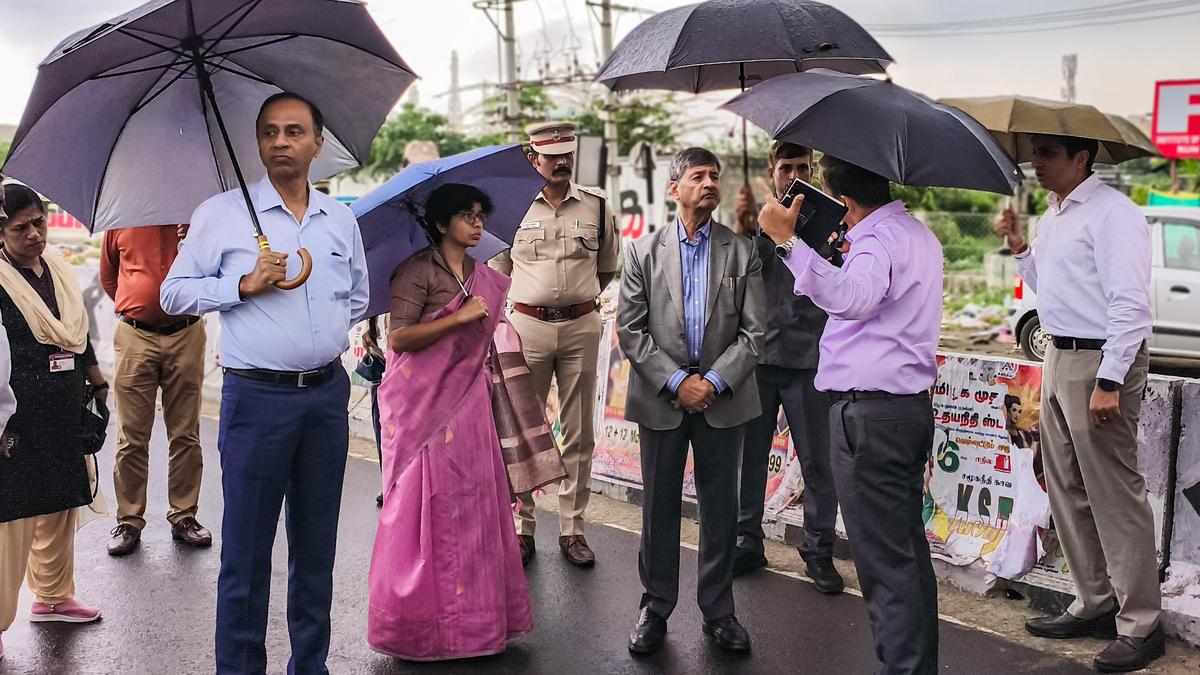
Retired Supreme Court judge Ajay Rastogi, who heads the Supreme Court-appointed committee monitoring the CBI probe into the Karur stampede, inspects locations where TVK had sought permission, accompanied by senior police and district officials, in Karur. File
| Photo Credit: Special Arrangement
The Supreme Court on Friday (December 12, 2025) said a strong belief that “everything has to be fair” powered its insistence on appointing non-Tamil Nadu “native” police officers as part of a retired apex court judge-headed supervisory committee to monitor the CBI probe into the Karur stampede tragedy.
“We want everything to be fair,” Justice J.K. Maheshwari, heading a Bench, addressed the Tamil Nadu government side, represented by senior advocates Siddharth Luthra and P. Wilson.
Forty-one people were killed and several injured in the Karur stampede on September 27 during a rally organised by the Tamilaga Vettri Kazhagam (TVK) founded by actor Vijay.

The State, in a plea settled by Mr. Wilson, had found the court’s assertion against having Tamil Nadu “native” IPS officers on the supervisory committee headed by Justice (retired) Ajay Rastogi “ex facie unconstitutional”.
“The direction proceeds on an impermissible presumption that officers of Tamil Nadu origin are inherently less impartial, which is an affront to the integrity of the All India Services,” the State has contended.
The State, in a plea filed by Mr. Wilson, also argued that the transfer of the case to the CBI merely on the ground that it had “political undertones” undermined State autonomy. The State contended that the order had set a dangerous precedent while upsetting the constitutional balance of powers between the Centre and the States.
“Mere political overtones or allegations cannot justify transferring investigation to the CBI. In a federal polity where different political parties govern at the Union and the State, allegations of political motive or rivalry are commonplace,” the Tamil Nadu government had argued.

The State government sought a change in the constitution of the supervisory committee, accusing one of the two police officers of a previous instance of bias in favour of a rival political party.
It further questioned the apex court’s decision to suspend the Chief Minister-appointed Commission of Inquiry headed by former Madras High Court judge, Justice Aruna Jagadeesan, on the ground that CBI had taken over the case.
“The Commission does not go into the areas of the investigation. The purpose of the Commission was to suggest measures required to be taken so that such tragedies did not happen in the future,” Mr. Wilson argued.
Justice Maheshwari said “there is something wrong in the Madras High Court” after perusing a report submitted by the Madras High Court Registrar.
The Supreme Court had sought a report from the High Court after voicing concern about the multiplicity of proceedings and orders passed by its Madurai Bench and a Single Judge on its Principal Bench in Chennai.
On October 13, the apex court had recorded concern about the manner in which the Single Judge suo motu proceeded to order a SIT investigation into the stampede when the Division Bench at Madurai was already hearing petitions seeking a CBI investigation.
The 25-page order of the top court in October had questioned the Single Judge’s decision to direct a SIT probe when the petition before it had only sought the framing of guidelines for the conduct of political rallies in public places. Besides, the top court had pointed out that Karur town fell within the jurisdiction of the Madurai Bench.
“Something is wrong in the High Court. Some practices are wrong,” Justice Maheshwari remarked.
Published – December 12, 2025 04:48 pm IST