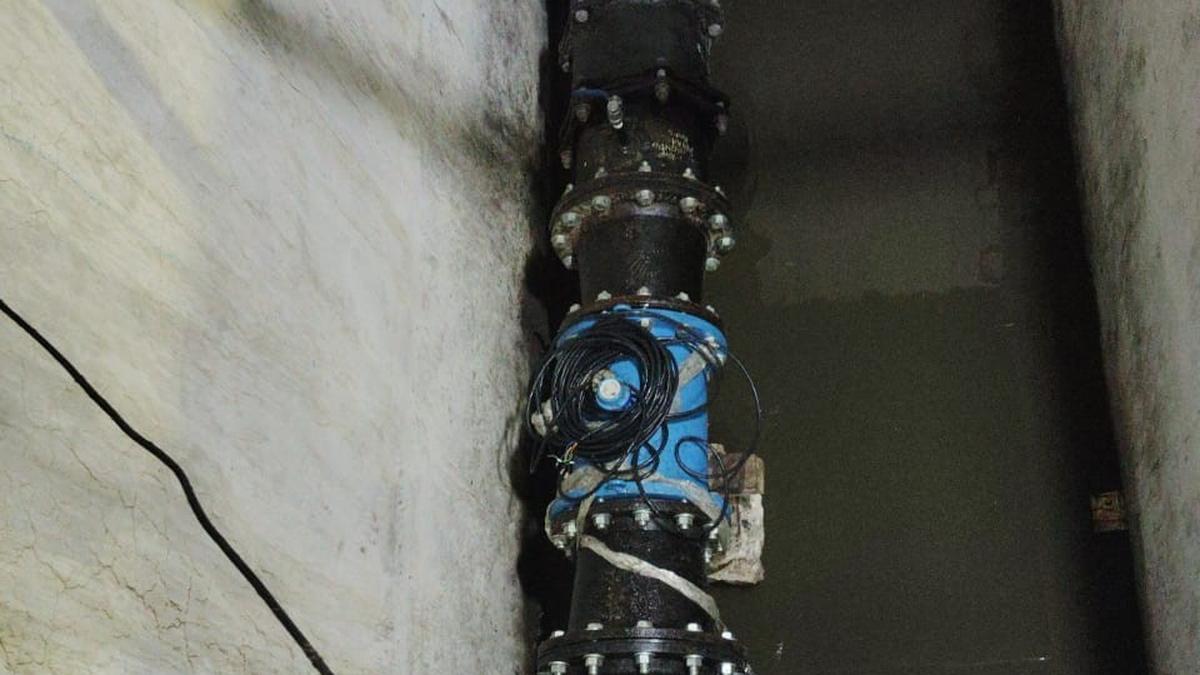
A Metrowater official said work is under way to fix 518 IoT-enabled flow meters to assess the water quantity received at treatment plants.
| Photo Credit: Special Arrangement
In an effort to assess non-revenue water and carry out a comprehensive water audit, Chennai Metrowater is in the process of installing electromagnetic flow meters across all its water treatment and distribution facilities in the city. The bulk metering project is expected to be completed by March 2026.
While strengthening source availability and supply management, the water agency has increasingly turned its focus to demand–side management and conserving resources, including reducing leakages, replacing ageing infrastructure and adopting a comprehensive metering policy.
Non-revenue water
The water agency has estimated that non-revenue water contributed to 20%-30% of the water supply. Officials of the Metrowater said work is under way to fix 518 IoT-enabled flow meters to assess the water quantity received at treatment plants and distributed through the network.
At present, the quantity of water received, treated, and supplied is largely calculated based on pumping operations. Once the bulk metering project is completed, the water agency would be able to precisely identify water losses, track water consumption and monitor water drawal and distribution in real time.
Over 1,000 mld
On an average, Chennai is supplied with nearly 1,226 mld (million litres a day) of drinking water.
Of this, domestic consumers in the city and added areas are provided with nearly 1,173 mld through pipelines and tankers.
The ₹44.93-crore project covers flow measurement across treatment and distribution network. Nearly 277 such flow meters have been fixed in pipelines varying from 500 mm to 2,000 mm in size at various places, including lines conveying water to distribution stations and also at receiving point of water distribution stations.
Hydrostatic sensors
Hydrostatic water level sensors are also being installed in underground sumps and overhead tanks.
The city has a water treatment capacity of 1,510 mld in nine facilities, including one in Veeranam. Treated water is distributed through 16 major distribution stations to localities across the city.
The water agency is fixing bulk water meters in 33 distribution lines at Kilpauk Water Works, the city’s first water treatment plant. It is from here that various parts of north and central parts of Chennai, including Kellys, Perambur and Ayanavaram, receive their daily supply.
Officials said the data generated would be transmitted to a central dash board, with engineers receiving automated alerts.
“We will be able to detect drops in supply, curb unauthorised connections and identify leaks through variations in flow. It will help us to regulate water supply according to the need in various localities and ensure equitable distribution,” an official said.
Published – December 27, 2025 04:30 am IST